25. – Huang , would you mind if I used your Pipa for the coming singing competition?
– ________
A. Yes, of course you can. B. Certainly, please use it.
C. No, you can’t use it. D. No, go ahead.
24. – Lucy doesn’t mind lending you her dictionary.
– She . I have already borrowed one.
A. can’t B. mustn’t C. needn’t D. shouldn’t
23. John did quite well in his exams, how little he studied.
A. consider B. considering C. considered D. to consider
22. A library with five thousand books ______ to the nation as a gift.
A. is offered B. has offered C. are offered D. have offered
第一节:单项填空 (共15小题;每小题1分,满分15分)
21. The education of young is always hot and serious topic in China.
A. /; a B. the; a C. /; the D. the; /
第二节 听下面5段对话或独白。每段对话或独白后有几个小题,选出最佳选项。每段对话或独白读两遍。
听下面一段材料,回答第6至7题。
6. What is the woman’s problem?
A. She hasn’t got a train ticket. B. She can’t find her luggage. C. She can’t catch the train.
7. Who is the woman probably talking to?
A. A taxi driver. B. A railway clerk. C. A hotel manager.
听下面一段材料,回答第8至10题。
8. What is the girl’s problem with her parents?
A. They treat her in old ways. B. They praise her too often. C. They never stay with her.
9. What do we know about the boy and his parents?
A. They never trust him. B. They seldom agree with him. C. They worry too much about him.
10. What can we learn from the conversation?
A. There are differences between generations.
B. No parents get on well with their parents.
C. Most children are tired of their parents.
听下面一段材料,回答第11至13题。
11. What did the man think of the film?
A. It’s very good. B. It’s very bad. C. It’s neither good nor bad.
12. Where did the couple in the film live?
A. In their own house. B. With the husband’s mother. C. With the wife’s mother.
13. What happened to the couple in the film in the end?
A. They bought a house of their own.
B. They continued to live with the husband’s mother.
C. They needn’t work any more.
听下面一段材料,回答第14至16题。
14. When does the man eat fast food?
A. On workdays. B. On weekends. C. Every day.
15. What does the man think of fast food?
A. It’s his favourite. B. It needs improving. C. It tastes bad.
16. What kind of food is NOT mentioned in the conversation?
A. Hamburgers. B. Sandwiches. C. Eggs.
听下面一段材料,回答第17至20题。
17. What’s the passage mainly about?
A. Air pollution outside. B. Indoor air pollution. C. The disease caused by the polluted air.
18. Where did some of the worst indoor air pollution happen?
A. In most developing countries.
B. In a few developed countries.
C. In developing countries where people used wood and coal to cook.
19. How many diseases could be caused by breath in harmful indoor air according to the passage?
A. 5. B. 6. C. 7.
20. What would be probably talked about next?
A. Problems of indoor air pollution.
B. Ways to solve the problem of indoor air pollution.
C. Causes of indoor air pollution.
第一节 听下面5段对话。每段对话后有一个小题,选出最佳选项。每段对话仅读一遍。
1. What is the woman doing?
A. Making suggestions. B. Making excuses. C. Making requests.
2. What does the man say about Mary?
A. She seldom works. B. She enjoys working at the same job.
C. She often changes her job.
3. How is the woman’s health according to the doctor?
A. She’s healthy. B. She’ll be all right soon. C. She’s often sick, but not serious.
4. How long does it take the woman to drive home when there’s not much traffic ?
A. 20 minutes. B. 25 minutes. C. 50 minutes.
5. What is the weather like in Scotland in December?
A. Warm. B. Cold. C. Hot.
21.(本小题12分)已知向量,,且.
(1)若,求函数关于的解析式;
(2)求的值域;
(3)设的值域为D,且函数在D上的最小值为2,
求a的值.
20.(本小题12分)函数 ()是 R上的偶函数,其图像过点M,且在区间上是减函数,求 的值.
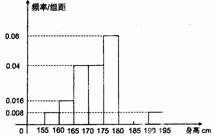
19.(本小题12分)从某学校高三年级共800名男生中随机抽取50名测量身高,据测量被测
学生身高全部介于155cm和195cm之间,将测量结果按如下方式分成八组:第一组、第二组;…第八组,下图是按上述分组方法得到的频率分布直方图的一部分,已知第六组比第七组多1人,第一组和第八组人数相同.
(1)求第六组、第七组的频率并补充完整频率分布直方图;
(2)若从身高属于第六组和第八组的所有男生中随机抽取两名男生,记他们的身高分
别为,求满足的事件概率;
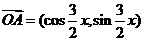 ,
, ,且
,且 .
. ,求函数
,求函数 关于
关于 的解析式;
的解析式; 的值域为D,且函数
 在D上的最小值为2,
 (
( )是 R上的偶函数,其图像过点M
 ,且在区间
,且在区间 上是减函数,求
 的值.
的值. 、第二组
、第二组 ;…第八组
;…第八组 ,下图是按上述分组方法得到的频率分布直方图的一部分,已知第六组比第七组多1人,第一组和第八组人数相同.
 别为
别为 ,求满足
,求满足 的事件概率;