题目内容
16.观察下列等式:①$\frac{1}{\sqrt{2}+1}$=$\frac{\sqrt{2}-1}{(\sqrt{2}+1)(\sqrt{2}-1)}$=$\sqrt{2}$-1
②$\frac{1}{\sqrt{3}+\sqrt{2}}$=$\frac{\sqrt{3}-\sqrt{2}}{(\sqrt{3}+\sqrt{2})(\sqrt{3}-\sqrt{2})}$=$\sqrt{3}$-$\sqrt{2}$
③$\frac{1}{\sqrt{4}+\sqrt{3}}$=$\frac{\sqrt{4}-\sqrt{3}}{(\sqrt{4}+\sqrt{3})(\sqrt{4}-\sqrt{3})}$=$\sqrt{4}$-$\sqrt{3}$
…
回答下列问题:
①化简:$\frac{1}{\sqrt{n+1}+\sqrt{n}}$=$\sqrt{n+1}$-$\sqrt{n}$
②利用上面的规律计算:$\frac{1}{1+\sqrt{2}}$+$\frac{1}{\sqrt{2}+\sqrt{3}}$+$\frac{1}{\sqrt{3}+\sqrt{4}}$+…+$\frac{1}{\sqrt{99}+\sqrt{100}}$.
分析 ①分母有理化即可;
②利用已知等式得原式=$\sqrt{2}$-1+$\sqrt{3}$$-\sqrt{2}$+$\sqrt{4}$-$\sqrt{3}$+…+$\sqrt{100}$-$\sqrt{99}$,然后合并即可.
解答 解:①原式=$\frac{\sqrt{n+1}-\sqrt{n}}{(\sqrt{n+1}+\sqrt{n})(\sqrt{n+1}-\sqrt{n})}$
=$\sqrt{n+1}$-$\sqrt{n}$;
②原式=$\frac{1}{\sqrt{2}+1}$+$\frac{1}{\sqrt{3}+\sqrt{2}}$+$\frac{1}{\sqrt{4}+\sqrt{3}}$+…+$\frac{1}{\sqrt{100}+\sqrt{99}}$
=$\sqrt{2}$-1+$\sqrt{3}$$-\sqrt{2}$+$\sqrt{4}$-$\sqrt{3}$+…+$\sqrt{100}$-$\sqrt{99}$
=$\sqrt{100}$-1
=10-1
=9.
故答案为$\sqrt{n+1}$-$\sqrt{n}$.
点评 本题考查了二次根式的计算:先把各二次根式化为最简二次根式,再进行二次根式的乘除运算,然后合并同类二次根式.在二次根式的混合运算中,如能结合题目特点,灵活运用二次根式的性质,选择恰当的解题途径,往往能事半功倍.

练习册系列答案
相关题目
6.阅读与计算:阅读以下材料,并完成相应的任务.
任务:请根据以上材料,通过计算求出裴波那契数列中的第1个数和第2个数.
斐波那契(约1170-1250)是意大利数学家,他研究了一列数, 这列数非常奇妙,被称为斐波那契数列(按照一定顺序排列着的一 这列数非常奇妙,被称为斐波那契数列(按照一定顺序排列着的一列数称为数列).后来人们在研究它的过程中,发现了许多意想不到 的结果,在实际生活中,很多花朵(如梅花、飞燕草、万寿菊等)的 瓣数恰是斐波那契数列中的数,斐波那契数列还有很多有趣的性质, 在实际生活中也有广泛的应用. 斐波那契数列中的第n个数可以用$\frac{1}{\sqrt{5}}[(\frac{1+\sqrt{5}}{2})^{n}-(\frac{1-\sqrt{5}}{2})^{n}]$ 表示(其中n≥1),这是用无理数表示有理数的一个范例. |
4. 如图,⊙O是Rt△ABC的外接圆,∠ABC=90°,点P是⊙O外一点,PA切⊙O于点A,且PA=PB.
(1)求证:PB是⊙O的切线;
(2)已知PA=2$\sqrt{3}$,BC=2.求⊙O的半径.
如图,⊙O是Rt△ABC的外接圆,∠ABC=90°,点P是⊙O外一点,PA切⊙O于点A,且PA=PB.(1)求证:PB是⊙O的切线;
(2)已知PA=2$\sqrt{3}$,BC=2.求⊙O的半径.
11.分别顺次连接①平行四边形;②矩形;③菱形;④对角线相等的四边形“各边中点所构成的四边形”中,为菱形的是( )
| A. | ①② | B. | ①③ | C. | ②③ | D. | ②④ |
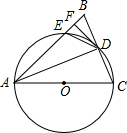 如图,在△ABC中,AB=AC,以AB为直径作⊙O,分别交BC、AC于点D、E,连接AD,过点D作DF⊥AB,垂足为点F.