|
功 能 句 式 |
Speak
about procedures in agriculture and botanical science 1. Can you tell something about…? 2. What is it used for? 3. Can you think of ways to…? 4. What kind of … do you know? 5. Which (flower) is your favorite? 6. Why do people need to …? 7. What problems did … have in common? 8. Why was/is … important to …? 9. Where do … come from? 10. What could be a possible explanation for …? |
|
词
汇 |
1.
四会词汇 procedure, rose, strawberry, lemon, bunch, growth, herb, identification, male, privilege, botanical, cosy, appetite, astronomy, expense, cocoa, enterprise, settlement, straw, pineapple, tone, reward, technician, appearance, output, millimeter, merely, classify, promote, appoint, calculate, accumulate, abandon, nowhere, altogether, latter, distinguish 2. 认读词汇 tulip, peony, Carl Linnaeus, Daniel Solander, Joseph Banks, wealth, Oceania, Tahiti, Venus, hemp, involve, Kew, classification, Oxford, Charles Darwin, beagle, Galapagos, finch, beak, Gregor Mendel, Gote Turesson, dandelion 3. 词组 look out for, on a large scale, year after year, pass away, name…after, in detail, have something done 4. 重点词汇 procedure, growth, merely, herb, classify, identification, male, promote, botanical, astronomy, on a large scale, accumulate, abandon, output, distinguish, appoint, calculate |
|
语 法 |
Review the object: what is
used as the object; direct and indirect object |
|
重 点 句 子 |
1.
Attempts had been made
by others to classify plant species into groups, but the breakthrough came
with the work of Carl Linnaeus. P30 2. In 1768, the Royal Navy appointed James Cook as the commander of the Endeavor to take members of the Royal Society on an expedition to Tahiti. P31 3. He also looked out for new economic species: plants that could be grown in England or other parts of the world to produce cops that could be sold. P31 4. Banks was the first to move crops from one continent to another on a large scale, helping to develop local economies with these new imports. P31 5. Darwin’s observations on that voyage led him to write his famous book On the Origin of Species. P34 6. Back home, in England, Darwin realized that differences in habitat could lead to different species in birds as well as in plants. P34 7. As a result of Darwin and Mendel’s research, scientists of the nineteenth century formed the belief that the influence of the environment was behind the development of new species. P35 8. It would take a next generation of scientists to bring the importance of the environment on species back in view. P35 |
2. Cooperative learning.
 Teaching aids 教具准备
Multimedia and a blackboard.
Teaching procedures && ways 教学过程与方式
Step I Greetings
Greet the whole class as usual.
Step II Warming up
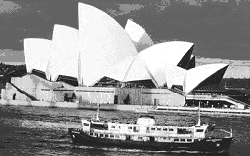
Show the students a picture of Sydney Opera House on the screen.
T: OK. Now please look at the picture and then tell me what it is and where it is.
S: It is Sydney Opera House and it is in Australia.
T: You are right. OK. Now today we’ll learn about Australia, in other words, the land down under. I think you should have known a lot about Australia. So I’ll ask you some questions. Question 1 is “What do you know about Australia? List three things that interest you.” Who’d like to have a try?
S1: I know some famous cities, for example, Sydney, the largest city in Australia; Canberra, its capital and Melbourne.
S2: I know some Australian animals, for example, Kangaroos, dingoes and Platypus.
S3: I know some Australian attractions, for example, Great Barrier Reef, Sydney Harbor Bridge and Gold Coast.
T: OK. So much for this question. Let’s look at the map of Australia on Page 19 in our book. Which of the places would you like to visit? Why? What would you do there? Volunteers!
S4: I’d like to visit Great Barrier Reef, because it is a beautiful place, and there I can dive to learn more about the secrets of the sea.
S5: I want to visit South Australia, I can go cycling there.
S6. I’d like to visit Brisbane, I can go surfing there.
T: OK. I wish your wishes come true some day. Now could you tell me where the Pacific Ocean, the Indian Ocean, Sydney, Melbourne and Canberra are? Volunteers!
S7: The Pacific Ocean is to the east of Australia while the Indian Ocean is to the west of Australia. Sydney is in the southeast of Australia, belonging to New South Wales; Melbourne is also in the southeast of Australia, belonging to Victoria, and Canberra is in the southeast of Australia, belonging to Capital Territory.
Step III Listening
T: OK. We have talked a lot about Australia. Now let’s listen to something about Australia. Imagine that you are going to visit Australia. Listen to the travel tips on the tape and plan a trip to one of the destinations. First let’s look at the word list below. Tick the words you think you will hear on the tape. Are you clear?
Ss: Yes.
Students do Exercise 1. After a minute.
T: Have you finished?
Ss: Yes.
T: OK. Let’s do Exercise 2.
Play the tape for the first time. After that, ask some students to complete the chart, and if not correct, give the correct ones. Then play the tape again for the students to listen.
T: Before you go on your trip, you need to think what to bring and how to stay safe. Use what you know about adventure travel and safety to list a few items in the chart below. Then I’ll ask some of you to give your answers. (After two minutes) Are you ready?
Ss: Yes.
Ask three students to give their answers.
Suggested answers:
|
Safety |
Walk
early in the day and rest during the heat of the day; Drink plenty of water in hot climates. Pace yourself when walking, climbing, etc. Don’t photograph locals without their permission. On a wildlife trip, don’t wear perfume or colognes. |
|
Equipment |
Clothing:
2 pairs of trousers / shorts, 2 —4 shirts, sweaters, rain gear (coat and / or
umbrella), coat (weight depends on destination), 3 or 4 pairs of socks, 3 or
4 pairs of undergarments (walking shoes /boots) Tools: duffel bag, flashlight (extra batteries && bulbs), Swiss army knife (or similar), plastic water bottle && folding cup, spoon (fork, plate), compass, whistle, inflatable travel pillow, sleep sack (lightweight) or sleeping bag, nylon cord, sewing kit, small towel, water purifier (chemical or mechanical) Medication: analgesic such as aspirin, insect repellent, bandages Others: maps, guidebooks, camera, accessories, film, extra batteries, dark glasses. |
|
Environmental
protection |
Don’t
destroy the habitat of plants and animals. Don’t make a fire where it is forbidden. Don’t pour anything like Coca-cola into rivers or lakes. Don’t go to destroy birds’ nets and take eggs out of them. No touching corals or anything else while diving. Don’t throw waste anywhere. |
T: Good. We’ll hear the second part of the tape, and you will hear an experienced outback guide give advice about safety equipment. After that, please complete the chart according to what you hear.
Play the tape and then check the answer with the whole class. If necessary, play the tape again.
Step IV Listening (Workbook)
T: Now let’s do some more listening. Please turn to Page 161, Exercise 1.
Ask three students to answer the three questions.
Suggested answers: