题目内容
19.大家知道,因式分解是数学中的一种重要的恒等变形,运用因式分解的思想方法有时能取得意想不到的效果,如化简:$\frac{1}{\sqrt{2}+1}$=$\frac{2-1}{\sqrt{2}+1}$=$\frac{(\sqrt{2})^{2}-1}{\sqrt{2}+1}$=$\frac{(\sqrt{2}+1)(\sqrt{2}-1)}{\sqrt{2}+1}$=$\sqrt{2}$-1;$\frac{1}{\sqrt{3}+\sqrt{2}}$=$\frac{3-2}{\sqrt{3}+\sqrt{2}}$=$\frac{(\sqrt{3}+\sqrt{2})(\sqrt{3}-\sqrt{2})}{\sqrt{3}+\sqrt{2}}$=$\sqrt{3}$-$\sqrt{2}$.
(1)化简:$\frac{1}{\sqrt{4}+\sqrt{3}}$;
(2)从以上化简结构中找出规律,写出用n(n≥1,且n为你整数)表示上面规律的式子;
(3)根据以上规律计算:($\frac{1}{\sqrt{2}+1}$+$\frac{1}{\sqrt{3}+\sqrt{2}}$+$\frac{1}{\sqrt{4}+\sqrt{3}}$+…+$\frac{1}{\sqrt{2014}+\sqrt{2013}}$)($\sqrt{2014}$+1).
分析 (1)根据平方差公式化简$\frac{1}{\sqrt{4}+\sqrt{3}}$;
(2)根据平方差公式化简$\frac{1}{\sqrt{n+1}+\sqrt{n}}$;
(3)先根据(2)的规律化简,再抵消即可求解.
解答 解:(1)$\frac{1}{\sqrt{4}+\sqrt{3}}$=$\frac{\sqrt{4}-\sqrt{3}}{(\sqrt{4}+\sqrt{3})(\sqrt{4}-\sqrt{3})}$=$\sqrt{4}-\sqrt{3}$=2-$\sqrt{3}$;
(2)$\frac{1}{\sqrt{n+1}+\sqrt{n}}$=$\sqrt{n+1}$-$\sqrt{n}$(n≥1,且n为你整数);
(3)($\frac{1}{\sqrt{2}+1}$+$\frac{1}{\sqrt{3}+\sqrt{2}}$+$\frac{1}{\sqrt{4}+\sqrt{3}}$+…+$\frac{1}{\sqrt{2014}+\sqrt{2013}}$)($\sqrt{2014}$+1)
=($\sqrt{2}$-1+$\sqrt{3}$-$\sqrt{2}$+$\sqrt{4}$-$\sqrt{3}$+…+$\sqrt{2014}$-$\sqrt{2013}$)($\sqrt{2014}$+1)
=($\sqrt{2014}$-1)($\sqrt{2014}$+1)
=2014-1
=2013.
点评 考查了因式分解的应用,分母有理化,关键是得到$\frac{1}{\sqrt{n+1}-\sqrt{n}}$=$\sqrt{n+1}$+$\sqrt{n}$的规律.

练习册系列答案
 世纪百通主体课堂小学课时同步达标系列答案
 世纪百通优练测系列答案
 百分学生作业本题练王系列答案
相关题目
7. 如图:将一张长方形纸片沿EF折叠后,点D、C分别落在D′、C′的位置,ED′的延长线与BC交于点G.若∠BFC′=70°,则∠1=( )
 如图:将一张长方形纸片沿EF折叠后,点D、C分别落在D′、C′的位置,ED′的延长线与BC交于点G.若∠BFC′=70°,则∠1=( )
| A. | 100° | B. | 110° | C. | 120° | D. | 125° |
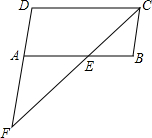 如图,已知?ABCD,点E在边AB上,连接CE并延长交DA的延长线于点F,若AE=AF,求证:AB=DF.