|
学生活动 |
教师组织和引导 |
教学意图 |
|
回答问题 |
提问: 生物变异的概念、分类及区别 |
回顾基础知识, |
|
自主学习 合作探究 交流讨论 回答问题 听讲思考 |
基础知识进行回顾 例题讲解 三种可遗传的变异的比较 染色体组的概念 二倍体、多倍体、单倍体比较 |
通过比较让对基础知识进行回顾梳理、突出重点、突破难点 通过自主合作学习培养良好的学习方法 |
|
分层练习 |
引导、帮助、肯定 |
巩固基础知识和提升学生解题能力,实现主体分层目标 |
|
交流讨论、提出存在问题 |
引导学生通过交流讨论并解答学生提出的问题 |
解决学生知识问题和培养学生自主学习和合作学习能力 |
|
归纳总结 |
引导学生小组讨论合作完成 |
培养学生合作意识及归纳总结能力 |
|
课后作业 |
布置作业 |
巩固和提高基础知识 培养自学能力 |
 (ii)
1. Find the inverse of the following matrices:
(i)  (ii)
 (iii)
 (iv)

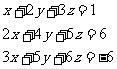
This leads us into the realm of simultaneous equations:
Consider the problem of solving the set of simultaneous equations:
 This
can be represented as

The purpose of solving these equations is
to find the values of x and y. Therefore we need to remove the matrix at the
front of the column matrix. This can be done by multiplying by the inverse of  . Using the method above or by using your calculator find the
inverse which is
 .
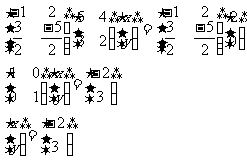
Therefore the solution is x = -2 and y = 3.
|
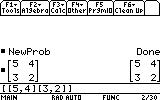
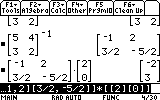
Type in the
matrix you are working with: |
 |
|
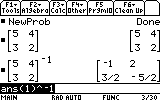
Use the ANS
feature to find the inverse: |
 |
|
Multiply the
inverse by the answer matrix. |
 |
This of course means we can solve very complex sets of simultaneous equations with ease.
Exercise 4:
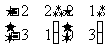
1. Find the matrix products in the following questions:
(i)  (ii)
 (iii)
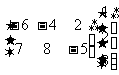
(iv)  (v)
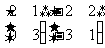 (vi)
INVERSE MATRICES
An important aspect of matrices is the ability to be able to find the inverse of the matrix. This replaces the idea of division.
If  the first step to
finding its inverse is to calculate the determinant. The determinant is
represented by
 . The inverse of A is then given by:
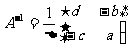 or
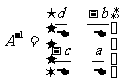
eg.
If  then

Then 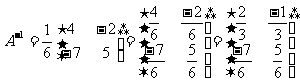
Then we can check what the advantage of the inverse is:
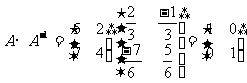 The Unit
matrix.
|
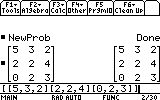
Type in the
matrix you are working with: |
 |
|
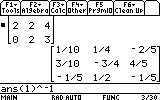
Use the ANS
feature to find the inverse: |
 |
|
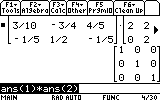
Check that
when you multiply the original and the inverse together that the unit matrix
is produced. Note ans(2) is the second last answer! |
 |
Exercise 3:
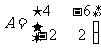 and
 find:
 , then
 and
 then
