2. (弹性课堂。要求学生背一句谚语。)
(板书)
|
Proverb: Where there is a will, there is a way. 有志者事竟成。 |
1. (1)(让学生调查自己的同伴或邻近的学生,根据调查结果,写一段话,尽量使用频度副词。)
T: Now, look at the table. Please make a survey about your partner or your neighbors. You should fill out the form with the adverbs of frequency. At last, write a short passage according to the form.
(表格如下。)
|
Activity Name |
go shopping |
watch TV in the evening |
walk after supper |
get up early |
|
|
|
|
|
|
|
|
|
|
|
|
|
|
|
|
|
|
|
|
|
|
|
|
(2)(找几名学生,汇报他们的调查结果。)
T: OK. Who wants to share your passage with us?
S1: I do. ×× often goes shopping. ×× always watches TV in the evening.
2. (1)(让学生完成3b。)
T: Now, talk about the pictures in 3a with your partner.
For example:
A: How does Maria go home?
B: Maria sometimes goes home by subway. Is that clear? Begin!
(2)(呈现句子的同义替换,加强对乘坐交通工具方式的灵活运用。)
(总结归纳乘坐交通工具的方式并板书。)
|
by subway - take the subway by bike - ride a bike on foot - walk by bus - take a bus by car - take a car by plane - fly |
T: Look at this sentence again: Maria sometimes goes home by subway.
We can also say: Maria sometimes takes the subway home.
But what about these sentences?
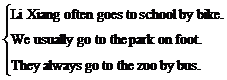
(3)(让学生做上一步的同义替换练习,并核对答案。)
(板书答案。)
|
Li Xiang often rides a bike to school. We usually walk to the park. They always take a bus to the zoo. |
5. (让学生利用关键词造句。)
For example:
never: I never go to school on foot.
…
Step 4 Practice 第四步 练习(时间:10分钟)