题目内容

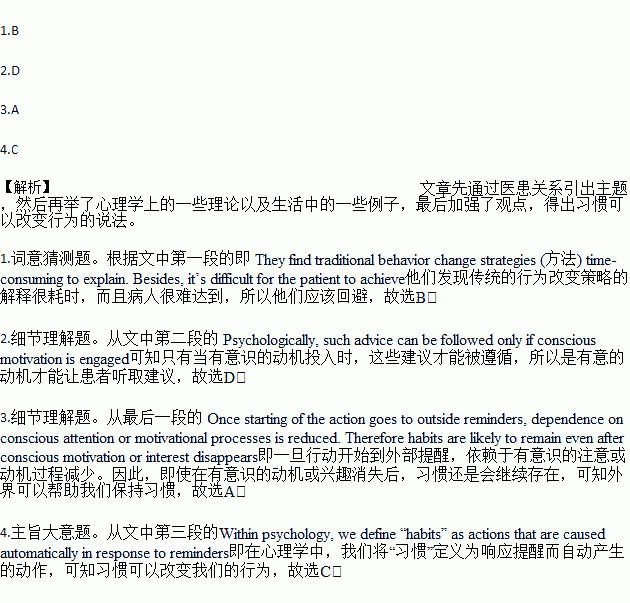
Patients trust health professionals as a source of advice on behavior change. However, many health professionals dodge giving advice on that. They find traditional behavior change strategies (方法) time-consuming to explain. Besides, it’s difficult for the patient to achieve. Furthermore, even when patients successfully start the recommended changes,the gains are often short-lived because few of the traditional behavior change strategies have built-in mecha-nisms for maintenance (保持).

Meanwhile, brief advice is usually based on advising patients on what to change and why (for example, reducing fat intake lo reduce the risk of heart attack). Psychologically, such advice can be followed only if conscious motivation is engaged. However, the effects are typically short-Jived because motivation and attention will decline. Brief advice on how to change, engaging automatic processes, may offer a valuable alternative with potential for long-term influence— habit.

Within psychology, we define “habits” as actions that are caused automatically in response to reminders. These reminders have been associated with performances. For example, automatically washing hands after using the toilet. Decades of psychological research consistently show that mere repetition of a simple action in a consistent context leads to the action being activated upon .following exposure to those contextual cues (环境暗示). Once starting of the action goes to outside reminders, dependence on conscious attention or motivational processes is reduced. Therefore habits are likely to remain even after conscious motivation or interest disappears.

1.Which word can best replace the underlined word “dodge” in Paragraph 1?

A. Risk. B. Avoid.

C. Appreciate. D. Admit.

2.What plays the key role in patients’ taking advice?

A. Reasons to change. B. Ways to change.

C. Increasing attention. D. Intended motivation.

3.What may help to keep habits after interest disappears?

A. Outside reminders. B. Mere repetition.

C. Conscious attention. D. Brief advice.

4.What is the passage mainly about?

A. Motivation to form habits. B. Conflicts between patients and professionals.

C. Habits to change behavior. D. Advice from professionals to patients.
练习册系列答案
相关题目

Thinking about the future isn’t special skill. Actually, everyone does it all the time. We schedule future activities and appointments on our calendars. We make to-do lists, a promise to ourselves of how we will spend our future time and energy. We look up the weekend’s weather. We make predictions about the results of sporting events. We practice, study and train for upcoming events that matter to us. We daydream about events we’re eagerly looking forward to. We worry about others.

Most of this common future thinking is about the near future: the next few minutes, hours, days, weeks, months or maybe even the next few years of our lives. Little time is spent thinking about what our lives will be like or what actions we should prepare to take in the far future: ten years, twenty years, or even fifty years from now. This kind of far-future thinking is the domain of professional futurists.

Futurists are trained to imagine distant realities that seem impossible to others: technologies that don’t exist yet, great changes to laws, strange diseases most likely to infect us in the year 2031. Why indeed think about such distant futures? Are there psychological and social benefits to imagining the world, and our lives, decades in advance? And if so, what does it take to become good at imagining the far future?

These were the fascinating questions that we recently explored with other futurists. I was personally inspired by the discussions, and learned a lot about how futurists imagine the future of life. They specifically wanted to use their imaginations to make the world a better place. Another big benefit for me was that this way of thinking is a skill that can be taught. Society would benefit greatly if we all learned the valuable skills that enable us to think about what things would be like in the future.

1.The writer gives many examples in the first paragraph to __________.

A. draw readers' attention B. explain the topic

C. entertain readers D. tell readers the main idea of the passage

2.The underlined word, "domain", in the second paragraph can be replaced by “_________”.

A. understanding B. choice

C. field D. rule

3.Which of the following things might a futurist think about?

A. The result of sporting event being held.

B. The weather of the coming weekend.

C. A new technology widely used in daily life.

D. A life-threatening disease that doesn't exist yet.

4.What does the writer want to tell us in the last paragraph?

A. The way futurists imagine the future of life is interesting.

B. Society will benefit a lot if we all train ourselves to think as a futurist.

C. It is impossible for us to think about future things as futurists.

D. The idea of using imagination to make the world a better place is ridiculous.

The family is where a child learns words and their meanings. What you say and how you say it has an important effect on how your child will view himself and his world.1.Their cries let the family know that they are hungry, tired or need to be held. The family is how a child learns to understand and to express his wants, needs, feelings opinions and ideas.

Include your child in conversations from the very beginning. Help him join in. At first the sounds are babbling(婴儿发出的咿呀声).2.Families who include their children in conversation give their children important practice in communication and social skills, as well as a better chance for future success.

3.Talk about what you did, what you are doing, and what you plan to do. Provide your child with words for his feelings. Help him to state them. A child who can say, “ I am disappointed”, or “ I’m really happy” can share more about his world. A child who can use words will feel more safe. Encourage your child to speak up and ask questions. 4.

5.From the time they are very young, they can tell when adults are distracted or not listening. If they think their part of the conversation is not being listened to, they will become mad.

Take the time to build communication within your family. Think about the words you use and take the time to truly listen to what is being said.

A. Let your child talk on the phone

B. Give your child words for everything.

C. Then slowly the child learns to join in.

D. Children are really aware of adult communication.

E. Young children especially like to see their words in print.

F. This is a way to learn more about the world, and contribute to conversation.

G.. Babies communicate their needs and wants from the first moments of their life.

违法和不良信息举报电话:027-86699610 举报邮箱:58377363@163.com

精英家教网