题目内容

Below you’ll find some stories and their main ideas. Use these good stories to improve your family life. They’ll help your children to be better kids.

Book, Ink,

and Feather

It’s a story about cooperation and positive attitude(合作与积极的态度).

“Forgetting the past doesn’t solve anything. Try to change one’s situation and find the necessary help to do so.”

The Great Gifts

It’s a short story about stopping bullying(恃强凌弱) in school.

“Children who at first seem strange are special in fact. We should help them to find their own talents.”

Peggy’s Talking Pets

It’s a story about communica-tion and listening.

“When we open our hearts and communicate with others, we enjoy getting to know them, because we all have things to share.”

The Magic Key

It’s a story about children’s adventures(冒险经历).

“Children can learn, read and speak good English while they are sharing the exciting experiences with the characters in the story.”

The Homework Party

It’s a story about making homework funny.

“Interest and games are the best ways to motivate(激励) yourself to do the jobs which need more hard work.”

1.What’s the main idea of Book, Ink, and Feather?

①Forget the past.②Work together.③Good attitude.

A. ①③ B. ①②③ C. ①② D. ②③

2.You should read if the kid is too shy to talk with others.

A. Peggy’s Talking Pets B. The Homework Party

C. The Great Gifts D. The Magic Key

3.Which of the following is NOT mentioned in the passage?

A. Interest helps kids do their homework better and easier.

B. Students should study hard at school.

C. Learn English while reading a story.

D. Sharing with and knowing about others make us happy.

4.The passage is mainly prepared for .

A. students B. teachers

C. parents D. children

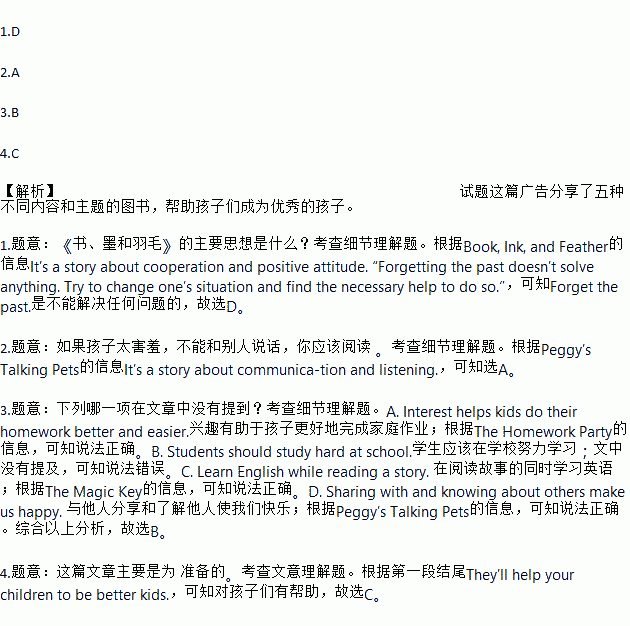
1.D 2.A 3.B 4.C 【解析】试题这篇广告分享了五种不同内容和主题的图书,帮助孩子们成为优秀的孩子。 1.题意:《书、墨和羽毛》的主要思想是什么?考查细节理解题。根据Book, Ink, and Feather的信息It’s a story about cooperation and positive attitude. “Forgetting the pa...
练习册系列答案
相关题目

Wu Jing was born on April 3rd, 1974 in Beijing. He won the National Wushu Championship at the age of 8. But he was not able to move his legs when he was 14. With the help of his mother and his strong will, he stood up again and became famous as a movie star. We can see him in many plays.

In 2015, the film Wolf Warriors I about modern military warfare(军事战争)directed and starred by Wu Jing won a big success. He played the role of Leng Feng, an excellent solider, defeated a group of foreign mercenaries(雇佣兵). The words “I fight for China.” made my heart full of pride.

Two years later, Wolf Warriors II, catches many people’s eyes and makes Wu Jing more famous than before. As the director and main role, he tried his best to make the new film perfect. “God chooses to stand on our side.” seems to prove the success. Last year, Zhou Xingchi made the box office(票房) record of 3,500,000,000 yuan by Mermaid(《美人鱼》),but now Wolf Warriors II has broken the record. More and more people go into the movie theatre not only because of the great scenes of the film, but also because of their love to our country. What’s more, it’s also a good gift for our Party’s 96th birthday for all Chinese.

Let’s remember “When you are in danger overseas, do not give up! A strong motherland always backs you up. ”

1.When did Wu Jing direct his first movie Wolf Warriors Ⅰ?

A. In 1974. B. In 2015.

C. In 2016. D. In 2017.

2.How old is Wu Jing when his film Wolf Warriors II was on?

A. 8. B. 14. C. 43. D. 55.

3.Which is NOT true according to the passage?

A. Wu Jing is both a director and an actor.

B. There are many great scenes in Wolf Warriors.

C. Wu Jing is the maker of the box office record of 3,500,000,000 yuan.

D. Wolf Warriors Ⅰ and Wolf Warriors Ⅱ are both popular with Chinese people.

4.Where can we see the words in the last paragraph?

A. A postcard. B. A driving license.

C. An ID card. D. A passport.

1.B 2.C 3.C 4.D 【解析】试题这篇人物小传简单介绍了当代著名影星吴京的成功之路,重点介绍了他导演并主演的《战狼》系列。 1.题意:吴京导演他的第一部电影《战狼I》是什么时候?考查细节理解题。根据In 2015, the film Wolf Warriors I about modern military warfare directed and star...

Could the students from less developed areas in central and western China get the same educational chances as those in big cities in the east Could the children in poor rural (农村) areas develop as well as those in rich cities Maybe the answers were “No” in the past. But now, China is trying to change the situation.

In order to help rural students grow taller and stronger. China’s Nutrition(营养)Improvement Program started in 2011. According to the program, a lot more money was spent improving students’ meals. More than 36 million students from 134,000 primary and junior high schools in poor rural areas have benefited from the program. They are provided with healthy food like eggs and milk from Monday to Friday at school. And the result of a survey shows that the students in those areas are much taller and stronger than before.

It is true that there were differences between less developed areas and developed areas in education before. Recently, The Guideline for Popularizing High School Education(2017-2020) has come out. According to the guideline, above 90%students from all over the country will go to high schools by 2020. What’s more, the schools in central and western areas will get more support to improve their education.

Students from rural and poor areas also get more chances to receive higher education. A special college program makes it possible for more students from those areas to go to key (重点的) colleges and universities. The number will be increased by 10%in 2017.

With the guideline and the programs, we can expect a fairer and more balanced(均衡的) education in the future.

1.The number 134,000 in Paragraph 2 is the number of in poor rural areas.

A. the key high schools

B. the poor students

C. the key colleges and universities

D. the primary and junior high schools

2.The underlined word “benefited” in Paragraph 2 means in Chinese.

A. 逃离 B. 获益 C. 受害 D. 赚钱

3.If we put the passage into three parts, which of the following is the best?

(①=Para.(自然段)1②=Para.2③=Para.3④=Para.4⑤=Para.5)

A. ①②;③④;⑤ B. ①;②③;④⑤

C. ①;②③④;⑤ D. ①②;③;④⑤

4.What can we infer(推断) from this passage?

A. Liu Xi, a student from Chongqing, can go to any high school if she wants to.

B. Li Mei, a student from a western rural school, can get a bag of milk every day.

C. Hu Jia, a 12-year-old rural student, will more easily receive high school education.

D. Han Lei, a student from Beijing, will have few chances to go to key universities.

1.D 2.B 3.C 4.C 【解析】试题本文是一篇议论文。中国政府为改变中西部教育不均的状况,实施了“中国营养改善计划”,出台了普及高中教育(2017年至2020年)的指导方针,让人们能够期待未来更公平、更平衡的教育。 1.题意:第2段的数字134000是 的数量。考查细节理解题。根据More than 36 million students from 134,0...

Years ago, I lived in a building in a large city. The building next door was only a few feet away from mine. There was a woman who lived there, whom I had never met, yet I could see her seated by her window every afternoon, sewing or reading.

As several months had gone by, I began to notice that her window was dirty. Everything was unclear through the dirty window. I would say to myself, “I wonder why that woman doesn’t wash her window. It really looks terrible.”

One bright morning, I decided to clean my flat, including washing the window inside.

Late in the afternoon when I finished the cleaning, I sat down by the window with a cup of coffee for a rest. What a surprise! Across the way, the woman sitting by her window was clearly visible. Her window was clean!

Then it dawned on me. I had been criticizing (批评) her dirty window, but all the time I was watching hers through my own dirty window.

That was quite an important lesson for me. How often had I looked at and criticized others through the dirty window of my heart, through my own shortcomings

Since then, whenever I wanted to judge (评判) someone, I asked myself first, “Am I looking at him through my own dirty window”

Then I try to clean the window of my own world so that I may see the world about me more clearly.

1.Why couldn’t the writer see everything clearly through the window?

A. Because the woman’s window was dirty.

B. Because the writer’s window was dirty.

C. Because the woman lived nearby.

D. Because the writer was near-sighted.

2.The writer was surprised that .

A. the woman was sitting by her window

B. the woman’s window was clean

C. the woman did cleaning in the afternoon

D. the woman’s window was still terrible

3.The underlined sentence “it dawned on me” probably means “ ”.

A. I began to understand it

B. it cheered me up

C. I knew it grew light

D. it began to get dark

4.What can we learn from the passage?

A. One shouldn’t criticize others very often.

B. One should often make his windows clean.

C. One must judge himself before he judges others.

D. One must look at others through his dirty windows.

1.B 2.B 3.A 4.C 【解析】试题本文是一篇哲理小品,作者通过因透过自己脏兮兮的窗户没能准确看清一个人这件小事感悟到,在评判别人之前,必须先看清楚自己,然后才能更清楚地看到自己周围的世界。 1.题意:为什么作者不能透过窗户看到一切?考查细节理解题。根据第二段开头I began to notice that her window was dirty. Ever...

This was a luxurious hall of a beautiful restaurant with modern cars parking around and people wearing beautiful clothes were sitting at the round tables enjoying their delicious food. Mary, a young waitress , worked here for just a month.

One day, an old man in an old jacket and broken shoes walked slowly into the restaurant with his cane(拐杖).He looked unusual in this big hall. Mary watched him move toward a table by the window. She ran over to him, and said with a smile, “Here, sir. Let me give you a hand.”

Without saying a word, he gave her a smile. She pulled the chair away from the table and helped him sit down. Then she put his cane against the table so that he could reach it. In a soft, clear voice he said, “Thank you, Miss.”

“You’re welcome, sir,” she replied, “I’ll be back in a moment, and if you need anything, just wave at me!”

After he had finished a good meal, Mary brought him the change. She handed him his cane, and walked with him to the front door. Holding the door open for him, she said, “Come back and see us, sir!” The old man turned around and smiled.

When Mary went to clean his table, she was shocked. Under the dish, she found a business card, a 100-dollar bill and a note. The note said, “Dear Mary, I respect you very much, and you respect yourself, too. It shows the way you treat others. You have found the secret of happiness.”

In fact, the old man was the owner of the restaurant. That was the first time that she, or any of his waitresses, had seen him.

1.What does the underlined word “luxurious” in the first paragraph probably mean in Chinese?

A. 宏伟的 B. 豪华的 C. 简陋的 D. 空旷的

2.Mary was of a beautiful restaurant.

A. a young waitress B. a young guest

C. a young owner D. a young boss

3.As soon as the old man entered the restaurant, Mary greeted him and .

A. helped him politely

B. moved to him slowly

C. put his cane away angrily

D. ran away from him quickly

4.What did Mary do after the old man had finished the meal?

A. She went to clean his table quickly.

B. She paid for his bill.

C. She walked with him to the front door.

D. She found the secret of happiness.

5.How did Mary feel when she saw the business card, the 100-dollar bill and the note?

A. Pleased. B. Interested.

C. Surprised. D. Worried.

1.B 2.A 3.A 4.C 5.C 【解析】试题本文是一篇记叙文。玛丽是一家豪华餐厅的年轻服务员,一天来了一位穿着破烂的老人,玛丽很热情礼貌地接待了他,并在他用餐后亲自送到门外,回来收拾餐桌时却吃惊地发现,老人留下了一张名片、一张100美元的钞票和一张便条。便条上写着:“亲爱的玛丽,我非常尊敬你,你也尊重你自己。它显示了你对待他人的方式。你已经找到了幸福的秘密。”...

违法和不良信息举报电话:027-86699610 举报邮箱:58377363@163.com

精英家教网