Part A Short Conversations
Directions: In Part A, you will hear ten short conversations between two speakers. At the end of each conversation, a question will be asked about what was said.The conversations and the questions will be spoken only once. After you hear a conversation and the question about it, read the four possible answers on your paper, and decide which one is the best answer to the question you have heard,
1.A.Japan. B.Italy. C.Australia. D.Egypt.
2.A.Four times. B.Five times. C.Ten times. D.Fourteen times.
3.A.A journalist. B.A novelist. C.A sportsman. D.A newsagent.
4.A.To tell him they are busy. B.To cancel an appointment.
C.To invite him to see a film. D.To ask him to get film tickets.
5.A.He didn’t understand the lecture. B.Professor Smith misused a word.
C.He couldn’t find Professor Smith’s class. D.Professor Smith kept the class late.
6.A.She should lose five pounds. B.She can’t gain any more weight.
C.She should buy some new clothes. D.She needn’t worry about her weight.
7.A.They’re not in the same direction. B.He’ll join the woman.
C.He’s going to Work for IBM. D.He’s going to buy a computer.
8.A.She learned a lot about characters. B.She forgot the title of the book.
C.She also found the book difficult. D.She also read a book about names.
9.A.He’ll be in both places. B.He has to change his schedule at once.
C.He’ll go to the party immediately. D.He regrets that he can’t go to the party.
10.A.He plans to buy a new MP3. B.He doesn’t need his MP3 until Friday.
C.He can’t wait until Friday for his MP3. D.He is going to borrow an MP3.
Part B Passages
Directions: In Part B, you will hear two short passages, and you will be asked three questions on each of the passages. The passages will be read twice, but the questions will be spoken only once. When you hear a question, read the four possible answers on your paper and decide which one would be the best answer to the question you have heard.
Questions 11 through 13 are based on the following passage.
11.A.Relationship with parents. B.Life in the university.
C.Experience of sharing fiats. D.Friendship with foreigners.
12.A.The parties were not very enjoyable. B.The house was too noisy.
C.They had no time to clean the bathroom. D.She couldn’t afford the phone bill.
13.A.She doesn’t need to cook every day. B.She has someone to share feelings.
C.She can live in a new and quiet place. D.She can get up as late as she likes.
Questions 14 through 16 are based on the following news.
14.A.What they take along B.How they travel safely.
C.Which travel guide they choose D.How t-hey survive overseas.
15.A.Something mysterious. B.A strange art form.
C.Something he is good at. D.Part of every life.
16.A.Doing experiments. B.Helping athletes compete in games.
C.Checking the alcohol level D.Testing the safety of food.
Part C Longer Conversations
Directions: In Part C, you will hear two longer conversations. The conversations will be read twice. After you hear each conversation, you are required to fill in the numbered blanks with the information you have heard.Write your answers on your answer sheet.
Blanks 17 through 20 are based on the following conversation.
|
Market Research Interview |
|
Interviewee: Jack Length of Net Experience: About 17 months Monthly Expense: £10 to the 18 provider Purpose: Mainly to communicate with people belonging to the same 19 group Advantage: Easy to 20 ideas and information with others |
Complete the form. Write ONE WORD for each answer.
Blanks 21 through 24 are based on the following conversation.
|
When is Mike’s project
supposed to be finished? |
21 |
|
What is Mike’s project
about? |
The 22 in Canadian cities. |
|
How is Mike going to deal
with the book he’s found? |
To 23 some pages and charts. |
|
What is the most important
requirement in doing the project? |
Students should write the
project 24 . |
Complete the form. Write NO MORE THAN THREE WORDS for each answer.

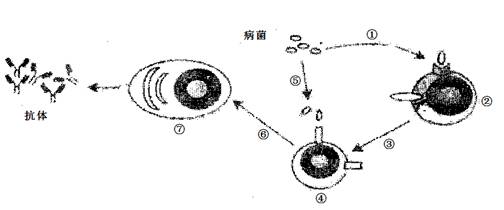 (15分)下图表示病菌感染人体后,免疫细胞做出应答的部分过程。请据图回答问题。