25. The two ladies are _______ the same age, but there seems to be ten years _______ them.
A. at; between B. about; among C. as; among D. of; between
24. Mr White, who comes from ___________ European country, has formed _________ habit of attending ________ church on Sundays.
A. an; ×; the B. a; the; × C. an; the; × D. a; a; a
23.The Expo site should be ____ from anywhere in the city of Shanghai within 90 minutes by bus ,subways and special taxis.
A. adoptable B. acceptable C. available D. accessible
22.This method must be effective ,for I’ve seen it ____ jobs by many different people.
A. applying to B. being applied to C. applied to D. applied for
21. Mr. Li_____a secretary for five years in the company, and now he is the general manager of it.
A. is B. was C. had been D. has been
听下面5段对话,回答1-5题
1. What will the weather be like this afternoon?
A. Sunny. B. Windy. C. Rainy.
2. Where does the conversation most probably take place?
A. In an office. B. In a restaurant. C. At home.
3. What does the boy want to be in the future?
A. A businessman. B. A lawyer. C. A professor.
4. What is the man doing?
A. Offering help. B. Expressing thanks. C. Asking for permission.
5. What does the man mean?
A. He'll deliver the luggage by car. B. He won't take the luggage with him.
C. He doesn't need any help with the luggage.
听第6段对话,回答6--8题
6. Where does this conversation take place?
A. In a restaurant. B. In a night club. C. In a supermarket.
7. What kind of snack does the woman have?
A. Pancake. B. Chips. C. Salad.
8. How much does the woman pay for the things she asked?
A. 75 pence. B. 1.30 pounds. C. 2.05 pounds.
听第七段对话,回答9-11题
9. Which age group do the two speakers most likely belong to?
A. Young. B. Middle-aged. C. Old.
10. Which part of the body is probably OK with the woman?
A. Her leg. B. Her back. C. Her eyes.
11. Why can't the man do gardening a lot?
A. Because of his back trouble. B. Because of his leg trouble.
C. Because of his arm trouble.
听第八段对话,回答12-14题
12. How does the man feel?
A. Happy. B. Sad. C. Excited.
13. What's wrong with the man?
A. He was knocked down by a car.
B. He had an accident when he was walking along the street.
C. He had an accident in the car.
14. Why did it happen?
A. Because there's something wrong with the driving mirror.
B. Because there's something wrong with the roadside mirror.
C. Because the other driver drove too fast.
听第九段对话,回答15-17题
15. Where is Miss Smith?
A. She is at home. B. She is taking a break. C. She is attending a meeting.
16. When should Miss Smith call today whether she will attend the meeting or not?
A. On Thursday. B. Today. C. The day after tomorrow.
17. What number should Miss Smith call?
A. 802 8714 -246. B. 802 9714 -246. C. 902 8741-426.
听第十段独白,回答18-20题.
18. Why couldn t the speaker meet with Mr. Smith as soon as he arrived'.'
A. He missed the appointment. B. He arrived late. C. He was sick.
19. Why did he give up making a new appointment with Mr. Smith?
A. He couldn't reach Mr. Smith's office.
B. He didn't want to see Mr. Smith any more.
C. He didn't want to take the trouble making it.
20. Whom did he meet on the street one day?
A. A stranger. B. Mr. Smith. C. Mr. Smith's secretary.
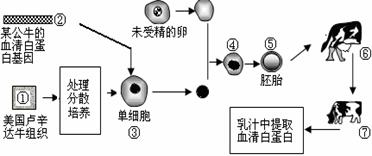
32、(10分)随着科学技术的发展,人们可以根据人类的需求来改造生物的性状,在许多领域取得了可喜的成果,下图是利用奶牛乳汁生产人血清白蛋白的图解,根据下图回答:
(1)上述过程中涉及到的现代生物技术主要有: 、 、 。
(2)在形成图中③的过程中,实现②进入③的方法目前最常用的是 。
(3)图中①一般经 酶处理可以得到③。
(4)重组细胞④发育至胚胎⑤的过程中,细胞分裂方式是 。
(5)小牛⑦的性别是 。⑦是⑥的后代,那么⑦与⑥的遗传性状一样吗?
为什么? __________________________________________。利用核移植的方法得到的动物
叫做______________________。
2009-2010年度第二学期江苏省武进高级中学期中考试
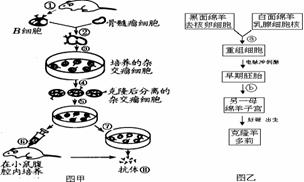
31、(11分)下面甲、乙两图分别是单克隆抗体制备过程和克隆羊培育过程示意图,请据图回答下列问题:
(1)图甲方案能达到预期效果吗? 。原因是 。
(2) 图甲中②为 过程,常用 作为诱导剂。过程⑥与⑦相比,其优点是___________
(3)抗体⑧在疾病的诊断、治疗和预防方面,与常规抗体相比,其特点是_________________。能将其制成生物导弹,定向攻击癌细胞,主要是利用其_________________。
(4) 图甲和图乙所示的过程中,都必须用到的动物细胞工程技术手段是_______________。
(5) 若不考虑环境因素影响,克隆羊的性状全部像白面绵羊吗?________。原因是_________________
(6)在目前现有技术条件下,还不能将从动物体内分离出来的成熟的体细胞直接培养成一个新个体,而是必须将体细胞的细胞核移植到去核的卵细胞中才能发育成新个体,你认为原因可能是 ( )
A.卵细胞大,便于操作 B.卵细胞含有的营养物质多
C.卵细胞细胞质可使体细胞核全能性得到表达 D.重组细胞才具有全能性
30、(7分)下图为经过体外受精和胚胎移植培育优质奶牛的过程,请回答下列问题:
(1)在进行体外受精前要对B进行 处理。
(2)①的名称是 ;②将发育成 ;③的名称是 ,功能上具有 特点。
(3)D是 胚。E进一步扩大,导致①破裂,F伸展出来的过程叫 。
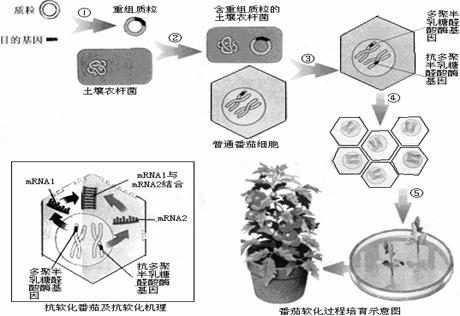
29、(13分)番茄营养丰富,是人们喜爱的一类果蔬。但普通番茄细胞中含有多聚半乳糖醛酸酶基因,控制细胞产生多聚半乳糖醛酸酶,该酶能破坏细胞壁,使番茄软化,不耐贮藏。为满足人们的生产生活需要,科学家们通过基因工程技术,用土壤农杆菌中的Ti质粒作为运载体,把目的基因重组入Ti质粒上的T-DNA片段中,再将重组的T-DNA插入植物细胞的染色体DNA中。培育出了抗软化、保鲜时间长的番茄新品种。操作流程如图,请回答:
(1)在该操作流程图中用到的生物技术有_________________、_________________
(2)过程①需要的工具酶有__________________________。
(3)在构建基因表达载体时,重组质粒组成中除插入目的基因外(本题中的目的基因是____________),还包括____________、终止子以及______________。
(4)在番茄新品种的培育过程中,将目的基因导入受体细胞的方法叫做______________
(5)从图中可见,mRNAl和mRNA2的结合直接导致了____________无法合成,最终使番茄获得
了 的特性。若上图中番茄是二倍体植株,经分析,该植株含有一个携带此目的基因的T-DNA片段,因此可以把它看作是杂合子。理论上,在该转基因番茄植株自交F1代中,仍具有新特性的植株占总数的 。 多聚半乳糖醛酸酶基因与抗多聚半乳糖醛酸酶基因是否为等位基因? 。
(6)普通番茄细胞导入目的基因后,经[④]______过程形成的组织细胞的特点是_______,然后诱导出试管苗,进一步培养成正常植株。

 (3)在构建基因表达载体时,重组质粒组成中除插入目的基因外(本题中的目的基因是____________),还包括____________、终止子以及______________。