22. I am wondering ___________he expects will win the gold medal in Men’s Sing.
A. whom B. who C. which D. what
第一节 单项填空(共15小题;每小题1分,满分45分)
从A、B、C、D四个选项中,选出可以填入空白处的最佳选项,并在答题卡将该项涂黑。
21. -Shall I give you a ride since you live so far away?
-Thank you.______________。
A. It couldn’t be better. B. Of course you can.
C. If you like. D. If you are convenient.
做题时,先将答案标在试卷上,录音内容结束后,你将有两分钟的时间将试卷上的答案转涂到答题卡上。第一节(共5小题:每小题1.5分,满分7.5分)听下面5段对话。每段对话后有一个小题,从题中所给的A、B、C三个选项中迁出最佳选项,并标在试卷的相应位置。听完段对话后,你都有10秒钟的时间来回答有关小题和新闻记者下一小题。第段对话仅读一遍。
1. Where does the conversation take place?
A. At home. B. At the station. C. In the office.
2. What day is it today?
A. Tuesday. B. Wednesday. C. Thursday.
3. What does the man mean?
A. It’s dangerous to climb the mountain alone.
B. Something is wrong with John’s ears.
C. John won’t listen to him.
4. Where did the woman go on business?
A. London. B. New York. C. Paris.
5. Why does the man take a bus instead of driving to work?
A. He hasn’t got a driver’s license.
B. He wants to protect the environment.
C. He isn’t a skilled driver.
第二节(共15小题:每小题1.5分,满分22.5分)
听下面5段对话或独白。每段对话或独白后有几个小题,从题中所给的A、B、C三个选项中选出最佳选项,并标在试卷的相应位置。听每段对话或独白前,你将有时间新闻记者各个小题,每小题5秒钟;听完后,各小题将给出5秒钟的作答时间。每段对话或独白读两遍。
听第六段材料,回答第6、7题。
6. What are the two speakers talking about?
A. Who will host a French program.
B. Who will go to London.
C. Who will attend a debate.
7. Who is the most suitable person?
A. Julia. B. Rose. C. Joan.
听第7段材料,回答第8至10题。
8. Why is the woman worried?
A. She can’t speak Chinese.
B. She hasn’t received any e-mail.
C. She misses Australia.
9. Where are the two speakers probably going next?
A. Guangzhou. B. Shanghai. C. Australia.
10. When does the conversation take place?
A. In Summer. B. In autumn. C. Before Christmas.
11. What are they going to do next week?
A. Go shopping. B. Go skiing. C. Go climbing.
12. What does the man need?
A. A new pair of shoes. B. A new pair of glasses. C. A neo pair of gloves.
13. What’s the relationship between the two speakers?
A. Good friends. B. Neighbor. C. Husband and wife.
听第9段材料,回答第14至17题。
14. How much does the man have to pay for the course?
A. 300 yuan. B. 360 yuan. C. 316 yuan.
15. When does the next class start?
A. On June 6th . B. On July 6th. C. On July 16th.
16. When will the next class start?
A. On Tuesday. B. On Wednesday. C. On Thursday.
17. What do we know about the course?
A. It lasts 8 hours a day. B. It lasts 7.5 hours a day. C. It lasts7 hours a day.
听第10段材料,回答第18至20题。
18. Who first developed plastic on a large scale?
A. A Frenchman. B. An Englishman. C. An American.
19. What was the advantage of plastic collars?
A. They were hard. B. They were easy to wash. C. They were comfortable.
20. Why were the plastic toys a good idea for some mothers?
A. Because they were easy to make.
B. Because they were cheap.
C. Because kids preferred them.
43、(10分)[环境保护]
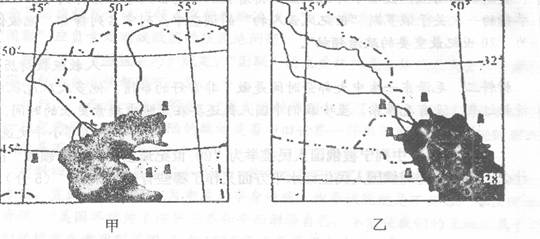
下图甲、乙水域都是世界重要的资源分布区,读图回答下列问题。
(1)甲、乙两水域最常见的水污染形式是 ,这种污染对当地水生生物有何不利影响?(5分)
(2)若甲、乙两区域遭受了同等程度的水污染,在自然状态下,哪一处更难净化?为什么?(5分)
历史选作题(每题材5分,请在第44、45、46、47四题中任选一题作答,如果多作,则按所作的第一题计分。作答时请务必写清题号。)
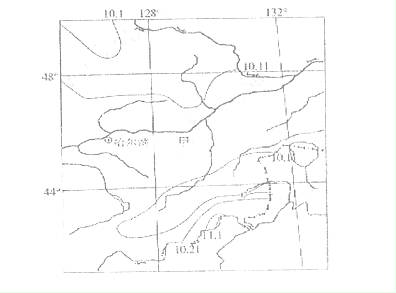
41、(10分)[旅游地理]下图中等值线表示我国东北局部地区某年降雪初始日期分布状况,依据图文资料和所学知识,回答下列问题。
(1)描述图中区域降雪初始日期总体变化趋势,并简述其主要原因。(4分)
资料:东北地区振兴规划之一是积极发展旅游业。主要建设哈尔滨、吉林等冰雪旅游基地;绥芬河、满洲里等边贸旅游基地;鞍山、大庆等工业旅游基地;大小兴安岭、长白山等森林旅游基地;三江平原等湿地生态旅游基地;黑龙江五大连池等火山岩熔地貌观光基地;高句丽遗址旅游基地等。
(1) 说出上述资料中东北地区的世界文化遗产,并评价其价值。(4分)
(2) 依据资料列举东北地区具有环境效益的旅游资源。(2分)