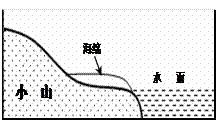
学生在研究性学习时,在两个相同的长方形塑料盒子的一端用潮湿的土壤分别搭起一座相同坡度的“小山”,从盒子的另一端倒入等量的水,形成“湖泊”;不同的是在其中一个盆子内,将一块微湿的海绵压入“小山”底端的土壤里(见右下图)。分别用两个喷水壶,往“小山”上洒等量的水,模拟降水,观察、比较两个盒子内水面发生的变化。据此回答1-3题。
1、放有海绵的盒子的水面与另一盒子的水面相比
A.高出很多 B.高出稍许
C.高度相同 D.高度较低
2.该实验模拟的地理事实是
A.湖泊能够调节空气湿度 B.坡度变化会改变地表径流量
C.湿地能够吸纳地表径流 D.降水变化能够影响自然环境
3.有一组学生在小山上种植苔藓和杂草,培植两周左右,让植物成活后再开始实验,下列地区的国土整治措施,与实验所验证的地理原理相同的是:
A.西北地区为防止荒漠化植树种草 B.沿海地区广泛种植海防林
C.流域山坡上植树种草 D.黄淮海平原的盐碱地的治理
第二节 书面表达(满分25分)
2008年春节前,中国十几个省份遭受了50年不遇的冰雪灾害。假如 你是李华,你的国外朋友Steve发来电子邮件向你了解受灾情况。请你把受灾情况(水、电、媒、交通等方面)向Steve 进行介绍,并告诉他在政府的领导和各方的大力支援下,现在情况有了很大的好转,人们过着幸福安康的生活。
注意:1,词数100左右。 2. 信的开头以给出。但不计入总词数。
Dear Steve,
第二节 完形填空(共20小题;每小题1.5分,共30分)
Some personal characteristics play an important role in the development of one’s intelligence. But people fail to realize the importance of training these factors in young people.
The so-called“non-intelligence factors” include 36 feelings, will, motivation interests and habits. After a 30 year follow-up study of 8,000 males, American Psychologists 37 that the main cause of disparities in intelligence 38, but non- intelligence factors including the desire to learn, will-power and self-confidence.
39 people all know that one should have definite objectives, a strong will and good learning habits, quite a number of teachers and parents don’t pay much attention to 40 these factors.
Some parents are greatly worried 41 their children fail to do well in their studies. They blame either genetic factors, malnutrition or laziness, but they never take 42 consideration these non-intelligence factors. At the same time, some teachers don’t inquire into these, as reasons 43 students do poorly. They simply give them more courses and exercises, or 44 criticize or laugh at them. After all, these students lose self-confidence. Some of them just feel defeated and 45 themselves up as hopeless. Others may go astray(迷途)because they are sick of learning.46 investigation of more then 1,000 middle school students in Shanghai showed that 46.5 per cent of them were 47 of learning, because of examinations, 36.4 per cent lacked persistence, initiative(主动) and consciousness and 10.3 per cent were sick of learning.
I t is clear 48 the lack of cultivation of non-intelligence factors has been a main 49 to intelligence development in teenagers. It even causes an imbalance between physiological (生理) and 50 development among a few students.
If we don’t start now to 51 the cultivation of non-intelligence factors, it will not only affect the development of the 52 of teenagers, but also affect the quality of a whole generation. Some experts have put forward _53_ about how to cultivate students’ non-intelligence factors.
First, parents and teachers should _54_ understand teenager psychology. On this basis, they can help them to pursue the objectives of learning, 55 their interests and toughening their willpower.
36. A. one’s B. their C. his D. her
37. A. came out B. found out C. made out D. worked out
38. A. in itself B. by itself C. itself D. on its own
39. A. Though B. Nevertheless C. However D. Moreover
40. A. believing B. studying C. cultivating D. developing
41. A. about B. when C. how D. whether
42. A. for B. in C. into D. over
43. A. why B. that C. when D. how
44. A. ever B. even C. still D. more
45. A. put B. get C. handle D. give
46. A. The B. An C. Another D. A
47. A. afraid B. ahead C. aware D. ashamed
48. A. that B. how C. why D. which
49. A. difficulty B. question C. threat D. obstacle
50. A. intelligent B. characteristic C. psychological D. physical
51. A. practise B. thrust C. strengthen D. urge
52. A. intelligence B. diligence C. maturity D. performance
53. A. projects B. warnings C. suggestions D. decision
54. A. fully B. greatly C. very D. highly
55. A. insuring B. going C. encouraging D. exciting
35. We all thought Mr. White was right, but Bruce seemed to think ___.
A. otherwise B. different C. opposite D. contrary