68. Notre Dame Cathedral is one of the most c in the world.
67. I don't think students should be a to bring mobile phones to school.
六.单词拼写
根据下列句子所给汉语注释,在句子空缺处写出各单词的正确形式(每空只写一词)。
66. They live on the (十二) floor.
五、听力。
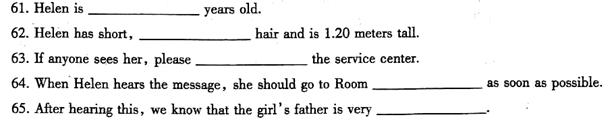
听一段独白,然后根据所听内容完成第61~65小题。在每小题句子空白处填写适当的词语,使句子意思与所听内容一致。
C
Fire can help people in many ways. But can also be very harmful. Fire can heat water warm your houses, give light, and cook food. But fire can burn things too. It can burn trees, houses, animals, or people. Sometimes big fires can burn forests.
Nobody knows for sure how people began to use fire. But there are many interesting, old stories about the first time a man or woman started a fire. One story from Australia tells about a man very, very long time ago. He went up to the sun by a rope and brought fire down.
Today people know how to make a fire with matches. Children sometimes like to play with them. But matches can be very dangerous. One match can burn a piece of paper, and then it might burn a house. A small fire can become a big fire very fast.
Fires kill many people every year. So you must be careful with matches. You should also learn to put out fires. Fires need oxygen. Without oxygen they die. There is oxygen in the air. Cover a fire with water, sand, or in an emergency, with your coat or something else. This keeps the air away from a fire and kills it.
Be careful with fire, and it will help you. Be careless with fire, and it will burn you.
56.( ) Which is true?
A. We are not sure how people started to use fire.
B. It is an Australian who started a fire.
C. We know how people began to use fire.
D. Nobody knows how to make a fire.
57.( ) Children mustn’t play with matches because ______.
A. matches burn paper
B. it is not interesting
C. matches can be dangerous
D. they don’t know how to make a fire with matches
58.( ) If you are going to put out a fire, you ______.
A. must be careful with matches
B. ought to know it can be harmful
C. have to cover it with water only
D. should keep air away from it
59.( ) We must be careful with fire, or it ______.
A. can be B. warms our houses C. might burn us D. will help us
60.( ) What is the main idea of the passage?
A. Fire can help people in many ways. B. Fire can be both helpful and harmful.
C. Fire can burn things and people D. We must be careful with matches.
非选择题(45分)
B
“What is success?” Mr Gruber asked his 6th grade business class. It was his opening conversation for the first class of the term.
“Success is riding in a sweet car, watching an 80-inch TV, and living in a place with at least twelve rooms.” One student answered, earning laughs from all the students.
Mr Gruber smiled, but shook his head. “Tom, that is excess(过量). That is not success.”
“How about being able to provide for your family?” A blonde girl named Sandy in the front suggested as an answer.
“Now we’re getting closer,” Mr Gruber smiled, “but try thinking about what you need and what you want.”
“Getting everything you want.” Tom shouted out an answer again, trying for more laughs.
Mr Gruber sighed. “ I believe we’ve already talked about excess versus(与…比较) success.”
“Getting everything you need, but some of what you want?” James, sitting in the back wondered aloud.
“Quite right!” Mr Gruber clapped. “Success is getting everything you need and some of what you want. The more you get that you want, the more successful you are. You do reach a point where you are living in excess, though.”
“What does this have to do with business?” Tom asked. It seemed if it wasn’t funny, he wasn’t happy.
“Well, Tom, think of it this way: the point of business is to make a living to support your family. Once you have properly seen to (确保) their needs, you can then see to getting the extras that you want.”
“What if I don’t have a family?” he continued to be difficult.
“Then you have to provide for yourself, a family of one.”
“He has goldfish to think about!” Peter, Tom’s friend, shouted out.
“Then he needs to provide for a family of one with a fishbowl.” Mr. Gruber corrected himself.
Tom nodded, satisfied with that answer.
“So in the next nine weeks, we’re going to study basic business situations, like having a checking account and understanding credit cards.”
Tom rubbed his hands together excitedly. “When do we get to start spending?”
“You already are, Tom. You’re spending time with us!” Mr. Gruber laughed. “Now, let’s see what you guys know about credit cards…”
51.( ) What class did Mr Gruber teach?
A. History B. Science C. Maths D. Business
52.( ) Which student didn’t seem to be taking the class seriously?
A. Tom B. James C. Peter D. Sandy
53.( ) How did Mr Gruber make his class lively and interesting?
A. He himself kept talking. B. He just read from a textbook.
C. He showed a movie to his students.
D. He got his students to take part in a discussion.
54.( ) What do you think of Mr Gruber according to the passage?
A. Strange B. Patient C. Shy D. Proud
55.( ) What can be the best title of this passage?
A. Get What You Want B. Needs and Wants
C. Try to Get More Money D. How to Live Well
三.完形填空
Carnegie was born in 1888 to a poor farming family in the central United States. The boy didn’t see a train 36 he was 12 years old. In his teens, he had to get up at 3 a.m. every day to milk the cows in his family.
When Carnegie first entered college, he felt 37 because of his clothes and ordinary looks. His mother 38 him: “Why not try to be better in other things instead of just dress and good 39 ?”
Carnegie tried to be more active in college. He joined the debate (辩论) team. But one after another, he lost 12 meets. The young man was very 40 in himself. He said later that he thought of killing himself after so many failures. 41 soon Carnegie was seen practicing public speaking on the riverside. Because of his hard work, he 42 at last. In 1906, Carnegie won a famous speech contest and became widely known. The young man made his own words come true, “Believe that you will succeed, 43 you will.”
In order to 44 his success, Carnegie opened schools and wrote books. His best-sellers include How to Win Friends, Influence People, How to Stop Worrying and Start Living. More than 50 million 45 of his books have been printed in 38 languages. They are still helping people on the road to success.
36.( ) A. when B. as C. until D. while
37.( ) A. hopeless B. tired C. happy D. useless
38.( ) A. replied B. ordered C. protected D. encouraged
39.( ) A. colleges B. looks C. families D. speeches
40.( ) A. interested B. surprised C. disappointed D. excited
41.( ) A. Although B. Then C. So D. But
42.( ) A. succeeded B. failed C. graduated D. tried
43.( ) A. or B. but C. and D. so
44.( ) A. achieve B. share C. realize D. show
45.( ) A. schools B. ones C. stories D. copies
35.( ) —Would you like to watch the TV program A Bite of China with me?
— , but I’m busy reviewing for my test.
A. Not at all B. That’s all right C. I’d love to D. My pleasure
34.( ) It’s said that of the water around the world ________ polluted.
A. two third; have B. two thirds; has C. two third; are D. two thirds; is
 听一段独白,然后根据所听内容完成第61~65小题。在每小题句子空白处填写适当的词语,使句子意思与所听内容一致。




