题目内容

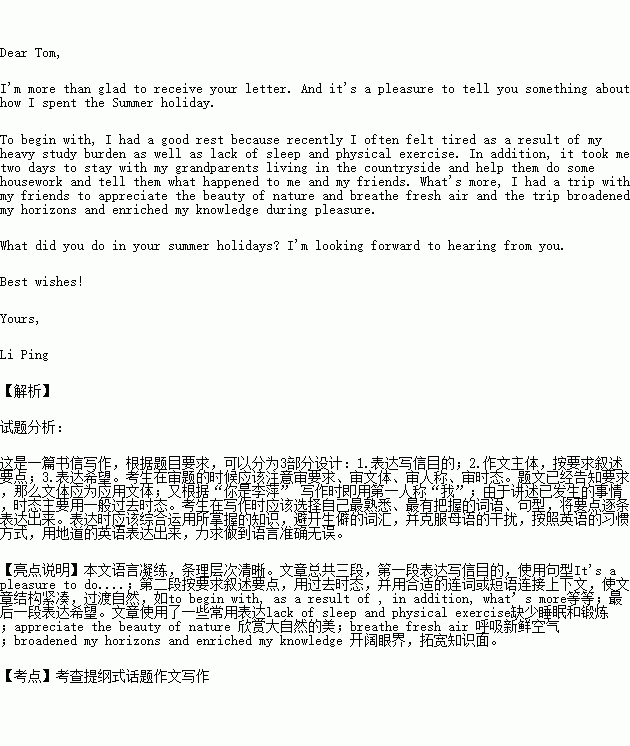
假如你叫李平,你的美国笔友Tom来信询问你暑假过的怎样。请根据以下信息给他回信,说明你在假期中的活动和理由。

活动

休息

学习紧张,缺少锻炼和休息

看望乡下的祖父母

帮助他们做点家务,并给他们谈了身边的新鲜事

和朋友进行短途旅游

欣赏大自然,呼吸新鲜空气

注意:词数100左右。

Dear Tom,

_______________________________________________________________________________

_______________________________________________________________________________

_______________________________________________________________________________

_______________________________________________________________________________

_______________________________________________________________________________

_______________________________________________________________________________

_______________________________________________________________________________

_______________________________________________________________________________

_______________________________________________________________________________

Yours,

Li Ping
练习册系列答案
相关题目

You're not doomed to toss and turn every night. Although you might not be able to control all of the factors that relate to your sleep, you can adopt habits that encourage better sleep. Start with these simple sleep tips.

No. 1: Stick to a sleep schedule

Go to bed and get up at the same time every day, even on weekends, holidays and days off. Being consistent reinforces (加强) your body's sleep—wake cycle and helps promote better sleep at night. If you don't fall asleep within about 15 minutes, get up and do something relaxing. Go back to bed when you're tired.

No. 2: Pay attention to what you eat and drink

Don't go to bed either hungry or stuffed. Your discomfort might keep you up. Also limit how much you drink before bed, to prevent disruptive middle-of-the-night trips to the toilet. Nicotine, caffeine and alcohol deserve caution, too. The stimulating effects of nicotine and caffeine — which take hours to wear off — can ruin quality sleep.

No. 3: Create a bedtime ritual

Do the same things each night to tell your body it's time to wind down. This might include taking a warm bath or shower, reading a book, or listening to light music. Be careful of using the TV or other electronic devices as part of your bedtime ritual. Some research suggests that screen time or other media use before bedtime has impact on sleep.

No. 4: Get comfortable

Create a room that's ideal for sleeping. Often, this means cool, dark and quiet. Consider using room-darkening shades, earplugs, a fan or other devices to create an environment that suits your needs.

Your mattress and pillow can contribute to better sleep, too. Since the features of good bedding are subjective, choose what feels most comfortable to you. If you have children or pets, set limits on how often they sleep with you — or insist on separate sleeping quarters.

No. 5: Limit daytime naps

Long daytime naps can affect nighttime sleep — especially if you're struggling with poor sleep quality at night. If you choose to nap during the day, limit yourself to about 10 to 30 minutes and make it during the mid-afternoon.

If you work nights, you'll need to make an exception to the rules about daytime sleeping. In this case, keep your window coverings closed so that sunlight — which adjusts your internal clock — doesn't interrupt your daytime sleep.

No. 6: Include physical activity in your daily routine

Regular physical activity can promote better sleep, helping you to fall asleep faster and to enjoy deeper sleep. Timing is important, though. If you exercise too close to bedtime, you might be too energized to fall asleep. If this seems to be an issue for you, exercise earlier in the day.

No. 7: Manage stress

When you have too much to do — and too much to think about — your sleep is likely to suffer. To help restore peace to your life, consider healthy ways to manage stress. Start with the basics, such as getting organized, setting priorities and dividing tasks. Give yourself permission to take a break when you need one. Share a good laugh with an old friend.

Nearly everyone has an occasional sleepless night — but if you often have trouble sleeping, contact your doctor. Identifying and treating any underlying causes can help you get the better sleep you deserve.

1.Which of the following is helpful to have quality sleep at night?

A. Listening to light music before bed.

B. Working out in the gym only in the day time.

C. Using expensive pillows that sell well.

D. Drinking lots of water instead of coffee before bed.

2.Which of the following sleep tips is not mentioned in the passage?

A. Control your daytime sleep time.

B. Adopt healthy ways to handle stress.

C. Follow a flexible sleep timetable.

D. Schedule your daily physical activities.

3.According to the passage, in what situation do you need to contact your doctor?

A. You can not nap in the day time.

B. You frequently have trouble sleeping.

C. You do not fall asleep within 15 minutes.

D. You have too much to think about before bed.

4.What’s the purpose of this passage?

A. To provide advice on promoting better sleep at night.

B. To inform readers of different sleep habits before bed.

C. To offer tips on various relaxing activities before bed.

D. To convince readers of the importance of quality sleep at night.

“Have a nice day!” may be a pleasant gesture or a meaningless expression. When my friend Maxie says “Have a nice day!” with a smile, I know she sincerely cares about what happens to me. I feel loved and secure since another person cares about me and wishes me well.

“Have a nice day. Next!” This version(版本) of the expression is spoken by a salesgirl at the supermarket who is rushing me and my groceries out the door. The words come out in the same tone with a fixed procedure. They are spoken at me, not to me. Obviously, the concern for my day and everyone else’s is the management’s attempt to increase business.

The expression is one of those behaviors that help people get along with each other. Sometimes it indicates the end of a meeting. As soon as you hear it, you know the meeting is at an end. Sometimes the expression saves us when we don’t know what to say. “Oh, you just had a tooth out? I’m terribly sorry, but have a nice day.”

The expression can be pleasant. If a stranger says “Have a nice day” to you, you may find it heart-warming because someone you don’t know has tried to be nice to you.

Although the use of the expression is an insincere, meaningless social custom at times, there is nothing wrong with the sentence except that others who speak it without thinking may not really care about my day. But in a strange and comfortable way, it’s nice to know they care enough to pretend they care when they really don’t care all that much. While the expression may not often be sincere, it is always spoken. The point is that people say it all the time when they like.

1.How does the author understand Maxie’s word?

A. Maxie really wishes the author a good day.

B. Maxie shows her anxiety to the author.

C. Maxie encourages the author to stay happy.

D. Maxie really worries about the author’s security (安全).

2.What does the underlined sentence in Paragraph 2 mean?

A. The salesgirl is rude.

B. The salesgirl is bored.

C. The salesgirl cares about me.

D. The salesgirl says the words as a routine(惯例).

3.By saying “Have a nice day.” a stranger may ________.

A. express respect to you

B. give his blessing to you

C. try to be friendly to you

D. share his pleasure with you

4.What is the best title of the passage?

A. Have a nice day—a meaningless expression

B. Have a nice day—a Heart-warming Greeting

C. Have a nice day—a Social Custom

D. Have a nice day—a Polite Ending of a Conversation

阅读下面短文,从短文后各题所给的四个选项(A、B、C 和 D)中选出可以填入空白处的最佳选项,并在答题卡上将该项涂黑。

One of the qualities that most people admire in others is the willingness to admit one’s mistakes. It is extremely hard sometimes to say a (n) ________ thing like “I was wrong about that,” and it is even harder to say, “I was wrong, and you were right about that.”

And I had an experience recently with someone ________ to me that he had made a mistake fifteen years ago. He told me he had been the ________ of a certain grocery store in the neighborhood where I grew up, and he asked me ________ I remembered the egg boxes. Then he ________ an incident and I began to remember vaguely the incident he was describing.

I was about eight years old ________, and I had wandered into the store with my mother to do the weekly grocery shopping. On that ________ day, I must have found my way to the dairy food department ________ the incident took place. There must have been a special ________ on eggs that day because there was an impressive display of eggs in dozen and half-dozen boxes. The boxes were ________ three or four feet high. I must have stopped in front of them to ________ the boxes. Just then a woman came by pushing her grocery cart, ________ the boxes and left. For some reason, I ________ that it was up to me to put the display back together even though it was not my ________, so I began to work.

The manager heard the ________ and came rushing over to see what had happened. When he appeared, I was on my ________ checking some of the boxes to see if any of the eggs were broken, but to him it looked as if I was the wrongdoer. He severely ________ me and wanted me to pay for any broken eggs to ________ the loss. I protested my innocence and tried to explain, but it did ________ good. Even though I quickly forgot all about the incident, ________ the manager did not.

1.A. pleasantB. enjoyableC. simpleD. difficult

2.A. arguingB. notingC. promisingD. admitting

3.A. bossB. cleanerC. cashierD. manager

4.A. ifB. howC. whyD. when

5.A. imaginedB. rememberedC. performedD. related

6.A. at a timeB. at the timeC. at timesD. at one time

7.A. usualB. luckyC. wonderfulD. particular

8.A. whereB. afterC. untilD. though

9.A. displayB. exhibitionC. saleD. design

10.A. piledB. decoratedC. wrappedD. packed

11.A. inspectB. admireC. arrangeD. destroy

12.A. knocked onB. knocked overC. knocked offD. knocked at

13.A. declaredB. pretendedC. decidedD. regretted

14.A. faultB. taskC. goalD. plan

15.A. screamB. alarmC. noiseD. call

16.A. back B. kneesC. stomachD. head

17.A. praisedB. hitC. shoutedD. scolded

18.A. set asideB. sort outC. make up forD. pick up

19.A. nothingB. noC. anyD. something

20.A. obviouslyB. frequentlyC. unfortunatelyD. unnecessarily

How teens can stay fit

Any type of regular, physical activity can improve your fitness and your health. 1.

Exercise should be a regular part of your day, like brushing your teeth, eating and sleeping. It can be in gym class, joining a sports team, or working out on your own. Keep the following tips in mind:

2. A good attitude is important. Find an activity that you think is fun. You are more likely to stick with it if you choose something you like. A lot of people find it's more fun to exercise with someone else, so see if you can find a friend or family member to be active with you.

Take it one step at a time. 3. For example, walk or ride your bike to school. Get on or off the bus several blocks away and walk the rest of the way. Use the stairs instead of taking the elevator.

Get your heart pumping. Whatever you choose, make sure it includes aerobic (有氧的) activity that makes you breathe harder and increases your heart rate. This is the best type of exercise because it increases your fitness level and makes your heart work better. 4. Examples of aerobic activities are basketball, running, or swimming.

Don’t forget to warm up with some easy exercises or stretching (拉伸) before you do any physical activity. 5. It is also important to stretch out after you exercise to cool down your muscles.

A. Do the activity as often as possible, but don't exercise to the point of pain.

B. The most important thing is that you keep moving!

C. Make physical activity a habit.

D. Small changes can add up to better fitness.

E. Stay positive and have fun.

F. This warms your muscles up and may help protect against injury.

G. It also burns off body fat.

Tu Youyou, an 84-year-old female(女性)scientist, became the first Chinese to win a Nobel Prize in science on Oct 5. Before that, she ever won the 2011 Lasker Award for finding out artemisinin (Qinghaosu), which saved millions of lives. She was grateful(感激的)for the Lasker prize, but said, “It is just a scientist’ duty. I will go on fighting for the health of all humans.”

Tu kept her work in the 1960s and 1970s. In that age, Malaria (疟疾) could took away people’s health. Scientists all over the world had already tried over 240, 000 times but failed. Tu Youyou, a member of the Academy of Traditional Chinese Medicine, Beijing, began to study Chinese herbs.

Before 2011, people didn’t know Tu very much. Many friends played jokes with her “the Professor of Three None's” : no degree(学位), no study experience abroad, not a member of any Chinese national colleges. But she is hard-working. She read a lot of traditional Chinese medicine books and did a lot of researches on the disease.

In February, 2012, Tu was named National Outstanding Females (One of the Ten) Tu is now a model of Chinese medical workers.

1.Artemisinin is used to ________.

A. make medicineB. make food

C. get awardD. do the experiment

2.In the 1960s and 1970s ________ could find ways to stop the Malaria.

A. Scientists in China B. only Tu Youyou

C. Scientists all over the world D. no scientist

3.Tu Youyou became very famous ____________.

A. in the 1960sB. in 1970

C. before 2011D. after 2012

4.From Tu Youyou’s story, we know that she is a ___________ woman.

A. friendlyB. kindC. cleverD. hard-working

违法和不良信息举报电话:027-86699610 举报邮箱:58377363@163.com

精英家教网