It is now believed that the game of snooker(斯诺克) was invented by Sir Neville Francis Fitzgerald Chamberlain in 1875 in Jubbulpore, India.

The rules of world snooker have been improved to a fine degree. There are six pockets in the table. Two in each corner of one end, known as the top pockets, and two in each corner of the other end, known as the bottom pockets, and the final two in the middle of the longer sides, known as the center pockets. Different “spots”(地点) are signed on the table for the different colored balls. The values(分值) of the balls are red-1, yellow-2, green-3, brown-4, blue-5, pink-6, and black-7. The cue(球杆) must be no less than 914mm long. Snooker may be played by two or more players, either independently or as sides.

Snooker is a big sport in China. There are 300 million snooker players there, which is more than the rest of the world put together. So it’s no surprise that some of the world’s best players come from China. They have been showing off their talent at the World Snooker Championship, which takes place every year in the UK at the Crucible Theatre in the northern English city of Sheffield. And it is the most important event in professional snooker. This year four of the contenders(冠军争夺者) for World Snooker Champion were Chinese – Marco Fu, Liu Chuang, Ding Junhui and Liang Wenbo. Liu Chuang and Liang Wenbo were making their debut(首次亮相) in Sheffield this year, in fact. And they did quite well in the game.

1.The game of snooker was invented in __________.

A. IndiaB. the UKC. China

2.The center pockets are __________.

A. in the corners of the end

B. in the middle of the table

C. in the middle of the longer sides

3.The World Snooker Championship takes place __________.

A. in 1875B. every yearC. twice a year

4.The snooker players in China are __________ those in other countries in the world.

A. fewer thanB. more thanC. as many as

5.The underlined word “it” in Paragraph 3 refers to(指代) __________.

A. the city of Sheffield

B. the Crucible Theatre

C. the World Snooker Championship


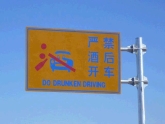
Survey: Most Chinese think penalty(惩罚) for drunk driving too light

2009-08-18 13:33:53 GMT2009-08-18 21:33:53 (Beijing Time) Xinhua English

BEIJING, Aug.18 (Xinhua) -- Most Chinese people consider drunk driving impossible to stop in the country while the current law(法律) too light for drunk drivers, a survey has found.

According to the survey done by the China Youth Daily, more than 96% of the 1,792 respondents(被告) said people around them had driven after drinking, while more than 81% complained the current penalty was too light, the paper reported Tuesday. Now offenders(违规者) face a three-to-six month suspension(吊销)of their driving licenses and detention(拘留) for up to 15 days in serious cases.

Drunk driving has attracted wide public attention in China after several serious accidents in recent months. On Aug. 4, a drunk driver in Hangzhou killed a 16-year-old girl. Two days later, another drunk driver in Shanghai killed a four-year-old boy and injured three others.

Drunk driving is regarded as just traffic violation if no accidents result, according to the Chinese law. But some people have called for regarding it as a crime no matter whether it results in serious accidents. “If it’s a crime and anyone caught will go to jail(监狱), a lot more people will be afraid of risking it,” said Wang Mingliang, a professor at the Fudan University. However, other people disagreed.

In 2008, China’s alcohol(酒精)-related traffic accidents led to 18,371 deaths, 76,230 injuries, and a property(财产) loss of 250 million yuan ($36.7 million), according to official figures.

1.Most Chinese think it’s hard to stop drunk driving because of the __________ penalty for it according to the current law.

A. lightB. lessC. heavy

2.If a drunk driver is caught now, he or she will have to face __________.

A. a detention and an important report

B. a suspension of driving license and a detention

C. a suspension of driving license and a serious survey

3.How many people died of alcohol-related traffic accidents in China in 2008?

A. 1,792B. 18,371C. 76,230

4.According to the passage, which of the following is true?

A. A drunk driver in Shanghai killed a 4-year-old boy On August 4.

B. Over 1700 respondents in the survey complained the current penalty was too light.

C. China’s alcohol-related traffic accidents caused a property loss of $36.7 million in 2008.

5.This passage may come from a __________.

A. newspaperB. science fictionC. story book


Computers can injure you. Most other injuries happen suddenly. For example, if you fall off a bike and break your arms, it happens very quickly. But computer injuries happen slowly.

You probably know how to ride a bike safely. Now learn to use a computer safely.

Your eyes

Too much light can injure your eyes, so never sit too close to a computer screen. Your eyes should be at least 50cm from the screen. Remember to look away from it sometimes. This gives your eyes a rest.

When you use a computer, the window should be on your left or your right. If it is behind you, the light will reflect(反射) on the screen. If the window is in front of you, the sun and the screen will both shine into your eyes.

Your hands and wrists(手腕)

Hand and wrist injuries can happen because the hands and wrists are moved in the same way hundreds of times. If you use a keyboard for a long time, follow these rules: Rest your wrists on something. Keep your elbows at the same height as the keyboard. Stop sometimes and exercise your hands, wrists and fingers in a different way.

Your back

Some people sit for many hours in front of a computer. If you sit in the wrong way, you can injure your back or your neck. So you should sit with your back straight. The top part of the screen should be in front of your eyes. Your forearms, wrists, hands and the upper part of your legs should all the parallel (平行) to the floor. If you are sitting for a long time, get up every 30 minutes and exercise your arms, legs and neck.

1.A computer screen may injure your eyes if __________.

A. you sit 60cm away

B. your eyes are too close to it

C. the window is on your left or right

2.Hand and wrist injuries are caused when you __________.

A. move in the same way again and again

B. rest your wrists on something

C. keep your elbows as high as the keyboard

3.When using a computer, your eyes and hands will be safe if you __________.

A. work near a window

B. work for a long time

C. take rests at times

4.It is good for your back and neck if you sit __________.

A. for many hours

B. in the right way

C. with the screen below your eyes

5.What would be the best title for the text?

A. How to Use a Computer Safely

B. How to Keep your Hands and Wrists Safe

C. How to Protect your Eyes and your Back


As we know, it is not easy to build a satellite(卫星). Building a traditional satellite usually takes years. The costs can be as high as $250 million or more. Most members of the design teams have worked in the field for a long time. They hold advanced degrees(学历) in math, science, or engineering.

But things are changing. High costs, unusual educational needs and long start-up times are no longer an obstacle(障碍) to space exploration. The scientists have developed a new type of tiny, inexpensive earth-orbiting(轨道) satellite.

So far, college students have built and launched(发射) several cube-shaped satellites, or CubeSats. At least 15 more are ready to go. Those already in orbit take pictures, collect information and send it back to the earth, just as regular satellites do.

But you might not even have to wait until you get to college to start designing and building your own satellite. A new program called KatySat aims to get teenagers to take part in. When kids understand what satellites can do, the kinds of ideas they’ll come up with may be countless.

Education isn’t the only aim of CubeSats because these tiny, technology-filled boxes are inexpensive to build and can be put together quickly, they’re perfect for testing new technologies that might one day be used on major space tasks.

The biggest challenge now is to find ways to bring the satellites back to the earth after a year or two. Or space junk could gradually increase because CubeSats become more popular.

Nowadays, college and high school students are getting a chance to learn what it takes to explore in space. Someday—perhaps a lot sooner that you imaging—you might get to design, build and launch your own satellite. If you do, you’re sure to have fun. And you might also get crazy about science for life.

1.Building a traditional satellite __________.

A. costs $250,000

B. needs college students

C. takes quite a long time

2.Compared with the traditional ones, the new satellites __________.

A. need long start-up times

B. are cheap and small-sized

C. collect more junk in orbit

3.The underlined word “countless” in Paragraph 4 probably means “__________”.

A. 无用的B. 无价值的C. 无数的

4.According to the passage, which of the following is true?

A. CubeSats could possibly cause pollution in space.

B. Scientists designed CubeSats for kids to play with.

C. Students can’t design satellites without college education.

5.The purpose of the author writing the passage is __________.

A. to tell us that satellite technology can also be learned by kids

B. to show that high technology brings a big change in kids’ life

C. to tell us that kids must study hard to learn satellite technology


 0  83917  83925  83931  83935  83941  83943  83947  83953  83955  83961  83967  83971  83973  83977  83983  83985  83991  83995  83997  84001  84003  84007  84009  84011  84012  84013  84015  84016  84017  84019  84021  84025  84027  84031  84033  84037  84043  84045  84051  84055  84057  84061  84067  84073  84075  84081  84085  84087  84093  84097  84103  84111  159627 
违法和不良信息举报电话:027-86699610 举报邮箱:58377363@163.com

精英家教网