

【题目】

You probably know many of the things that you can do with the hundreds of different muscles in your body. But have you ever thought about how the muscles in an animal’s body are different from yours? An animal’s muscles are made to do the things that are most important for its life.

Lions are hunters. They depend on their ability to catch other animals. Lions must be fast in order to catch their prey(猎物). The powerful muscles in their back legs allow them to run at speeds of more

than 30 miles per hour. They can also jump a distance of more than 35 feet. The strong muscles in their front legs help them catch their prey.

Snakes also use their muscles for hunting prey and for movement, but their muscles work in very different ways than lions’ do. Because snakes do not have any legs, they use their muscles to push against the ground or other objects to move themselves forward. Their muscles also allow them to eat things that seem much too large. For example, a snake may eat an egg that is larger than the width of its body. How does this happen? The snake’s strong neck muscles work together to push the egg down the mouth.

The elephant’s long nose has a lot of muscles. Scientists believe that the nose alone has more than 100,000 muscles! This is because the elephant uses its nose much in the same way that people use their hands and fingers. Even though the nose is large, it can perform surprisingly tasks. For example, an elephant can pick up a small leaf from the ground. The nose can also be a powerful tool. An elephant can use its nose to pick up a tree by its roots or even to lift a baby elephant.

The great muscles of these animals seem pretty unbelievable. But the muscles in your body work exactly the way you need them to. After all, it might be fun to be able to jump a distance of 30 feet, but as a human being, there is just not much need for it.

1The underlined word “hunters” in Paragraph 2 means persons or animals that .

A. keep animals for fun B. raise animals for meat

C. catch animals for food D. run after animals for exercise

2All the following are talked about in the passage EXCEPT .

A. An elephant’s nose is strong enough to pick up a tree by its roots.

B. The strong muscles in the back legs help lions catch their prey.

C. Snakes can’t move themselves forward without their muscles.

D. Muscles in an animal’s body are different from a human’s.

3According to the passage, what makes the muscles in your body different from an animal’s?

A. The exercise. B. Your parents. C. The environment. D. Your needs.

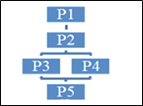
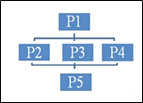
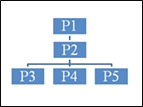
4Which of the following shows the structure (结构) of the passage? (P = Paragraph)

A. B. C. D.

【题目】根据材料内容选择最佳答案,并将其标号填入题前括号内。
Have you ever had trouble sleeping in a new place?

Lots of people do. And now researchers from Brown University in Rhode Island think they know why. They found that one-half of the brain "remains more awake" than the other half when people are trying to sleep in a new place.
The sleep findings were reported in Current Biology by Brown University. In their report, the researchers said many people report they have a harder time sleeping the first night at a hotel or other places outside their home. They call it "first-night influence". "In Japan they say, 'If you change your bed, you can't sleep,'" said Yuka Sasaki, one of the report's writers. "You don't sleep very well in a new place. We all know about it."
The researchers measured brain waves (测量脑波) for 35 volunteers over two nights in a laboratory. The two nights were a week apart (间隔). They found during the first night the left half of the brain was more active than the right half. This was during the first deep-sleep period, the researchers said.
Sasaki said a lot of questions remain.
Researchers did not keep measuring brain waves all night long. So, they don't know if the left half keeps "watch" all night, or whether it "works in shifts (轮换) with the right half later in the night". They also do not know why the brain activity, at least during the first period of deep sleep, is always on the left half.
For some, this research may be calming. It is good to know that our brain is "looking out for us" in a new place. But it may not help with sleep. That brain activity, at least according to this new research, makes it harder to get the sleep people need to wake up well rested in the morning.
(1)How many times did the researchers measure brain waves for 35 volunteers?
A.Once.
B.Twice.
C.Three times.
D.Four times.
(2)The researchers found during the first deep-sleep period.
A.the brain waves remained the same
B.the brain activity helped with sleep
C.the right half of the brain kept "watch"
D.the left half of the brain was more active
(3)Which of the following is one of the questions that remain?
A.Whether the new bed keeps you from sleeping.
B.How you have trouble sleeping in a new place.
C.Why the brain activity is always on the left half.
D.What people can do when they can't sleep well.
(4)The underlined word "calming" has the closest meaning to" ".
A.pleasing
B.different
C.serious
D.strange
(5)What is the text mainly about?
A.What we will have to do to sleep well.
B.How researchers measure brain waves.
C.Who doesn't sleep well in a new place.
D.Why it's harder to sleep in a new place.

 0  144020  144028  144034  144038  144044  144046  144050  144056  144058  144064  144070  144074  144076  144080  144086  144088  144094  144098  144100  144104  144106  144110  144112  144114  144115  144116  144118  144119  144120  144122  144124  144128  144130  144134  144136  144140  144146  144148  144154  144158  144160  144164  144170  144176  144178  144184  144188  144190  144196  144200  144206  144214  159627 

违法和不良信息举报电话:027-86699610 举报邮箱:58377363@163.com

精英家教网