ÌâÄ¿ÄÚÈÝ

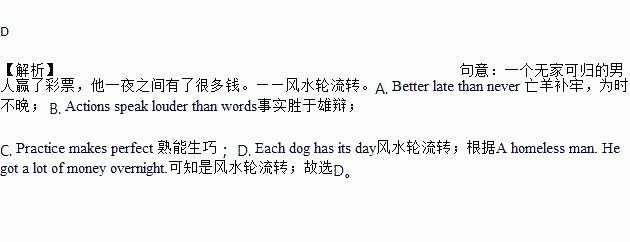
£¨ÌâÎÄ£©¡ªA homeless man won a lottery ticket (²ÊƱ). He got a lot of money overnight.

¡ª________.

A. Better late than never B. Actions speak louder than words

C. Practice makes perfect D. Each dog has its day

D ¡¾½âÎö¡¿¾äÒ⣺һ¸öÎ޼ҿɹéµÄÄÐÈËÓ®ÁË²ÊÆ±£¬ËûÒ»Ò¹Ö®¼äÓÐÁ˺ܶàÇ®¡£¡ª¡ª·çË®ÂÖÁ÷ת¡£A. Better late than never ÍöÑò²¹ÀΣ¬ÎªÊ±²»Íí£» B. Actions speak louder than wordsÊÂʵʤÓÚÐ۱磻 C. Practice makes perfect ÊìÄÜÉúÇÉ£» D. Each dog has its day·çË®ÂÖÁ÷ת£»¸ù¾ÝA homeless...
Á·Ï°²áϵÁдð°¸
Ïà¹ØÌâÄ¿

Mr Green is a very careful driver. He _____ the traffic rules (¹æÔò) all the time. Let¡¯s have a look at how well he drives. If ______drives like Mr Green, there will be few traffic accidents (ʹÊ) on the roads.

Before getting in the car, Mr Green _______ walks around it. Is the car all right? Is there anything in front or at the back of the car? He thinks he ______ check it first.

When Mr Green drives, he _____ the mirrors (¾µ×Ó) on the car every five to eight seconds. 2_____he never drives near the car in front of him. When he drives to the _____, he always uses the turn signals (תÏòµÆ). ¡°Many new drivers don¡¯t _____ to use the signals. That is_____. Cars behind you will go into yours.¡±

Also, Mr Green never talks ____ the mobile phone when he is driving. He never eats or drinks either.

1.A. knows B. misses C. follows D. prepares

2.A. nobody B. everybody C. somebody D. everything

3.A. always B. never C. sometimes D. seldom

4.A. would B. could C. shall D. should

5.A. looks at B. looks for C. looks out D. looks after

6.A. So B. If C. But D. And

7.A. turnings B. roads C. bridges D. streets

8.A. plan B. need C. remember D. help

9.A. interesting B. difficult C. funny D. dangerous

10.A. at B. on C. to D. for

1.C 2.B 3.A 4.D 5.A 6.D 7.A 8.C 9.D 10.B ¡¾½âÎö¡¿±¾ÎĽéÉÜÁËһλʮ·Ö½÷É÷¼ÝÊ»µÄ˾»úµÄÏà¹Ø¼ÝÊ»¾­Ñé¡£ 1.¾äÒ⣺Ëû×ÜÊÇ×ñÊØ½»Í¨¹æÔò¡£A.ÖªµÀB.´í¹ýC.¸úËæ£¬×ñÊØD.×¼±¸¡£Ç°¾ä˵ËûÊÇÒ»¸öСÐĵÄ˾»ú£¬ËµÃ÷Ëû»á×ñÊØ¹æÔò¡£¡°follow rules¡±±íʾ¡°×ñÊØ¹æÔò¡±£¬¹ÊÑ¡C¡£ 2.¾äÒ⣺Èç¹ûÿ¸ö...

Why do people smoke? One reason is that people become addicted(³Éñ«) to cigarettes. The addictive substance(ÎïÖÊ£©in cigarettes is nicotine(Äá¹Å¶¡). When people smoke, the nicotine goes right into the blood stream and makes people feel comfortable. A smoker's body gets used to the nicotine, and if he stops smoking, he feels nervous. Many smokers try to stop smoking but because of the addiction to nicotine they feel so uncomfortable that they often find it too difficult____.

Another reason is that people simply enjoy smoking. Having a cigarette for many people means taking a break. For some people smoking becomes part of certain social rituals (ÀñÒÇ), for example, sending the cigarette after dinner. Many people enjoy smoking because it gives them something to do with their hands. Reaching for a cigarette, lighting it and flicking (µ¯µô) the ashes are special comfort in a situation where they feel nervous.

Many people also like the taste of tar (½¹ÓÍ) in cigarettes. However, it is the tar that causes cancer. While governments and health experts have tried to get people to give up smoking completely, cigarette manufacturers (Éú²úÉÌ) have tried to keep selling them by producing cigarettes with less tar. Many people in western countries have welcomed these cigarettes since they found it hard to stop smoking and wanted to reduce the danger to their health.

1.According to the passage, what gets people into the habit of smoking?

A. The cigarette. B. Nicotine. C. Tar. D. Blood.

2.What do the underlined words "to do so" mean?

A. They mean "to stop smoking".

B. They means "to make people feel comfortable".

C. They mean "to get used to the nicotine".

D. They means"to become addicted to cigarettes".

3.Why do people welcome low-tar cigarettes?

A. Because they taste better.

B. Because they are cheaper.

C. Because they are less harmful.

D. Because they are easy to be made.

4.Which of the following sentences is TRUE, according to the passage?

A. Smokers continue smoking because smoking is very interesting.

B. Tar in cigarettes causes cancer.

C. In order to look cool, many people enjoy smoking.

D. Many people in western countries welcome the cigarettes with more tar.

1.B 2.A 3.C 4.B ¡¾½âÎö¡¿ÊÔÌâÕâÆª¶ÌÎÄÖ÷Òª½²ÊöÁËΪʲôÈËÃÇϲ»¶ÎüÑÌ£¬ÒòΪÑÌÀïÃæÓÐÒ»ÖÖÉÏñ«µÄÎïÖÊÄá¹Å¶¡£¬»¹ÓÐÒ»¸öÔ­ÒòÎüÑ̾ÍÒâζ×ÅÐÝÏ¢¡£ÈËÃÇ·¢ÏÖºÜÄÑÍ£Ö¹ÎüÑÌ¡£ 1. 2. 3. 4.

¸ù¾Ý¶ÌÎÄÉÏÏÂÎÄ»òËù¸øÌáʾÌî´Ê¡£

What will happen if a family is without the Internet for a month£¿One American family decides to find out.They send 1. invitation to a leading US television station£¬expecting that it will send a film group to record their day£­to£­day life 2. this invention(·¢Ã÷) for a month.

When the film group meet the Smiths£¬they find that Mr.Smith£¬Mrs.Smith and their two kids are so crazy about technology that they h3. do things together.At dinner time£¬no one sits at the dining table for their food.¡°Everyone just runs into the kitchen£¬takes their food and then 4.(go) back to their screen£¬¡± Mrs.Smith explains.¡°U5. we make a change£¬our family will become strangers(İÉúÈË) to each other£¡¡±

Getting back to the.n6. life without the Internet is not easy£¬especially when the Smiths lose themselves in it.They have to make many changes.For example£¬the two kids have to go to the school library to borrow books for their scientific projects£¬and Mr.and Mrs.Smith need to go out shopping because they cannot buy things online.As the family have the new lifestyle(Éú»î·½Ê½)£¬they find that they can spend 7.(much) time talking over meals£¬playing sports and 8.(do) all kinds of activities together.

The Smiths keep on 9.(live) without the Internet for twenty days.Would they be a10. to go for long after the challenge?

1.an 2.without 3.hardly 4.goes 5.Unless 6.normal 7.more 8.doing 9.living 10.able ¡¾½âÎö¡¿ÎÄÕ½²ÊöÁËÊ·ÃÜ˹һ¼Òͨ¹ýÒ»¶Îʱ¼ä²»Ê¹Óà 1.¾äÒ⣺ËûÃÇ·¢ËÍÁËÒ»¸öÇë¼í¡£¸ù¾Ý²»¶¨¹Ú´Êa/anÒ»¸ö£¬aÓÃÓÚ¸¨ÒôÒôËØÇ°£¬anÓÃÓÚÔªÒôÒôËØÇ°£»¸ù¾Ýinvitation¹ÊÌîa...

Î¥·¨ºÍ²»Á¼ÐÅÏ¢¾Ù±¨µç»°£º027-86699610 ¾Ù±¨ÓÊÏ䣺58377363@163.com

¾«Ó¢¼Ò½ÌÍø