题目内容
【题目】
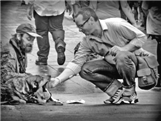
How nice are you? Do you give money to homeless people? Do you offer your seat to someone in need on a bus?
Many people believe that confident people think more highly of themselves, while those who have low self-esteem (自尊) think less of their good qualities. However, a new study says it might not be true, reported The Guardian.
The study was done by Jonathan Freeman, a psychology professor from the University of London, UK. He found that 98 percent of British people consider themselves to be among the nicest 50 percent of the population. In the study, Freeman first asked some people to rate (评级) their own niceness. Then he got people to answer questions like “Do you give directions to strangers?” and “Have you ever donated blood?”. The results showed that people are not as nice as they think they are. Two thirds of them seldom helped others carry heavy shopping bags, and only a quarter of them donated blood.
In another study by psychologists from universities in Chicago and Virginia, US, some people were shown pictures of themselves. Some pictures had been more or less changed to make them appear more attractive(有吸引力的). When asked to pick the unchanged pictures, people usually chose the more attractive ones.
So, why do we think we’re nicer than we actually are? There are many theories (理论). A popular one says we unknowingly cheat ourselves, so that we can get confidence without knowingly lying to ourselves or each other.
How can we solve it? Other studies show that there is a simple way: feedback (反馈). Compare others’ opinion toward yourself with your own and you will see a clearer picture.
【1】Where does the passage most probably come from?
A. A magazine. B. A grammar book. C. A dictionary. D. A story book.
【2】What did the new study find?
A. Confident people have more good qualities.
B. People with low self-esteem are mostly not nice.
C. People are not as nice as they think they are.
D. Confident people don’t like those with low-esteem.
【3】Which of the following about Freeman’s study is NOT true?
A. Freeman is a British psychology professor.
B. About 98 percent of British people think they’re nice people.
C. The people answered some questions about niceness.
D. One fourth of the people helped others carry heavy bags.
【4】According to Para 5, people chose the more attractive pictures of themselves because ________.
A. they were not happy with their looks
B. it was hard to tell small differences
C. they lied to themselves without knowing it
D. they wanted themselves to look good
【5】What does the story mainly talk about?
A. How to be a nicer person. B. Others’ opinions toward you.
C. How to know ourselves well. D. People’s opinion of their own niceness.
【答案】
【1】A
【2】C
【3】D
【4】C
【5】D
【解析】本文主要介绍了人们对自己的善良的评价。新的研究发现人们不像他们自己认为的那样好。把自己的看法和其他人对自己的观点进行比较,然后你就会清楚地了解自己。
【1】A
推理判断题。根据In another study by psychologists from universities in Chicago and Virginia, US, some people were shown pictures of themselves可知这是在介绍了一项心理学家进行的研究,这应是从杂志上摘录下来,故选A。
【2】C
细节理解题。根据The results showed that people are not as nice as they think they are.可知新的研究发现人们不像他们自己认为的那样好,故选C。
【3】D
细节理解题。根据Two thirds of them seldom helped others carry heavy shopping bags, and only a quarter of them donated blood.可知三分之二的人很少帮其他人搬很重的购物袋,只有四分之一的人会献血,故D项与文中不符,故选D。
【4】C
推理判断题。根据A popular one says we unknowingly cheat ourselves, so that we can get confidence without knowingly lying to ourselves or each other.可知人们选择自己最有魅力的照片,是因为他们不知道自己欺骗自己,而是在自己对自己撒谎,故选C。
【5】D
概括归纳题。根据In the study, Freeman first asked some people to rate (评级) their own niceness.可知本文主要介绍了人们对自己的善良的评价,故选D。

 备战中考寒假系列答案