5.“especially” 为”尤其、特别”

I don’t like bright colours,especially red.

我不喜欢鲜艳的颜色,尤其是红色。

This is a very common word,especially in spoken English.

在是一个很常见的词,尤其在口语中。

I like the country,especially in spring.

我喜欢乡下,尤其在春天。

Noise is unpleasant,especially when you are going to sllep.

噪声使人不快,尤其当你要入睡时。

6)A)ashamed是表语形容词,后接“of”短语,that从句或动词不定式。

 He felt ashamed of having done so little work

他只因做了一点点工作而感到惭愧。

She feels too ashamed to ask for help.他不好意思让人家帮忙。

B)shame是名词,为“羞愧”可耻的”

It’s a shame to cheat in the exam.考试中作弊是可耻的。

7) “work”为“运转、开动、有效、行得通”

His mother keeps asking him not to smoke,but it doesn’t work.

他妈屡次告戒他不要吸烟,但是不管用。

I bought a recorder yesterday here,but it doesn’t work.

昨天我在这儿买了一台录音机,但是不响。

Your idea sounds good,but it won’t work.你的想法不错,但行不通”

8)“recover”为“恢复到正常状态”

 He has fully recovered from his illness.他已经完全康复了。

The city has recovered form the war.小城已经从战争中恢复了。

9)“match”A)作为名词用为“配偶”“比赛”“相匹配的人或物”

He is a good match.(他是一个好丈夫)

The chairs and desks are a good match.这些椅子和桌子很相配。

B)match作为动词为“胜过”“比得上”“与配套”

He is so excellent,no one can match him. 他是如此优秀,无人能比。

No one can match him in knowledge of English.

Why not buy a tie to match your shirt?为什么不买一个领带配你的衬衫。

10)“worth”为形容词“价值、值什么分量”、

The car is worth 30000 yuan.

His suggestion is worth nothing. 他的建议没有价值。

The film is worth seeing.这部电影值得一看。

The book is worth reading a second time. 这本书值得读第二遍。

2.Eric sits on his bed looking at Daniel, who has arms crossed and looks angry.

  句中looking at Daniel 是现在分词短语做伴随状语,表示伴随着谓语动词sits on his bed同时发生。

Task

²    present

A:

Present 作动词的用法如下:

1)演出,展出:

The school is presenting a play.

学校正在演出一场戏。

The gallery will present the works of a new artist.

美术馆展出一位新艺术家的作品。

2)送给,增与:

They present the flowers to their teacher.

他们把花送给老师。

Our class presented the school with a picture.

我们班赠给学校一幅画。

3)颁发、递交、呈递

The mayor presented the prizes.

那位市长颁奖。

Please present your report to the manager.

请把你的报告交给经理。

4)提出(论点、看法等):

He presented his views and sat down.

他提出他的观点,然后坐下来。

5)呈现、出现、显露:

Every country of latin American presents a similar picture.

拉丁美洲的每个国家呈现出类似的风光。

6)引见介绍:

May I present you to my husband?

我可以将你引见给我丈夫吗?

B:

Present 当形容词可以表示:

1)在场、出席:

Every member of the class was present.

班上每个人都到场了。

2)存在:

Oxygen is present in the air.

氧气存在于空气中。

3)现在的:

At the present moment he is supposed to be in Paris.现在,他应该在巴黎。

C:present 作名词,

1)表示“现在”

There is no time like present

没有什么时候像现在这样。

2)礼物、赠品

²    frustrated

²     

I found him quite frustrated last night.

昨晚我发现他相当沮丧。

Don’t be so frustrated! Everything will be OK.

不要这样气馁!一切都会过去的。

The result of the exam is frustrating to us.

考试的结果令我们灰心。

It is frustrating to hear the experiment has failed.

实验失败的消息让人极度灰心。

C :frustrate 是及物动词,表示:

1)粉碎、挫败、使失败

He frustrated our plan.

他挫败了我们的计划。

The bad weather frustrated all our hopes of going out. 坏天气使我们所有外出的希望全泡汤了。

2)使泄气:

He was frustrated by his poverty.

贫穷使他灰心。

All this is rather frustrating.

所有这一切相当令人泄气。

phone-in (电台、电视台的)听(观)众来电直播节目。

a regular morning phone-in.

早晨固定的听(观)众来电直播节目。

a phone-in problem sevice.

为你答问服务来电直播节目。

²    gist: 要点、主要意思(不可数)

I haven’ you give me the gist of it?

我没有时间看报告。你能把大意告诉我吗?

He gave me the gist of the headmaster’s report.

他把校长报告的大意告诉了我。

²    mood 在句中意为:“情绪、心理状态”(可数名词)

What was the general mood of the class?

这个班总的情绪如何?

He didn’t want to go home in that mood.

他在那总心态下不想回家。

²    for nothing

A:在句中意为“白费”“白白地”

We took all that trouble for nothing.

我们白费力找这些麻烦。

All his good work was for nothing .

他的一切努力都是白费的。

B:免费、没花钱

They will repaired it for nothing.

他们将免费修理它。

I get this book for nothing.

我免费得到这本书。

C: 无缘无故地

They quarrelled for nothing.

他们无缘无故地吵架。

²    mix up …… with……把、、、和、、、混淆在一起,把、、、看作是(另一个人)

注意:当mix up 的宾语是代词时,这个代词需放在mix与up 之间。

She had mixed him up with someone else.

她把他和另外一个人搞混了。

He’s forever mixed me up with my brother.

他永远弄不清我和我哥哥。

²    be meant (to do…)意为“必须(做),应该(做)”

You were meant to ask why I was disappointed with the idea.

你该问问我对这种想法为什么感到失望。

They were meant to look after their aged parents.

他们应该照顾他们年迈的父母。

     在本单元they are meant to be read aloud 应译为“这些话是为朗诵准备的”

²    keep… in mind 记住,放在心里

You have to be home by 11 o’clock. Keep that in mind.你必须到11点回家。记住这一点。

Please keep my words words in mind.

请把我的话记住。

²    character是名词,

A:在句中意为“人物”,(包括文艺作品中的人物)

Black is one of the charactors in a play I am now writing.

布莱克是我正在写作的一个戏里的人物之一。

B:性格、本性、个

a)(多做不可数名词)

Such influence can change man’s character for the better.

这种影响可以使人的性格变好。

b)(有时作可数名词)

I choose my friends for their good characters.

我按照好的品格选择朋友。

C:性质(多作不可数名词)

The two problems are quite different in character.

这两个问题性质相当不同。

D:一个一个的字(指非拼音文字)写出或印出的字母和符号(可数)

The letter ran to 12000 Chinese characters

这封信多达12000中国字。

The japanese used chinese characters.

日本人使用中国字。

²    A

²    am /are/is being+形容词/名词是be动词的现在进行式,表示一时的状态。

He is being silly.

他在发傻呢。

She is being friendly.

她这样做是为了表示友好。

 Xiao Hong is being a good girl today.

小红今天很乖。

provide在句中意为“提供”,是及物动词

A:The Red Cross provided food and shelter for disaster victims.

红十字会为受难灾民提供食品和收容所。

B:常用词语为proide…with…:给、、、提供、、、

His firm provided him with a car.

他的公司给他提供一辆小汽车。

Can he provide you with information?

他能提供你信息吗?

²    advice

A:作不可数名词,意为“忠告”、“劝告”“建议”

act on/follow /take one’s advice 听从/遵守/接受某人的劝告。

Let me give you a piece of /a bit of/a few words of advice.

让我给你一条/一点/几句话的忠告。

He give me some advice on learning/how to learn English well.

他给我一些如何学好英语的建议。

B:advice 的动词为advise。作及物动词,

The doctor advised a complete rest.

医生建议他休息。

The doctor advised him to take a holiday.

医生建议他休息。

They adviced starting early /an early start.

他建议早点出发。

They advised that we should put off the meeting.

他们建议我们推迟会议。

They advised her not marry/against marring quickly.他们建议她不要太快结婚。

²    Tidy (v):to make neat; put in order整理

Tidy up :When are you going to tidy your room up?你何时整理房间?

We’ll have to tidy away these papers before we have dinner.

我们吃晚饭前得把这些文件清理走。

²   

²     

²    Clean up (phr. V) :to clean thoroughly and remove anything unwanted.清理:

It’s your turn to clean (the kitchen)up.

Clean up this mess.

²    bit

²     

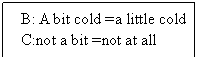
  He is not a bit surprised at the news.

他对此消息一点不吃惊。

Not a little =very much 非常

He is not a little surprised.

他对此消息非常吃惊。

  D:bit 前可用人称代词,意为“某人的一分力量”,而little 无此用法。Little 可用作不定代词,bit 无此用法。

We should do our bit for our country.

我们为祖国尽自己的一分力。

Little does he know about his illness.

他对病情知道得很少。

²    be proud of 意为“以、、、为荣”“因、、、而骄傲”如:

He is proud of knowing the president.

他以认识总统为荣。

Her prarents are proud of her great success.

她父母以她的成功而骄傲。

We are proud of being/to be a Chinese.

我们因自己身为一个中国人而感到骄傲。

be proud of 与take pride in 同义。

²    be nerous about 意为“对、、、感到紧张”,近义于 “be anxious about/beworried about”, be nervous about中,可用at代替about.

²     

project( Unit 2)Writing an advice letter

It looks as if /as though it’s going to rain.

看起来天好像要下雨。

It sounds as if /as though someone is knocking at the door.

听起来好象有人敲门。

It seems as if/though this pen were mine.

这支笔好象是我的。

She loves the boy as if/though she were his mother.

她爱这个男孩就像她是他妈妈一样。

He looked as if/though he had known the answer.

他看起来好象已经知道这个答案了。

You look as though you had seen a ghost.

你看起来好象见过鬼似的。

C:as if 后面可直接跟分词或不定式。如:

He opened his mouth as if to speak.

他张开口,像要说话一样。

He stared at the girl as if seeing her for the first time.他目不转睛地盯着那姑娘,好象第一次看见似的。

     insist “坚持、一定要、强调” (不及物动词),


We insist upon a definite answer.

我们一定要得到一个肯定的答复。

They always insist on a high standard.

他们一贯坚持高标准。

He insisted on seeing us home.

他坚持要送我们回家。

They insisted upon her staying in hospital.他们坚持要留在医院里。

She insists that she (should)be paid equally.她坚持要得到同等的工资。

 I insisted that you (should) be there on time.我坚决要求你准时到那儿。

He insisted that he heard someone in the  next  room.

他坚持说他听到隔壁屋里有人。

The boy insisted that he had not done that and (should) not be punished.

那男孩说他没做那事,不该受到惩罚。

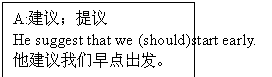
     Suggest  vt. [+名词或代词;+动词的ing形式;+(that)从句]


He suggested (going for ) a walk.他提议去散散步。

注:a:建议某人做某事用advise sb to sth 不能说suggest sb to do sth.

   b:suggest后加从句,如suggest表示“暗示;启发”,这时从句不用虚拟语气

The police suggested that the thief might be one of the family members.

警察提出窃贼可能是一名家庭成员。

Her yawn suggests that she is sleepy.

她打哈欠表明她困了。


They don’t allow smoking here.

他们不允许人们在这儿抽烟。

They allowed her to go to the party.

他们允许她参加聚会。

注:allow用于被动语态时不能用it做形式主语。

People are not allowed to smoke in the lecture hall./Smoking is not allowed in the lecture hall.不能说It is not allowed to smoke in the lecture hall.

Allow me让我来(做)吧

Allow for 体谅,为、、、准备、考虑到、、、

 You should allow for his youth.

你应考虑到他的年轻。

 Allow of 允许、容许(多用于否定句)

The situation allows of no delay.

情况不容拖延。

Such conduct allows of no excuse.

这样的行为是不容辩解的。

You allow of no exception.

你也不例外。

Forbid the meeting.

禁止这一集会。

She forbad him wine.

她不许他喝酒

The school forbids students to smoke/forbids students’ smoking .

学校不许学生抽烟。

     Forbid 的句型转换:

Every time 引导时间状语从句意为“每次;每当”=whenever

Every time I come across difficulties, I will turn to my father for help.

每当我碰到困难时,我就会向父亲求救。

 We would meet him every time we went to our uncle’s

每次我们去叔叔家,都会碰到他。

注:every time 是连词,类似的连词还有:each time ,next time ,the second time

Each time he come here ,he would tell me a different story.

每次他来这儿,都给我讲一个不同的故事。

I’ll return you the book next time I come to see you .下次我来看你的时候我将把书还给你。

They fell in love with eath other the second time they met.

他们第二次见面时,就爱上了对方。

      Unit3 语言点同步讲解

6.Daniel, we thought, you were an adult,a person from whom we could expect good decision

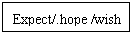
expect sb/sth  expect sb to do sth   expect to do sth  expect that…

I don’t expect so.我想不会=I expect mot.

None of us expected it. 我们谁也没料到这种情况。

I’ll expect you for supper .我将等你吃晚饭。

You can’t expect him to support you.你别指望他会支持你。

 Words and expressions to the play

     can’t wait to do…意为“迫不及待想干、、、”

例如:I can’t wait to see him.

我迫不及待想看他。

He can’t wait to go to the market.

他迫不及待地要到市场去。

     It’s so nice to be home.

It is +adj./n. +(for sb)+to do句型此句型中,it 为形式主语,

真正的主语是to do,译为“(对某人来说)做某事是、、、”

如:It is important for man to explore the outer space.

It’s not right to cut down young trees and burn down..

It’s easy to say but difficult to do.

It’s impossible to mix oil with water.

It’s important to learn English.

It is my duty to help you.

It is a pleasure to meet you.

      Eric runs in after it, followed by a big dog.


例如:Seen from the space,the earth looks like a huge water covered globe.

   从太空看,地球就像一个被水覆盖的球体。

Seen from the top of the hill, the park looks like a garden.

从山顶看,公园像个花园。

Given more time, we could have done it better.

如果多给点时间,我们能把它做得更好。

Folded up along the lines, the paper will be a paper box.

沿着线折叠,这张纸就成了一个纸合。

Though made with great care, the food was still not to her taste.

尽管精心烹制,食物仍然不合她的口味。

I won’t go to the party unless invited.

我不会参加聚会,除非邀请我。

When heated, water can be turned into vapour.

把水加热,水就会变成水蒸气。

     what am I to do?


例如:we are to meet at the school gate.

    You’re to be back by 10 o’clock.

    I am to inform you that the meeting will be held in hangzhou.

    A knife is used to cut

    They were never__________

(他们注定以后永远不再见面)

    A new hospital _________in our district.

(我们区将建立一个新的医院。)

    What is _________when something gets into your eyes?

(如果你的眼睛里进了东西,你该怎么办?)

     You are supposed to know the law.


  例如:Customers are not supposed to smoke here.

顾客不可以在这里吸烟。

     Tom, you’re not supposed to go out at night.

汤姆,晚上你不要出去了。

     Cats are supposed to be afraid of dogs,but my cat has just driven Mr. Brown dog out of the yard.

      按说猫本应是怕狗的,但我的猫刚刚却把布朗先生的狗从院子中赶了出去。

     Lu xun was supposed to be a doctor,but he became a famous writer.

鲁迅本应该当医生,但他却成了一位著名的作家。

     Is the servant supposed to clear the outside of the windows or only the inside.

这个佣人应该打扫窗户的外面呢,还是仅仅打扫里面呢?

     Listen to me young man –remember the day when we left you in charge?

In charge (of):负责(、、、)

Who is in charge here ?

谁负责这儿?

He is in charge of the Heath Department.

他负责卫生部的工作。

The doctor in charge was a tall man.

负责的医生是一位高个子男人。

The officer in charge requested John to put on his clothes.

负责的官员要约翰穿上衣服。

The boy was in Mary’s charge.

这男孩由玛丽照顾。

The hospital is in/under the charge of doctor Green.

医院由格林医生负责。

The project is in his charge.这工程由他负责 。

deserve vt. “值得,应当受到”,后面跟

(1)   名词或代词

   He deserved his glory.

   他应当得到光荣。

(2)   用过去分词做表语。

   He felt that her praise of him was deserved

    他觉得她对他的表扬是值得的。/他觉得他应当受到她的表扬。

(3)   不定式:

   You deserved to succeed.

你应该取得成功。

(4)   从句或动名词

He said that he really didn’t deserve she should be so kind.

她说他真的不值得她对他这样好。

Such bad behaviour deserves a beating.

这种坏行为该打.

     Maybe ,but now that he has been so rude to us ,I feel like we have to punish him or he won’t respect us .

   Now that 是个固定短语,用来引导壮语从句。意思是“既然,由于”

   Now (that)John has arrived, we can began right now.

既然约翰已经来了,我们可以立即开始。

    Now that he has finally turned off the radio ,we can have a good sleep.

    由于他最终关掉了收音机,我们睡了一个好觉。

    She has a very heavy responsbility now that she has to take care of her younger brther after her father’s death.

    由于她在她父亲死后得照顾她的两个小弟弟,她的负担非常重。

Feel like 是固定短语意思是

  I don’t feel like (having) a big meal now.

   我现在不想吃大餐。

   We’ll go for a walk if you feel like it.

   如果你想散步,我们就去。

   He feel like a good rest after a day’s walk.

走了一天之后,他想好好休息一下。

(2)“使人有某种特别的感觉”

  This material feels like silk.

    这种材料摸起来想丝绸。

   I was only there for two days but it felt like a week.

   我仅在那儿呆两天,但我感觉象一周。

   They made me feel like one of the family.

   他们使我感觉我是这家人之一。

     This is not the family where bad behaviour goes unpunished and you…

   His complaints went unnoticed.

   他的抱怨没有人注意。

   All the man here go armed

   这儿所有的人都武装起来。

   The food easily goes bad in the summer.

   食物在夏季很容易边坏。

   It is necessary not to let errors go uncorrected.

   不能让错误不订正是必须的。

     I forget what I did with the letter.

  (1):[与could,can连用]想要,需要


 (4)以、、、对付过去,凑和着用

   The teacher didn’t know what to do with the class.

老师不知道怎么对待这个班。

   Can you do with some cakes for lunch?

午饭吃点蛋糕,你能将就吗?

   If we can’t afford meat, we shall have to do with fish.

如果买不起肉,我们就将就着吃鱼吧。

   That has nothing to do with us.

那件事与我们无关。

     You should be out playing instead of working indoors.

你应该到外面去玩玩,不该闷在屋里工作。

    Instead of “代替,而不是”,其后可接名词/代词/动名词/介词短语/形容词等等。

   例如:He studies in the evening instead of during the day.

他在晚上学习而不是在白天。

     They went there on foot instead of by bus.

他们步行去那儿不是乘公交车去的。

     Things are now better instead of worse.

情况变好了,而不是更糟糕了。

We feel you should not have done that.

我们觉得你不应该做那事。

You should not have made that mistake again.

你本不应该再犯那个错误

We shouldn’t be late for school.

我们不应该上学迟到。

 You failed in the exam. You should have studied hard.

你考试失败了。你本应该努力学习的。

I should have cared more about my friends.

我本应该多关心我的朋友。

理解长句:

 0  304597  304605  304611  304615  304621  304623  304627  304633  304635  304641  304647  304651  304653  304657  304663  304665  304671  304675  304677  304681  304683  304687  304689  304691  304692  304693  304695  304696  304697  304699  304701  304705  304707  304711  304713  304717  304723  304725  304731  304735  304737  304741  304747  304753  304755  304761  304765  304767  304773  304777  304783  304791  447348 

违法和不良信息举报电话:027-86699610 举报邮箱:58377363@163.com

精英家教网