题目内容

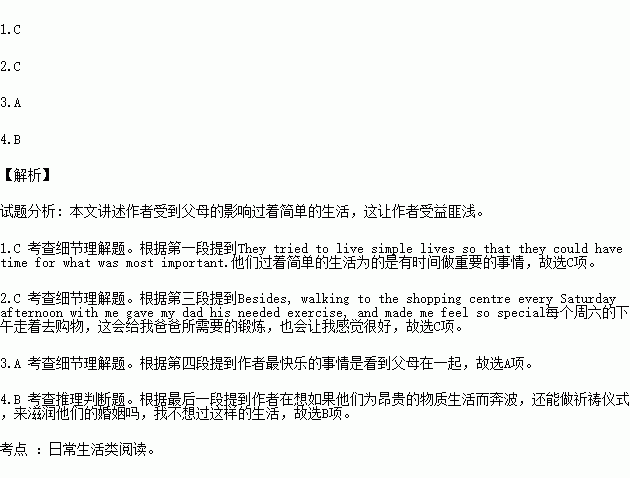
My parents knew their wealth: each other, their six children, and their faith. They tried to live simple lives so that they could have time for what was most important.

They didn’t busy themselves buying a bigger house, because that would mean working harder to pay the monthly mortgage(按揭贷款),working overtime or taking second job. Who would go running with me then? Who would read stories to me?

They didn’t burden themselves with buying an expensive car because that would mean worrying about installment(分期付款) bills. Besides, walking to the shopping centre every Saturday afternoon with me gave my dad his needed exercise, and made me feel so special.

One of my heart’s delights was seeing Dad and Mom in their bedroom at night, after our nightly family prayer. The lights were turned off, and I’d see the figure of my father seated on his old chair and Mom standing behind him, gently massaging(按摩) his shoulders. I’d hear them talk about what happened during their day. Even as a child, I sensed their quiet pleasure in being together.

My question today: Could they have done this rich ritual(仪式) each night and nourished(滋润) their marriage if they had been busy paying for expensive clothes for themselves or their kids, or if they had been worrying about monthly bills for new hi-tech equipment? I don’t think so. And I’ve made a choice: I don’t want that of life either.

1.Which of the following is TRUE about the author’s family?

A. There were six people in the family.

B. They decided to buy a bigger house.

C. They lived an easy and happy life.

D. They had a second-hand car.

2.What did the parents regularly do with the author?

A. They wrote stories together.

B. They read newspapers together.

C. They regularly took exercise together.

D. They went shopping together each day.

3. The author believed that his/her parents’ happiness was due to(由于, 归功于)

A. their attitude towards life

B. their love for each other

C. their common interests

D. their ability to communicate with each other

4. It can be inferred from the last paragraph that the author __________.

A. got bored with his/her parents’ way of educating kids

B. was influenced by his/her parents’ lifestyle

C. didn’t want to follow his/her parents’ advice

D. didn’t want to live the same life as his/her parents
练习册系列答案
相关题目

完形填空

阅读下面短文,从短文后各题所给的四个选项(A、B、C和D)中,选出可以填入空白处的最佳选项,并在答题卡上将该项涂黑。

In 1882 a baby girl caught a fever that was so serious that she nearly died. She_________ but the fever left its mark—she could no longer see and _________. Because she could not hear, she also found it very _________ to speak.

So how did this child, blinded and deafened at 19 months old, grow up to_________a world- famous author and public speaker?

The fever cut her _________ from the outside world, depriving(剥夺)her of sight and sound. It was _________she had been thrown into a dark prison room from which there could be no _________

Luckily Helen was not someone who _________easily. Soon she began to explore the world by using her other_________. She followed her mother wherever she went, _________onto her skirts. She touched and smelled everything she came across. She _________their actions and was soon able to do certain jobs herself, like milking the_________or kneading dough(揉面).She even learnt to___________ people by feeling their faces or their clothes. She could also _________where she was in the garden by the smell of the different plants and the_________of the ground under her feet.

By the age of 7 she had invented over 60 different_________by which she could talk to her family. If she wanted bread for example, she would pretend to _________a loaf and butter into slices. If she wanted ice cream, she _________her arms around herself and pretended to shake.

Helen was unusual in that she was extremely _________ and also very sensitive. By her own _________ she had managed to make some sense of an alien and confusing world. But even so she had limitations.

1.A.escaped B. succeeded C. finished D. survived

2.A.cry B. sleep C. hear D. read

3.A.difficult B. impossible C. able D. usual

4.A.explain B. become C. manage D. choose

5.A.down B. off C. in D. up

6.A.even if B. not only C. so that D. as if

7.A.increase B. release C.punishment D. praise

8.A.gave out B. picked up C. gave up D. turned up

9.A.senses B. plans C. projects D. dreams

10.A.falling B. hanging C. stepping D. rushing

11.A.copied B. stole C. expressed D. figured

12.A. chickens B. children C. cows D. birds

13.A.ask B. find C. lead D. recognize

14.A.remember B. tell C. forget D. improve

15.A. feel B. knowledge C. opinion D. sight

16.A. signals B. signs C. notes D. topics

17.A. order B. cook C. cut D. throw

18.A. reached B. packed C. dropped D. opened

19.A.generous B. kind C. intelligent D. honest

20.A.lives B. relationships C. effects D.efforts

When you travel in other countries, you'll have to get yourself well prepared to ensure your safety and handle emergencies.

Before you leave, you'd better:

1. Take out medical insurance policy and learn what the plan covers and whether departure or return to the hometown is covered. Figure out payment choices, such as whether you have to speak directly with the insurance company, before or after treatment, whether you have to pay first and get compensation later.

2. Keep up to date on all required vaccinations (接种疫苗) .

3. Learn about the city or area where you are going to travel. Know how to say street names and landmarks in the local language. Figure out unique climate issues such as altitude, seasonal changes, potentially risky animals and insects.

4. Visit some local hospitals and write down addresses in the local language along with emergency entrance locations; do the same for dental/pediatric (小儿科的) services. Get first aid equipment with necessary medications. Take enough prescribed medication from the home country.

5. Carry a card or note written in both English and the local language listing your emergency contact numbers, name, basic medical information such as blood type and allergies (过敏) .

6. Ensure a reliable means of communication is available and carry an extra phone battery and a charger. Ensure that housemaids, drivers, office assistants, those who work or travel know how to call for medical assistance since they may be the only ones available in an emergency.

7. Make sure to bring all documents and visas along with you. Plan your journey carefully and carry copies of documents (ID, insurance policy records, medical records) and keep in a place where someone else could access them in an emergency.

1.In case you come across an emergency, you should _________.

A. carry a card or note which is written in the local language only

B. make sure your means of communication is available and reliable

C. buy enough prescribed medication from the foreign country

D. buy a guide book which includes basic emergency instructions

2.According to the passage, the following are true EXCEPT that ________.

A. you should try to make a good study of medical insurance policy

B. you'd make sure someone will be able to help you in emergencies

C. you'd hide your copies of documents for safety in a place that no one can find

D. you should try to get familiar with the city or area that you will visit

3.The best title for the text is _________.

A. How to Prepare for a Safe Travel

B. Emergency Help at Home and Abroad

C. How to Know the Place You Will Visit

D. Keep Yourself Healthy When Traveling

违法和不良信息举报电话:027-86699610 举报邮箱:58377363@163.com

精英家教网