题目内容

假如你是李华,你的英国朋友John近期将来中国参加短期语言培训。食宿被安排在你市远大路的塔楼酒店。他来信询问酒店的相关信息,请你根据以下图示和信息给他写一封回信。要点如下:
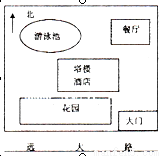
。※图示信息

※住宿费用;每人每天200元

※餐厅供餐时间:7:30a.m.一9:00 a.m.;

5:30p.m.-8:00 p.m.

注意:1.词数120左右;

2.开头已给出,不计人总词数;

3.语言通顺,行文连贯,可适当发挥。

Dear John ,

I'm very glad to hear that you will e to my city for short-term language training.

Looking forward to seeing you very soon.

_______________________________________________________________________________


Yours ,

Li Hua


DearJohn,

I’m very glad to hear that you will e to my city for short- term language training. In your letter, you asked me something about Tower Hotel. Now I’dlike to tell you some detailed information about it.

Tower Hotel is located on Yuanda Road. Go through the gate of the entrance, and you will see the high building---Tower Hotel, in front of which lies a beautiful garden. Behind the building is a swimming pool, where you can go swimming for relaxing. Near the swimming pool stands a dining hall, and there meals are served from 7:30a.m. to 9:00a.m. and between 5:30p.m. and 8:00 p.m.

Last but not least, as to acmodation fees, everyone should pay 200 yuan per day. Ifyou need further information, please enquire at the reception desk on the ground floor when you’ve arrived here.

Looking forward to seeing you very soon.

Yours,

【解析】考察看图作文与提纲类作文

【写作指导】

本文既要考生叙述图片中塔楼酒店的位置,也要根据文字提示说明培训具体情况。要使用第三人称和一般现在时。要点:1,塔楼酒店的位置;2. 住宿费用;每人每天200元;餐厅供餐时间:7:30a.m.一9:00 a.m.;5:30p.m.-8:00 p.m.

在完成图表作文时,首先要选择自己熟悉的短语或者句型,在你的能力范围之内,选择句式时要赋予变化,因为这样你才可以更好的驾驭。同时也要选择合适的连接词,把各个要点组织成一个完整的整体,

【一句多译】

穿过进口的门,你就会看见一栋高楼—塔楼酒店,在它的前面有一个美丽的花园。

①Go through the gate of the entrance, and you will see the high building---Tower Hotel, in front of which lies a beautiful garden.

②If You go through the gate of the entrance, you will see the high building---Tower Hotel, in front of which lies a beautiful garden.


练习册系列答案
相关题目

Caffeine not only gives us a daily jump start, but new research suggests it also can strengthen long-term memory.

According to the US Food and Drug Administration, nearly 90 percent of people worldwide consume about 200 milligrams of caffeine each day. That' s equivalent to about one strong cup of coffee a day. Writing in " Nature Neuroscience" , Johns Hopkins University researchers say their findings show that caffeine strengthens certain memories for up t0 24 hours after being taken in.

" We've always known that caffeine has cognitive-enhancing effects (促智效果) , but its ,particular effects on strengthening memories and making them resistant to forgetting has never been examined in detail in humans, " said senior author of the paper Michael Yassa. " We re- port for the first time a specific effect of caffeine on reducing forgetting over 24 hours. " Conducting a double-blind trial, the researchers worked with a test group of people who didn't regularly consume caffeinated products. Five minutes after studying a series of images, the test subjects were given either a placebo(无效对照剂) or a 200-milligram caffeine tablet.

To check the caffeine levels of their test subjects, the research team took saliva samples (唾液样品) from them before they took their tablets and again one, three and 24 hours after- wards.

Both groups of test participants ( those who took the placebo and those who took the caffeine tablet) were tested the following day to see if they could recognize the images they' d seen the previous day.

The test included showing the test subjects another series of images that included some new images , those that were shown the previous day, as well as other images that were similar, but not the same as those they had viewed earlier.

The researchers found that more members of the group who were given the caffeine tablets were able to correctly identify some of the new images as " similar" to previously viewed images rather than incorrectly identifying them as the same.

"We also know that caffeine is associated with health and longevity(长寿) and may havesome protective effects from cognitive decline like Alzheimer' s disease (阿尔茨海默症). " said Yassa.

1.The purpose of the new research is

A. to survey how much caffeine people consume a day

B. to write the paper " Nature Neuroscience"

C. to prove caffeine has cognitive-enhancing effects

D. to examine caffeine ' s memory-strengthening effects in detail

2. During the research ,the researchers did the following things EXCEPT

A. giving the test subjects placebos or caffeine tablets

B. checking the caffeine levels of the test subjects

C. encouraging the test subjects to drink more coffee

D. showing the test subjects series of images

3. How did the test subjects show the caffeine ' s memory-strengthening effects?

A. By recognizing images they ' d seen the previous day.

B. By taking the caffeine tablets instead of placebos.

C. By identifying the new images as the same.

D. By telling the differences between new images.

4. What will the next part of the text possibly talk about?

A. Ways to achieve health and longevity. B. The effects caffeine has on health.

.C. The treatment for Alzheimer' s disease. D. The harmful effects of cognitive decline.


When I decided to quit my job as a wedding photographer, I was in my late twenties, fresh from my divorce from Bob who had left me empty and confused. I decided to leave the US and travel. I had no savings, plus more than $5,000 in debt. What I did have were two sponsored tasks as a travel photographer- and with that along, I thought, it would be easy.

My first experience was a road trip from Toronto to Las Vegas, paid for by a car delivery service. Other trips followed and then I started a travel blog (博客). It was intended to be my calling card for assignment travel photography. Yet even with my blog and past experience, email after email I sent to publications, trying to get work, went unanswered. When they did get in touch, editors told me that I had no chance of making a career with travel photography. While I struggled to get on the path that I wanted, and as I expanded my blog to help get me there, I found myself wearing the hat of a full-time blogger.

Luckily, I got in at the right time. It was 2010,and the travel industry was just starting to turn its attention to bloggers. As I never could have predicted, my blogging-not my photography-did take me around the world successfully. At first,I thought it was for personal reasons, but I realized later that it was for free marketing for my blogging.

Within two years, I was being asked to speak at travel blogging conferences, which helped me to raise a network of friends around the world. Even more meaningful, however, was when I saw that my travels were also helping other people. My blog and social media followers saw that I chased my dreams and told me over and over again how they needed that kind of example, which was absent in their lives elsewhere.

1.After the author quit her job, she decided to ______.

A. divorce her husbandB. be a wedding photographer

C. pay off all her debtD. go travelling abroad

2. What can we learn about the author from the 2nd paragraph?

A. She paid money to a car delivery agency for a road trip.

B. She realised his dream of becoming a travel photographer.

C. She got a job as an editor in a publishing house.

D. She finally became a professional blogger unintentionally.

3.The author believed her success mainly resulted from ______.

A. her personal reasonsB. her photographing skills

C. free marketing for bloggingD. booming of travel industry

4. What did the author think of her two years' work?

A. Inspiring. B. Appealing. C. Interesting. D. Challenging.


Shirley Temple, who died on February 10, 2014, was that rare example of a Hollywood child star who, when the cameras stopped rolling, carved out a new career.

For four years, she was Hollywood’s biggest box-office star representing the kind of sweet, innocent girl that everyone wanted as their daughter. However, years later, she reappeared as a successful politician.

Shirley Temple was born in Santa Monica, California on 23 April 1928. Encouraged by her mother, she learned to dance while she was just three.

In 1934, Stand Up and Cheer became her first film and the film was a great success. At the age of six she was earning $1,250 a week — more than $21,000 at today’s values.

Across the world, audiences flocked to see her in films such as Little Miss Marker, The Little Colonel and The Littlest Rebel.

In 1935 she was awarded a special Oscar (Academy Award) and her foot and hand prints were added to those of stars such as Jean Harlow and Mary Pickford outside Grauman’s Chinese theatre in Hollywood. The peak of her film career came in 1939 when The Little Princess became a box-office success.

Temple starred in a total of 43 feature films. But she found it difficult to maintain her film career in adulthood and retired from Hollywood in 1950.

She disappeared from the spotlight for nearly 20 years. She returned to the public eye in 1967, as a Republican candidate for Congress. When Nixon became president, he rewarded her with an appointment to the American delegation to the United Nations. Then, in 1974, President Ford appointed her the United States Ambassador(大使) to Ghana. George Bush Snr, appointed her Ambassador to Czechoslovakia.

Shirley Temple drew a line between her childhood stardom and her later political career. “Some people are stuck on this image of the little girl,” she once said. “She is not me. We shouldn’t live in the past; my life is now.” Nevertheless, for many across the world, the name Shirley Temple always called to mind a superstar child.

1.Shirley Temple died at the age of _____.

A. 75 B. 80 C. 86 D. 90

2. What happened to Shirley Temple when she was 7 years old?

A. She won a special Oscar. B. She began to learn to dance.

C. She appeared in her first film. D. She retired from Hollywood.

3. Which of the following represents the peak of Shirley Temple’s film career?

A. Stand Up and Cheer. B. Little Miss Marker.

C. The Little Colonel. D. The Little Princess.

4. We can infer that _____.

A. the films in which Shirley Temple starred in adulthood were not popular

B. Jean Harlow and Mary Pickford appeared in the same film with Temple

C. Shirley Temple succeeded in being elected as Congresswoman in 1967

D. Shirley Temple was the youngest person to receive an Academy Award


违法和不良信息举报电话:027-86699610 举报邮箱:58377363@163.com

精英家教网