题目内容

When international aid is given, steps must be taken to ensure (确保)that the aid reaches the people for whom it is intended. The way to achieve this may not be simple. It is very difficult for a nation to give help directly to people in another nation. The United Nations Organization (UNO) could undertake to direct the distribution of aid. Here however rises the problem of costs. Also tied with this is time. Perhaps the UNO could set up a body of devoted men and women in every country who can speedily distribute aid to victims of floods and earthquakes.

More than the help that one nation can give to another during a disaster; it would be more effective to give other forms of help during normal times. A common proverb says, “Give me a fish and I eat for day, teach me to fish and I eat for a lifetime.” If we follow this wise saying, it would be right to teach people from less developed nations to take care of themselves. For example, a country could share its technology with another. This could be in simple areas like agriculture or in more complex areas like medical and health care or even in building satellites. Even small country is able to help less developed nations. Sometimes what is take for granted, like the setting up of a water purification plant or the administration of a school, could be useful for countries which are looking about to solve common problems. It does not cost much to share such simple things. Exchange students could be attached for a number of months or years and learn the required craft while on the site. They can then take their knowledge back to their homelands and if necessary come back form time to time to clear doubts or to update themselves. Such aid will be truly helpful and there is no chance of it being temporary or of it falling into the wrong hands.

Many countries run extensive courses in all sorts of skills. It will not cost much to include deserving foreigners in these courses. Besides giving effective help to the countries concerned, there is also the build-up of friendships to consider. Giving direct help by giving materials may be effective in the short run and must continue to be given in the event of emergencies. However, in the long run what is really effective would be the sharing of knowledge.

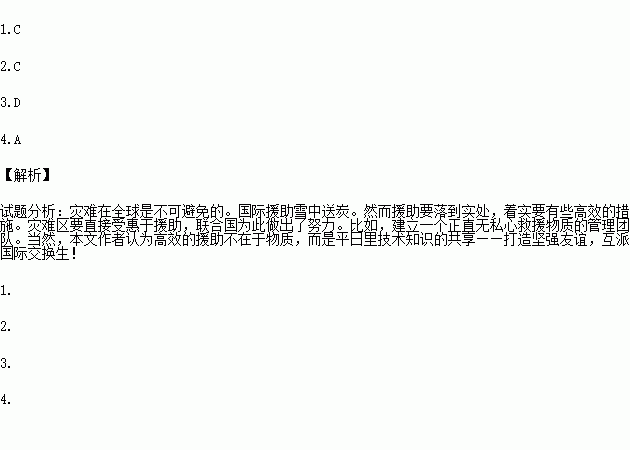
1.According to the author, how could international aid reach the victims in time?

A. By solving the cost problems

B. By solving the transportation problems

C. By setting up a body of devoted people in every country.

D. By relying on the direct distribution of the UNO.

2.What does the author try to express in the underlined sentence?

A.Providing food is vital

B.Learning to fish is helpful

C.Teaching skills is essential

D.Looking after others is important.

3.Which aid is likely to fall into the wrong hands?

A.A medical team.B.An exchange program.

C.A water plant.D.Financial support.

4.What can we infer about international aid from the passage?

A.It is facing difficulties

B.It is unnecessary during normal times

C.It should be given in the form of materials

D.It has gained support developed countries
练习册系列答案
相关题目

Some educators told us that more years of school could help students get higher scores on intelligence tests. That was a finding of a study of teenage males in some countries. Now, another research shows that physical activity may help students do better in their classes.

The research comes as educators in some countries are reducing time for activities like physical education. They are using the time instead for academic(学术的)subjects like math and reading. The studies appeared between 2008 and 2014. They included more than 55, 000 children, aged 6 to 18.

Amika Singh:“ According to the results of our study, we can conclude that being physically active is beneficial for academic performance. There are, first, Physiological explanations, like more blood flow, and so more oxygen to the brain. Being physically active means there are more hormones(荷尔蒙)produced like endorphins(内啡肽). And endorphins make your stress level lower and your mood improved, which means you also perform better.”

Also, students taking part in organized sports learn rules and how to follow them. This could improve their classroom behavior and help them keep their mind on their work.

The study leaves some questions unanswered, however. Ms. Stash says it is not possible to say whether the amount or kind of activity affected the level of academic improvement. This is because of differences among the studies.

The researchers said they found only two high-quality studies. They needed more high-quality studies to confirm (证实) their findings. They also pointed out that “results for other parts of the world may be quite different.”

Still,the general finding was that physically active kids are more likely to do better in school. Ms. Singh says schools should consider that finding before they cut physical education programs. Her paper on “Physical Activity and Performance at School” is published in the Archives of Pediatric and Adolescent Medicine.

1.The passage mainly tells us that ________.

A. a research on physical education has been done by the researchers

B. there is a possibility that physical activity leads to higher grades

C. the amount or kind of activity directly affects academic level

D. the research shows that the children aged 6 to 18 don't do sports

2.Which of the following is TRUE?

A. Being mentally active is good for academic subjects.

B. The more hormones you have, the more stressed you will get.

C. The researchers have found many high-quality studies to prove the research.

D. The educators in some countries think studies, not exercise, mean much to students.

3.The underlined sentence in Paragraph 6 probably means ________.

A. good marks result from high-quality study.

B. findings are probably different in different areas.

C. physical activity will spread all over the world.

D. academic performance depends on the surroundings.

4.What's the purpose of writing the passage?

A. To call our attention to the sports at school.

B. To introduce all types of physical activities.

C. To represent the academic performance.

D. To improve students’ health.

根据短文内容,从短文后的选项中选出能填入空白处的最佳选项。

It is important to introduce yourself in a creative, memorable way to distinguish yourself from the crowd. 1. . Since being witty(言辞诙谐的) doesn’t always come easily, try one of these creative introductions and separate yourself from the rest.

Write your first or last name on a piece of paper. 2. . So if your name is Tom, you might say you are tireless, optimistic and mild.

3. . Then say that you will do so in the words of your“best and worst critic”— your mother. By breaking the ice in this way, you can go on in either a humorous or serious fashion.

Introduce yourself silently, by drawing a picture of yourself on a large sheet of paper. 4. . In fact, in some situations, it may be better if you don’t. Put a title at the top of your drawing, if you like, such as “Hello! This is me.”

Turn the traditional introduction upside down by describing yourself in exactly opposite terms of who you are. Have fun with this“back door approach”, and keep people guessing just how much you are exaggerating(夸张). 5. . Don’t bother calling me tomorrow, because I will be hiding in a closet. Send text messages to my girlfriend while I drink a Bud Light on the job.

A. This introduction requires you to be gifted in art.

B. Freely admit that you don’t like talking about yourself.

C. It doesn’t matter whether you have artistic abilities or not.

D. For example: I am probaby the laziest person you will ever meet.

E. Use each letter as the first letter in an adjective that describes you.

F. Bring in the surprise factor— sometimes known as the shock factor.

G. After all, anybody can stand up and announce their name, business title and job responsibilities.

“Let’s have a journey. Why not fly out and meet me, Dad?” I say one day.

My father had just retired after 27 years as a manager for IBM. His job filled his day, his thoughts, and his life. While he woke up and took a warm shower, I screamed under a freezing waterfall in Peru. While he tied a tie and put on the same Swiss watch, I rowed a boat across Lake of the Ozarks.

My father sees me drifting aimlessly, nothing to show for my 33 years but a passport full of funny stamps. He wants me to settle down, but now I want him to find an adventure.

He agrees to travel with me through the national parks. We meet four weeks later in Rapid City.

“What's our first stop?” asks my father.

“What time is it?”

“Still don't have a watch?”

Less than an hour away is Mount Rushmore. As he stares up at the four Presidents carved in granite(花岗岩), his mouth and eyes open slowly, like those of a little boy.

“Unbelievable,” he says. “How was this done?”

A film in the information center shows sculptor Gutzon Borglum devoted 14 years to the sculpture and then left the final touches to his son.

We stare up and I ask myself, “Would I ever devote my life to anything?”

No directions, no goals. I always used to hear those words in my father's voice. Now I hear them in my own.

The next day we’re at Yellowstone National Park, where we have a picnic.

“Did you ever travel with your dad?” I ask.

“Only once,” he says. “I never spoke much with my father. We loved each other — but never said it. Whatever he could give me, he gave.”

That last sentence — it’s probably the same thing I’d say about my father. And what I’d want my child to say about me.

In Glacier National Park, my father says, “I've never seen water so blue.” I have, in several places of the world. I can keep traveling, I realize — and maybe a regular job won't be as dull as I feared.

Weeks after our trip, I call my father.

“The photos from the trip are wonderful,” he says. “We've got to take another trip like that sometime.”

I tell him I've decided to settle down, and I'm wearing a watch.

1.We can learn from Paragraphs 2 and 3 that the father _____.

A. was a very fashionable manager

B. was unhappy with the author's lifestyle

C. got bored with his job so he retired

D. liked the author's collection of stamps

2.What does the author realize at Mount Rushmore?

A. He should pursue a specific aim in life.

B. He should learn sculpture in the future.

C. His father is as innocent as a little boy.

D. His father is interested in sculpture.

3.From the underlined paragraph, we can see that the author _____.

A. wants his children to learn from their grandfather

B. hopes to give whatever he can to his father

C. learns how to communicate with his father

D. comes to understand what parental love means

4.What could be inferred about the author and his father from the end of the story?

A. They decide to learn photography together.

B. They begin to change their attitudes to life.

C. The call solves their disagreements.

D. The Swiss watch has drawn them closer.

First Lady Michelle Obama is a big fan of volunteering. Volunteering means working for free to help someone else. Mrs. Obama says volunteering is very important. “It should be part of everyone’s life,” she says.

Many teens agree. They say that helping others feels great and makes a difference. These days, more teens volunteer than work for pay. Teens clean up parks, walk dogs at animal shelters, visit the elderly and more.

Some cities ---- including Seattle, Chicago, and Washington, D.C. ----require high school students to volunteer. Students must volunteer in order to graduate. The student volunteers learn new skills and help their communities.

Many parents are in favor of the idea ---- they say volunteering helps teens build job skills. But most teens don’t want to be forced to volunteer. They say they are busy. And they say volunteering is only fun if it’s a choice.

Read both sides of the debate and decide.

YES

Volunteering can help teens get into college or get a job.

Many cities and towns need help. Volunteers can help keep important programs going.

Not all teens will volunteer if it isn’ t required. Schools should require students to do all they can to get ready for adult life.

NO

Most teens are already very busy with classes, homework, jobs and sports. Forcing them to do more isn’t fair.

It should be up to each person. Helping out doesn’t feel as good if you have to do it.

Finding a volunteer job isn’t always easy. Students shouldn’t be kept from graduating because of something they can’t control.

1.The writer mentions Michelle Obama in order to___________.

A. introduce the topic of the text

B. explain what volunteering is

C. tell what she does for the US

D. show she enjoys volunteering

2.According to the text, in Chicago, .

A. finding a volunteer job is quite easy

B. more people would rather work for pay

C. volunteering is a must for high school students

D. college students have to volunteer before graduation

3.The underlined part “are in favor of” in the text means”.

A. dropB. developC. catchD. like

4.Which question does the text mainly discuss?

A. Is volunteering good for students?

B. Should students be required to volunteer?

C. What is the best time to volunteer?

D. Which volunteer jobs should students do?

违法和不良信息举报电话:027-86699610 举报邮箱:58377363@163.com

精英家教网
