题目内容

文中共有10处语言错误,每句中最多有两处,每处错误仅涉及一个单词的增加、删除或修改。

增加:在缺词处加一个漏字符号(∧),并在其下面写出该加的词。

删除:把多余的词用斜线(\)划掉。

修改:在错的词下划一横线,并在该词下面写出修改后的词。

注意:1.每处错误及其修改均限一词。

2.只允许修改10处,多者(从第11处起)不计分

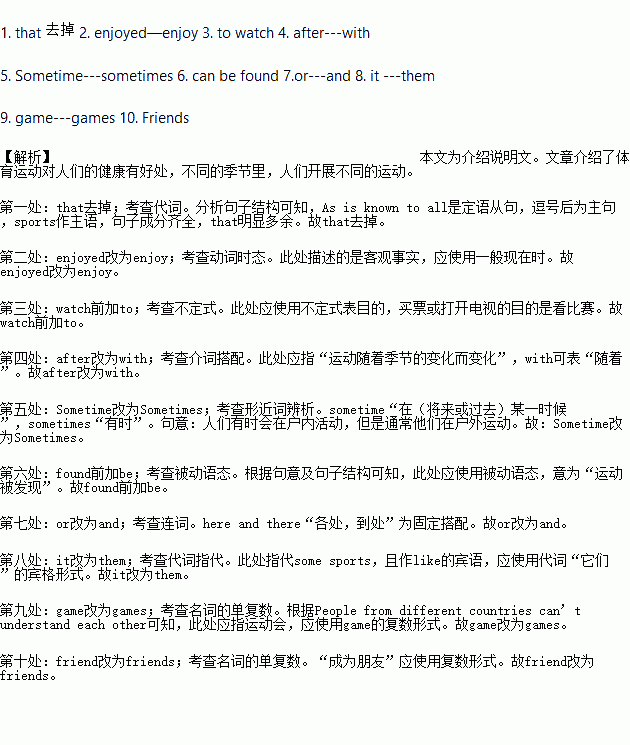
As is known to all, that sports are good for people’s health. People all over the world enjoyed sports. They buy tickets or turn on their TV sets watch the games. Sports change after seasons. People play different games in different seasons. Sometime they play inside, but usually they play outside. Sports can found here or there. Some sports are rather interesting and people everywhere like it. People from different countries can’t understand each other, but after game they often become good friend.
练习册系列答案
相关题目

Festival of Light, Longleat Safari Park, Wiltshire

Longleat is celebrating its 50th anniversary this year. Giant lanterns take the shape of some of the park’s animals, and there are also lots of characters in Beatrix Potter’s book, such as Peter Rabbit, Jemima Puddle-Duck, Squirrel Nutkin, to mark the 150th anniversary of the author’s birth. There is also a 20-metre-high birthday cake.

•£ 27.85, adult/£ 20.65, child/under-threes, free.

•15 Dec. to 2 Jan.

Festival of Light, Enchanted Park, Gateshead

Enchanted Park is an interactive walk through Saltwell Park, just south of the town centre, along a trail (小径) of light with performances and sculptures. The story being told is a Midwinter Night’s Tale, inspired by the 400th anniversary of William Shakespeare’s death. Visitors can join stories and songs with Santa, and attend decorating workshops.

•£ 8, adult/£ 2, child/under-fours, free.

•11 ~27 Dec.

Christmas Glow, RHS Wisley, Surrey

The garden is glowing with giant lighted flowers. Some of the trees are brilliant, too. The glasshouse is decorated like a gingerbread house, and displays (陈列) seasonal plants. There are lanterns around the lake. The cafe serves hot chocolate and apple juice.

•£ 9.90, adult/£ 3.60, child.

•20 Dec. to 2 Jan.

Christmas at Kew Gardens, London

Kew is a special place to visit at any time of the day or year, but the festive light show gives it a magical twist, as the mile-long trail through the garden is decorated with 60,000 lights. Some of the garden’s oldest and tallest trees are also beautifully lit along the way.

•£ 16, adult/£ 10, child/£ 48, family/under-fours, free.

•24 Dec. to 2 Jan.

1.What can people do in Enchanted Park?

A. Visit Shakespeare’s house. B. Listen to stories.

C. Leapt to create sculptures. D. Play the part of Santa.

2.Which place will attract children fond of fictional animal characters?

A. Kew Gardens. B. RHS Wisley. C. Enchanted Park. D. Longleat Safari Park.

3.How much is the admission to Kew Gardens for Mr. Green and his 3-year-old child?

A. £ 16. B. £ 10. C. £ 26. D. £ 48.

4.What do the parks mentioned in the text have in common?

A. Their open times are the same. B. They serve free cakes to children.

C. They are full of Christmas atmosphere. D. They are free for children under four.

February 14th is Valentine’s Day! In China, it is only a day for young boyfriends and girlfriends. But my teacher and friends in America told me that Valentine’s Day is a public day.

This was my first Valentine’s Day in America. I didn’t understand the customs(风俗) clearly. Maybe I didn’t need to send any gifts. I watched others to see what they did, so next time I can understand.

On that day, when we began the reading class, Mr. Peters gave every student some chocolates and said, “Happy Valentine’s Day!” I was very happy the teacher gave his students gifts and blessings. I never saw that in China. Maybe American teachers are very different. I didn’t buy a gift for the teacher, so I owed(欠) a gift to the teacher. Anyway, I want to say, ”Thank you, Mr. Peters, and I’m sorry.”

When we had a break, one of my classmates gave me a Pokemon card. It was very funny and I felt thankful, but I thought I owed a gift again.

When we were coming to our grammar class, suddenly I heard someone calling me. ”Shelly!” I stopped. Another classmate who had only been in our class one day gave me some chocolates. She said, “These are for you and your friends. Have a good day!” I was looking at her leaving and thinking that we were in the same class only one day, but now we are friends. That’s very great, but I owed a gift again.

When I came home, my Chinese friend sent some roses and chocolates. I was surprised and happy because I had never received roses in my past life, but I hoped it was the last gift. I didn’t want to owe more gifts.

1.Before the writer left China, she thought Valentine’s Day _______.

A. was a day for the young

B. was different in America

C. was a festival for all the people

D. was a holiday for the students

2.By saying “I never saw that in China,” the writer would like to tell us that in China _________.

A. the students gave gifts to the teachers

B. the teachers didn’t like the students at all

C. the students never received any gifts and blessings

D. the teachers wouldn’t give their students any gifts

3.The writer felt sorry probably because she ________.

A. made a mistake in class

B. didn’t like chocolate

C. had no gift for Mr. Peters in return

D. had no money to buy gifts

4.What was the first gift the writerreceived from his classmates?

A. A toy. B. A card. C. Some chocolates. D. Some roses.

Passenger pigeons (旅鸽)once flew over much of the United States in unbelievable numbers.

Written accounts from the 18th and 19th centuries described flocks (群)so large that they darkened the sky for hours.

It was calculated that when its population reached its highest point ,there were more than 3 billlion passenger pigeons—a number equal to 24 to 40 percent of the total bird population in the United States, making it perhaps the most abundant bird in the world. Even as late as 1870 when their numbers had already become smaller, a flock believed to be 1 mile wide and 320 miles (about 515 kilometers) long was seen near Cincinnati.

Sadly the abundance of passenger pigeons may have been their undoing. Where the birds were

most abundant, people believed there was an ever-lasting supply and killed them by the thousands.

Commercial hunters attracted them to small clearings with grain, waited until pigeons had settled to feed, then threw large nets over them, taking hundreds at a time. The birds were shipped to large cities and sold in restaurants.

By the closing decades of the 19th century ,the hardwood forests where passenger pigeons nested had been damaged by American’s need for wood, which scattered (驱散) the flocks and forced the birds to go farther north, where cold temperatures and storms contributed to their decline. Soon the great flocks were gone, never to be seen again.

In 1897, the state of Michigan passed a law prohibiting the killing of passenger pigeons but by then,

no sizable flocks had been seen in the state for 10 years. The last confirmed wild pigeon in the United

States was shot by a boy in Pike County, Ohio, in 1900. For a time , a few birds survived under human

care. The last of them, known affectionately as Martha, died at the Cincinnati Zoological Garden on

September 1, 1914.

1.In the 18th and early 19teh centuries, passenger pigeons____.

A. were the biggest bird in the world

B. lived mainly in the south of America

C. did great harm to the natural environment

D. were the largest bird population in the US

2.The underlined word “ undoing” probably refers to the pigeons’ ____.

A. escape B. ruin

C. liberation D. evolution

3.What was the main reason for people to kill passenger pigeons?

A. To seek pleasure. B. To save other birds.

C. To make money. D. To protect crops.

4.What can we infer about the law passed in Michigan?

A. It was ignored by the public. B. It was declared too late.

C. It was unfair. D. It was strict.

I was riding along the road when I heard someone shouting behind me. It was a young shepherd (牧羊人). He was running across a field, and pointing at something.

I looked and saw two wolves running across the field. One was fully grown, the other was a cub. The cub had on his back a lamb (羔羊) which had just been killed, and he had the leg in his mouth. The old wolf was running behind.

As soon as I saw the wolves, I joined the shepherd and started in pursuit (追击), setting up a shout.

When they heard, some peasants started out also in pursuit, with their dogs.

As soon as the old wolf caught sight of the dogs and the men, he ran to the young one, snatched (攫取) the lamb from him, threw it over his back, and both wolves increased their pace and were soon lost from view.

Then the shepherd began to tell me how it happened. The big wolf has sprung (跳跃) out from the valley, seized the lamb, killed it and carried it off. The old wolf allowed the young wolf to carry the lamb, but kept running a short distance behind.

But as soon as there was danger, the old wolf stopped giving the lesson, and seized the lamb himself.

1.What is a cub?

A. It’s an old wolf.

B. It’s a young wolf.

C. It’s a strong wolf.

D. It’s a big wolf.

2.The old wolf seized the lamb for himself because __________.

A. the cub would not carry it any longer

B. the cub was too tired

C. there was danger

D. the cub would not learn

3.What is the passage about?

A. How a young wolf carried a lamb.

B. How the wolves escaped.

C. How some peasants tried to catch the wolf.

D. How an old wolf taught its cub..

违法和不良信息举报电话:027-86699610 举报邮箱:58377363@163.com

精英家教网