题目内容
【题目】假定英语课上老师要求同桌之间交换修改作文,请你修改你同桌写的以下短文。短文中共有10处错误,每句中最多有两处。错误涉及一个单词的增加、删除或修改。
增加:在缺词处加一个漏字符号(∧),并在此符号下面写出该加的词。
删除:把多余的词用斜线(\)划掉。
修改:在错的词下划一横线,并在该词下面写出修改后的词。
注意:①每处错误及其修改均仅限一词;
②只允许修改10处,多者(从第11处起)不计分。
Dear Mr. Yang,
I am writing to let you know that I needed your help with my English writhing. Which is known to all, grammar plays a very vital part in the writing. But I feel that I have some problems of my grammar. I am afraid that I am not able to identify my specifically errors. I would be grateful if you could point out and correct your mistakes. What is more, I used to the Chinese way of thinking, which stops me organize my writing in a proper way. I am wondering that you could also help me improve the structures of my writing.
I am looking forward to making great progresses under your instruction. Thanks are extended to you in advance!
Yours sincerely,
Li Hua
【答案】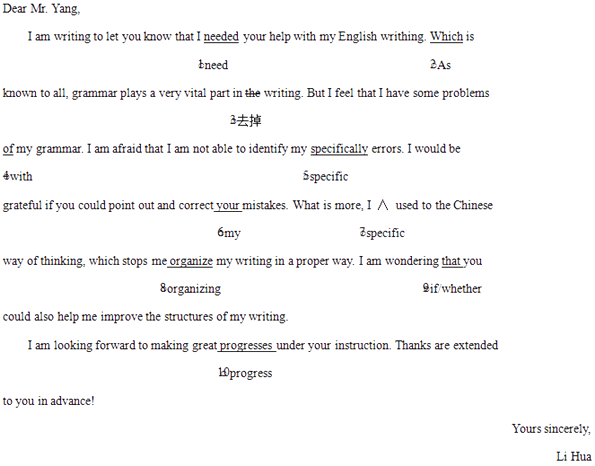
【解析】本文是一篇书信,主要讲述了学生李华由于英文写作能力不好,给杨老师写信希望能得到老师的指导,帮助自己提高语法、构建写作的思维框架。
(1)考查动词时态。“I am writing to let you know that I needed your help”,根据前句的 am writing为现在进行时,可知此句的时态应该确定为一般现在时,而后句的needed为过去时,与前句时态不符。故将needed改为need。
(2)考查固定句式。“Which is known to all”,as is known to all/us 众所周知,为固定句式,故将which改为as。
(3)考查冠词。“grammar plays a very vital part in the writing”,此处的写作指的是写作这一类型,表示的是泛指,并不是特指某一写作,故将the删掉。
(4)考查介词。“I have some problems of my grammar”,have problem with… 在…有问题。故将of改为with。
(5)考查形容词。“I am not able to identify my specifically errors”,分析句子结构,errors为名词,前面应该用形容词修饰名词,故将specifically改为specific。
(6)考查物主代词。“I would be grateful if you could point out and correct your mistakes”,correct与 point out都是由前句的主语you发出的,宾语是mistakes,结合本文是老师对我进行指导。故将your改为my。
(7)考查形容词。“I used to the Chinese way of thinking”中西方文化存在差异,在语言的表述上也是,按照西方习惯,此句应该是,我特定的习惯于中国人的思维方式。故添加specific。
(8)考查动词。“stops me organize my writing in a proper way”,stop sb doing sth. 让某人停止做某事,为固定句式,故将organize改为organizing。
(9)考查连接词。“I am wondering that you could also help me improve the structures of my writing”,根据作者的思路,此句应该是在征求对方的意见,故将that改为if或whether。
(10)考查名词。“ making great progresses”,progress作为名词进步时,为不可数名词,故将progresses改为progress。

 海淀课时新作业金榜卷系列答案
 期末金牌卷系列答案
 轻松课堂标准练系列答案
【题目】
When you throw something in the trash, soon a garbage truck will come to take it away. Then where does it go? That depends on where you live. Different towns deal with trash in different ways. | |
Recycling A recycling truck picks up paper, cardboard, metal, plastic and glass. These go to the recycling plant to be sorted and made into new things. |
|
Incinerator An incinerator is a huge stove that burns trash to make heat and electricity. The ash that’s left gets buried in a landfill. Trash ash can be poisonous, so it has to be stored carefully. But is takes up a lot less room than just plain trash. |
|
Compost Food waste might go to a composter. In a compost heap (堆肥堆), bacteria and worms break down dead plants and old food. They turn it in into good, rich oil. Some people keep compost heaps in their gardens. Big commercial composters handle waste from restaurants and farms. |
|
Landfills Some trash gets buried in landfills. A landfill starts as a big hole. Trucks dump trash. Big earth movers push it into place and crush it down. They cover the trash with dirt to keep scavengers (食腐动物) away. The bottom of a landfills is lined with a barrier to keep bad things from leaking into the ground. Pipes drain away liquid. When the landfill is full, it’s covered with earth. It might become a park or lawn. |
|


【1】What can we learn from the passage?
A.Recycling helps to generate energy.
B.Bacteria and worms helps handle food waste.
C.The landfill is used to drive scavengers away.
D.Trash ash is carefully handled to save room.
【2】What’s the purpose of the passage?
A.To inform us of trash treatment.
B.To appeal for trash classification.
C.To discuss solutions to trash pollution.
D.To raise awareness of the harm of trash.