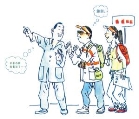
A group of fifteen-year-olds at a middle school in a town are holding a charity (慈善) sale to raise money to their classmate Li Xia. Li Xia had cerebral palsy (大脑性瘫痪)when she was a baby. Li Xia has to use a wheelchair (轮椅) to help her get around, she never . And she is always ready to help others.

Many parents have known it from their children and the news has been spread (传播). Some kind people give her a(n) and Li Xia’s classmates decided to raise money to show their love for her.

“Li Xia has the of standing up, but she needs an operation (手术)which will cost lots of money.” Li Xia’s doctor said.

“I thought that I could stand up one day. Actually the is surprising for me. However, when I see my parents are worried about the cost of the operation, I am sad. I am used to my life. I don’t even if I can’t stand up,” Li Xia said, “Now my classmates and some other kind people are helping me. I am really thankful. If I stood up one day, I would try my best to help more people.”

“While helping Li Xia, we can also learn a lot. We have learned to cook cookies and how to them,” Ma Fang, one of Li Xia’s classmates said. “Now we know making money is not easy, so we won’t money anymore.”

Zhang Tong, a boy in Li Xia’s class, told a reporter that they could raise about 100 yuan every day. “We have raised about 2,100 yuan so far. We hope we will raise more money for Li Xia’s operation,” said he.

Li Xia is very thankful. And she is very because so many people are helping her.

1.A. help B. thank C. encourage D. see

2.A. Since B. Because C. When D. Although

3.A. gets down B. shows off C. gives up D. has fun

4.A. gift B. hand C. smile D. idea

5.A. confidenceB. chance C. trouble D. skill

6.A. never B. often C. really D. nearly

7.A. dream B. hope C. help D. news

8.A. forget B. believe C. mind D. doubt

9.A. where B. why C. when D. how

10.A. sell B. share C. keep D. enjoy

11.A. receive B. spend C. waste D. make

12.A. kind B. excited C. brave D. lucky


Rose sat behind Kate in the classroom. They got on well with each other. But one day, Rose didn’t see her school IC card at lunch time. She asked her classmates and looked for it everywhere. But she couldn’t find it. Later, one girl said that she saw Kate take a card from Rose’s desk. Hearing this, Rose got very angry.

When she met Kate in the afternoon, Rose shouted, “You have stolen my card!” Hearing this, Kate began to cry, “No, no, I didn’t steal it! I only took it by mistake.” But Rose didn’t think so and she began to say bad words to Kate.

Just then a teacher came up and asked what had happened. Kate told the whole story. She said a middle school classmate of hers came to see her in the morning. She was so excited that she took the card on the desk and rushed out. Then they went for lunch happily. “I used the card, but I had thought it was mine. I didn’t know it was Rose’s until she looked for it. I was too afraid to explain it to her. So I decided to put the card back with some money secretly. I am sorry, Rose.” Kate said in a low voice.

“It’s just a misunderstanding (误会)!” said the teacher. Tears came into Rose’s eyes. Then she said, “I was very sorry, Kate! I hope we are still good friends.” Kate smiled when she heard the words. Hand in hand, they walked toward the classroom building.

1.Rose was very ____ when she heard someone took her IC card away.

A. quiet B. sorry C. excited D. angry

2.Kate didn’t find her mistake until ____.

A. she finished lunch B. Rose looked for the card

C. one girl told her D. the teacher asked her

3.From the end of the story, we can learn that Rose and Kate would ____.

A. be good friends again B. say sorry to the teacher

C. go on fighting laterD. explain more to each other


Knowing how to ask for information and help politely is important. In English, “Where are the restrooms?” and “Could you please tell me where the restrooms are?” are similar requests (请求) — both are correct English, but the first could sound rude. It’s important to use correct language, but sometimes this alone is not enough — we need to learn how to be polite when we make requests.

In English, just like in Chinese, we change the way we speak when talking with different people. The expressions you use might depend on whom you are speaking to or how well you know them. If you say to your teacher, “Where is my book?” this will sound rude. But if you say, “Excuse me, Mr West. Do you know where my book is?” your question will sound much more polite. On the other hand, it might be alright to say “Where is my book?” to the people you know well.

And you would not usually say, “Peter, lend me your pen.” A very direct order like this can sound rude in English. Usually in English polite questions are longer and include extra (附加的) language, such as “Could you please...?” or “Can I ask...?” It sounds more polite to say, “Peter, could you please lend me your pen?” If you stop a stranger in the street, we might first say, “Excuse me. I wonder if you can help me.” or “I’m sorry to trouble you but…” before asking him for help.

It might seem that speaking politely is more difficult than being direct, and in a way this may be true.

1.When we make requests, we need to speak in a ____ way.

A. polite B. careful C. different D. direct

2.You should say “____” when you ask a stranger for a way.

A. Which is the way to the zoo?

B. How can I get to the zoo?

C. Do you know the way to the zoo?

D. Excuse me. Can you tell me the way to the zoo?

3.Which of the following is true according to the passage?

A. We should use long sentences when we ask for information and help.

B. When we ask for help from others, polite language must be used.

C. The way of speaking is important when we ask different people for help.

D. In English, polite questions are as neccessary as rude and direct ones.


The best tool you can use in communicating with parents is to keep talking to them, no matter what. Strong relationship (关系) depend heavily on keeping the lines of communication open. Try to talk about everyday things with your parents. That doesn’t mean telling them everything. In fact, turn the focus onto them for a change: Ask about their day just as they do with you.

David, 16, is a senior school student. One evening, after he mentioned at dinner that he was thinking of trying out for the school play, his mom kept asking about it for weeks. And later, it also felt like she was getting too involved (参与) in something he wanted to do himself. Instead of telling his mom how he felt, David decided it would be easier not to tell her anything he was doing in the future.

A good way to get a parent to ask fewer questions is to offer some information on your own. This puts the communication in your hands. The more you keep a parent told about everyday things, the less they need to ask. Communicating everyday things has another advantage: It can show your parents that you’re responsible enough to make good decisions.

It won’t always be easy. You may get frustrated (受挫) at times. But try not to give up. It may take a bit for a parent who is used to making all the decisions to adjust (适合) to the independent-thinking person their child is becoming. Parents also don’t want to see their sons and daughters suffer (受苦) if the choices they make on their own aren’t the “right” ones. To many parents, it seems easier to step in and take control simply because they believe their years of experience put them in a better position to make decisions. If you feel that’s the case (情况) with your parents, talk to them about it.

1.The underlined part “turn the focus onto them” probably means ____.

A. talk the things about them

B. have a good time with them

C. show your thanks to them

D. do something good for them

2.In the third paragraph, you are advised to ____.

A. let your parents know everything about your daily life

B. tell your parents more information before you are asked

C. keep your parents asking you more questions of your things

D. be responsible to help your parents make good decisions

3.What causes parents to take control of children?

A. They find their children wrong.

B. They do well in almost everything.

C. They think they can make better decisions.

D. They are used to making choices for children.

4.The main idea of the passage is how to ____.

A. make decisions on your own

B. learn from your parents

C. think carefully for yourself

D. communicate with parents


阅读短文,根据其内容回答问题。

Have you heard the expression “You are what you eat”? Well, do you like who you are? If not, break some bad eating habits and feel better about yourself.

Bad habit 1:

Many people often eat packaged ( = in small bags) foods at their work places, such as frozen dumplings, rice rolls and instant noodles (方便面), which have lots of fat and calories (热量).

The solution (解答): Read the instructions to find the healthiest foods that are low in salt and high in fiber (纤维). Also check to make sure they have ingredients (混合物) such as vegetables and grains (粮食). When possible, use packaged foods as part of a “home-cooked” meal. For example, frozen dumplings with fresh vegetables are better than dumplings alone.

Bad habit 2:

People without breakfast don’t have enough energy they need to get through the morning. Eating breakfast improves your attention, memory and feelings.

The solution: Always keep a kind of quick foods like yogurt (酸奶). Or have a standing order at a breakfast place.

Bad habit 3:

It takes your body at least 20 minutes to “tell” your brain that you are full, so fast eaters usually eat more than people who eat slowly.

The solution: Try to slow down. Try eating at least some of your meals without TV, hand phones or computers. Use a plate or bowl when you eat.

Bad habit 4:

Healthy snacks (小吃) between meals are fine. But when you snack instead of having real meals, you will not eat your meals regularly. And snack foods such as chips and sweets aren’t very healthy. That makes it easy to overeat.

The solution: To get more energy, allow yourself two healthy snacks a day. Choose snacks that will make you feel full. Try fruit, yogurt or nuts.

As we all know, bad habits can be broken. Take the first step toward a healthier eating habit — start following these tips today!

1.Is the passage about eating habits?

2.What are the healthiest packaged foods?

3.How long does it take your body to tell your brain that you are full?

4.How can you eat snacks healthily?

5.What are the bad eating habits mentioned in the passage?


 0  84047  84055  84061  84065  84071  84073  84077  84083  84085  84091  84097  84101  84103  84107  84113  84115  84121  84125  84127  84131  84133  84137  84139  84141  84142  84143  84145  84146  84147  84149  84151  84155  84157  84161  84163  84167  84173  84175  84181  84185  84187  84191  84197  84203  84205  84211  84215  84217  84223  84227  84233  84241  159627 

违法和不良信息举报电话:027-86699610 举报邮箱:58377363@163.com

精英家教网