Because earthquakes happen without warning, it’s important to take steps now to prepare. Because you don’t know where you will be when an earthquake happens, prepare some supplies for your home, workplace, and car.
1. Water.
A person needs at least 1/2 gallon of water daily just for drinking. Store at least 1 gallon of water per person per day and be prepared for a 72-hour period. It is suggested that you buy bottled water. Keep bottled water in its original container and do not open it until you need to use it. Also, do check the “use by” date.
2. Food.
It’s always a practical idea to keep a supply of non-perishable(不易腐烂的) food on hand. Have an enough supply of canned food, powdered milk, dried fruits, non-salted nuts and canned juices for at least 72 hours.
3. Flashlights(手电筒) and spare batteries.
Keep a flashlight beside your bed, at your place of work, and in your car. Do not use matches or candles after an earthquake until you are sure that no gas leaks.
Prepare a battery-powered radio and spare batteries. Most telephones will be out of order, so radios will be your best source of information.
4. Clothes.
If you live in a cold place, you must think about warmth. You might not have heat after an earthquake. Think about your clothing and bedding supplies.
【小题1】Why should people prepare themselves for an earthquake?
| A.Because earthquakes can be known before they happen. |
| B.Because earthquakes take place without warning. |
| C.Because earthquakes usually take place in the neighborhood. |
| D.Because it’s people’s daily work to prepare the earthquakes. |
| A.A person should prepare 0.5 gallon of water for one day. |
| B.You’d better use your own containers to keep water. |
| C.You’d better open the bottled water when you buy it. |
| D.You shouldn’t open the bottled water until you need it. |
| A.powdered milk | B.fresh vegetables |
| C.dried fruits | D.canned juices |
| A.we need to prepare some supplies only at home |
| B.a telephone is the most important prepared thing |
| C.flashlights but not matches are first used after earthquakes |
| D.clothes are used to protect your head |
| A.some warm clothes and bedding supplies | B.some hot water |
| C.some batteries | D.some flashlights |
Whenever the sun dropped and the blue sky came up, my father and I used to climb the mountain near my house. Walking together, my father and I used to have a lot of conversations through which I learned lessons from his experiences. He always told me, “You should have goals like climbing the mountain.” Without the mountain-climbing that we both enjoyed, we couldn’t have enough time to spend together because my father was very busy. I really got a lot from the mountain-climbing. It gave me time to talk with my father and to be in deep thought as well as develop my patience.
Once we climbed a very high mountain. It was so challenging for me because I was only ten years old. During the first few hours of climbing, I enjoyed the flowers and trees, and the birds’ singing. But as time passed, I got a pain in both of my legs. I wanted to quit climbing, but my father said to me, “You can always see a beautiful sky at the top of the mountain, but you can’t see it before you reach the top. Only there can you see all of the nice things, which is just like your life.”
At that time, I was too young to understand his words. But later after that, I got to know the meaning of hope in life. I found myself standing at the top of the mountain, and the sky was as clear as crystal.
【小题1】The passage tells us that mountain-climbing was ______ for the father and the son.
| A.hard | B.enjoyable | C.painful | D.comfortable |
| A.岩石 | B.火焰 | C.水晶 | D.寒冰 |
| A.You will get all you need at the top of the mountain. |
| B.The sky is always as clear as crystal. |
| C.You can find life is full of nice things. |
| D.Never give up half-way. |
| A.the writer was very successful in his life |
| B.the writer reached the top of the mountain |
| C.though the writer was young, he could understand his father |
| D.the writer used to stop half-way when he climbed the mountain |
| A.Reaching the Top of the Mountain | B.Standing at the Top of the Mountain |
| C.Conversations between Father and Son | D.How to Get to the Top of the Mountain |
What might the future be like? Here are some predictions: things to come, things to go.
The Spring Festival, the most important Chinese holiday when everyone returns home, has caused headaches for millions of Chinese. More than 2 billion people travel at the same time, making getting travel tickets and the journey difficult. But in 28 years, Spring Festival travel may not be a problem at all. China plans to build more than 120,000 kilometers of railway and a fast transportation network that will serve 90% of the population by 2020. And because most of China will be cities, people will not have to go to other places to find a job, so it will no longer be a problem.
Newspaper will come to an end in 2043. In the future, digital(数字的) newspapers will be sent to personal web tools through Internet. Readers can discuss topics with journalists and editors. Information will move faster.
Oil is running out faster than expected. But scientists have found something else for oil as fuel(燃料). Coal, natural gas, solar power, nuclear power and even water can take the place of oil as sources of energy(能源).
Schools will go electronic(电子化). Computers will be important and popular among the students. Everything will be in the computer and students will not need to bring books to school. They will find information on the Internet. A computer will be the students’ library, schoolbag and connection to the outside world. There will be robot teachers, they will check homework on computers and communicate with the students’ parents through e-mail. And school buses will be like spaceships, comfortable and safe.
【小题1】 More than 2 billion people have a hard time returning home during .
| A.Christmas Day | B.National Day |
| C.the Spring Festival | D.the Mid-autumn Festival |
| A.in 28 years | B.by 2020 | C.by 2053 | D.in 33 years |
| A.Coal | B.Wind | C.Nuclear power | D.Water |
| A.the Spring Festival travel may still be a problem |
| B.90% of the population will live in the city |
| C.robot teachers will check homework |
| D.readers can discuss topics with each other through Internet |
| A.Schools will go electronic | B.Computers will be important |
| C.There will be robot teachers | D.School buses will be like spaceships |
Britain Today
Food
British people like good food, and more than half of them go to a restaurant every month. Fast food is also very popular— 30% of all adults have a hamburger every three months, but
46% have fish and chips!
Sports
British people don’t do a lot of sports. Only 17% of people go swimming every week, about 9% go cycling and 8% play golf—and only 6% of people play football( but 32% go to watch it ).
Cinema and TV
Films are very popular in Britain, and about 60% of people between 15 and 24 go to the cinema every month. At home, men watch TV for about three hours every day — two quarters more than women.
Holidays
British people love going on holiday, and have 56 million holidays every year. Most of these holidays aren’t in the UK—27% are in Spain,10% are in the USA, and 9% are in France. Maybe this is because the weather in Britain isn’t very good!
【小题1】Which food could be more popular among British adults, a hamburger or fish and chips?
| A.A hamburger. | B.Fish and chips. |
| C.Both. | D.Neither. |

【小题3】hose who are interested in movies are ____.
| A.men | B.women |
| C.old people | D.young people |
| A.Three hours. | B.Three hours and a half |
| C.Two hours | D.Two hours and a half |
| A.Spain | B.France | C.America | D.Australia |
Birthdays are celebrated(庆祝)all over the world. Some ways to celebrate birthdays are rather similar from county to country: candles, cakes, and birthday wishes. But there are also different ways to celebrate birthdays. Here are a few: 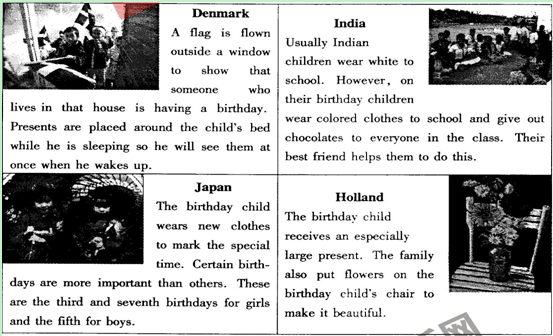
【小题1】When someone is having a birthday in Denmark, you can see ________ outside the window.
| A.flowers | B.presents | C.a flag | D.a chair |
| A.Japan | B.Denmark | C.India | D.Holland |
| A.India | B.Holland | C.Denmark | D.Japan |
| A.15 | B.7 | C.5 | D.3 |
| A.similar ways of celebrating birthdays in some countries |
| B.different ways of celebrating birthdays in some countries |
| C.children’s birthdays in western countries |
| D.the importance of children’s birthdays |
Many cultures have different ideas about why people catch colds. For example in the United States, some people think that you can catch a cold if your feet get cold. So, mothers tell small children to wear warm boots in the winter. In other places, including parts of the Middle East, some people believe that strong winds cause colds. So, on trains and buses, people usually don’t like to sit next to open windows. In parts of Europe, some people think that wearing wet clothes will give you a cold. They say that after you go swimming, you should quickly put on dry clothes. Today, scientists know that colds are caused by a virus(病毒). But the old ideas are still very strong, and many people still follow them to avoid(避免)getting ill.
【小题1】What is the main idea of this reading?
| A.People still believe old ideas about why they catch colds. |
| B.Colds are the biggest health problem in the world. |
| C.Some people think that strong winds cause colds. |
| D.You should take good care of your health in winter. |
| A.bad food | B.wet clothes | C.a virus | D.strong winds |
| A.scientists | B.old ideas | C.colds | D.dry clothes |
| A.There are many different ideas about how people catch colds. |
| B.Scientists don’t know how people catch colds. |
| C.Some people think that wearing wet clothes gives you a cold. |
| D.In the U.S., many small children wear boots in winter. |
| A.no | B.one | C.the same | D.different |
Most students in China have their own school rules. So do the schools in other countries.
Japan: Most schools demand(要求) that students wear uniforms, such as sports suits or skirts. They also demand that girls’ white socks be folded in a certain way and boys’ heads be shaved(剃)
Other Japanese schools tell students that they may not date, go to movies, leave home after sunset or play video games without permission from school.
USA: For safety at home USA schools, students must have a pair of indoor shoes to change into at school every day. This makes sure students won’t fall over on the slippery floors and keeps the schools clean. Gum chewing is not allowed in many USA school buildings, as it is difficult to clean up. And if students chew gum in class, they may not focus on study.
UK: Strange hairstyles are not allowed in some British schools. But they might allow students to wear certain hairstyles during the World Cup years. Two students had a special design shaved into their hair during 2002 World Cup. But they were not accepted by their school after that because the school said the rules changed since then.
【小题1】Many Japanese students have to follow the following rules EXCEPT .
| A.wear uniform | B.boys’ heads should be shaved |
| C.wear indoor shoes at school | D.can’t leave home after sunset |
| A.it is difficult to clean up | B.make students study carefully |
| C.it costs students too much money | D.it wastes teachers’ time |
| A.during Olympic Games | B.in the year 2007 |
| C.only during the World Cup | D.after the school rules changed |
| A.从事于 | B.继续 | C.专心于 | D.放弃 |
| A.Different countries have the same rules for the students |
| B.We must follow all the rules above |
| C.Students in different countries have to follow different rules |
| D.Most schools in China have different school rules |