题目内容
任务型阅读(共20分 , 每小题2分)(A) 阅读短文,根据其内容回答问题。(10分)
In a classroom in any countries , the teachers teaches more than art or history or language. He or she teaches something behind---the culture of the country.
In a country such as the United States, people with different history, culture and language join together and the pay much attention to personal ideas. Teachers try to make each student special. Students do not have to remember a lot of information , instead, they work and find answers by themselves. There is often discussion in the classroom..
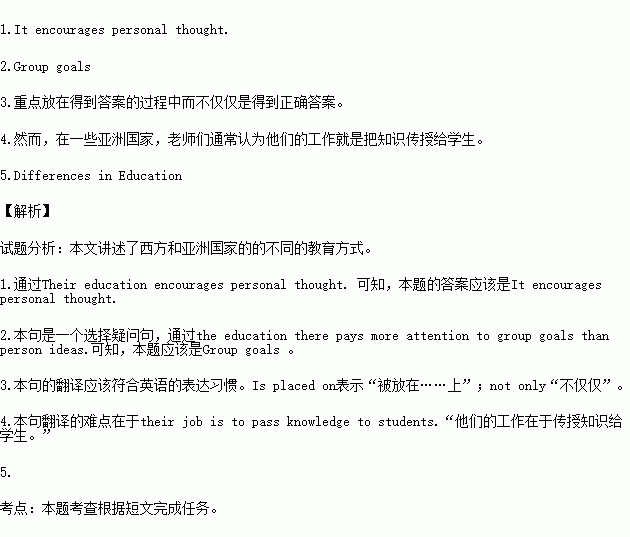
At an early age students learn to have their own ideas. Their education encourages personal thought.
The importance is placed on how to arrive at an answer and not only to get the correct answer.
In most Asian countries , people have the same language , history and culture. Perhaps for this reason , the education there pays more attention to group goals than person ideas. Children in China and Japan often work together and help each other on homework. In the classroom, the ways of teaching are often very traditional. The teachers says , and the students listen. There is not much discussion. Instead , the students repeat rules or information that they have been taught in order to keep them in minD.
In many ways these differences come from different educational ideas. In western countries teachers are taught to help students to learn. They make it easier for the students to learn by themselves. In some Asian countries , however , teachers often feel that their job is to pass knowledge to students.
1.What does the education in the United States encourage ?
____________________________________________
2.Which does the education in some Asian countries pay more attention to, group goals or personal ideas?
__________________________________________________
B: 将短文中画线的句子译成汉语。
3.___________________________________________________________________
4. ________________________________________________________________
5. 请给短文拟一个恰当的标题。
___________________________________________________

We all have habits that we want to give up. These are habits which are not good for us in some way or another. A habit is an activity that we have got used to. It's not easy to break a bad habit because we have got used to it, and it has become convenient (方便的).
We are so used to our bad habits that most of the time we even don't realize that we have them until someone points them out to us. So the first step that will lead to changing a bad habit is to accept the fact that is not good for you.
Since you know you have developed a bad habit, it's best to find out why you developed it in the first place. Find out the reason behind it, as that will help you in understanding why you're so willing to perform that act. There is nothing to feel scared of. You have to face it and then give it up.
Find out how bad habits have spoiled (损坏,糟蹋) things around you. For example, a bad habit of getting up late can destroy the schedule (时间表) of your whole day. And, if this is what you do every day, then imagine how many days it has already eaten up. Realize this and make up your mind to give it up.
An alarm (警报) is something that will prevent you from performing your habit. For example, to avoid getting up late, set an alarm and decide that you need to make a little effort to reach it to turn it off.
Tell your family and friends about your decision so that they can prevent you from performing the bad habit and also remind you of the promise you made to yourself.
Reward yourself every time you stop yourself from performing the bad habit. This will keep you encouraged to break the bad habit and at the same time make you happy.
There are habits that people have carried with them for years and it will surely take some time to give them up. However, breaking a habit is a better choice than letting it grow into an addiction(瘾). Try giving up a bad habit, and feel the difference in yourself. You will be proud of yourself and I will certainly congratulate you on it.
Title: How to break a bad habit
Why it is ___1.__ to break a bad habit | Because we have got used to it and it has become convenient |
___2.__ to break a bad habit | ◆___3.___ the fact you have a bad habit and it is not good for you. ◆Find out the reason why the bad habit is ___4.__. ◆Know the bad __5.___ that bad habits have brought you. ◆Use a(n) ___6.__ to prevent you from getting up late. ◆Get help from your ___7._ and friends. ◆Reward yourself when you ____8.___ in stopping yourself from performing the bad habit. |
The writer’s opinions of breaking a bad habit | ◆Breaking a bad habit is ___9.___ than letting it growing into an addiction. ◆Breaking a bad habit will make you feel __10.___ of yourself. |