题目内容
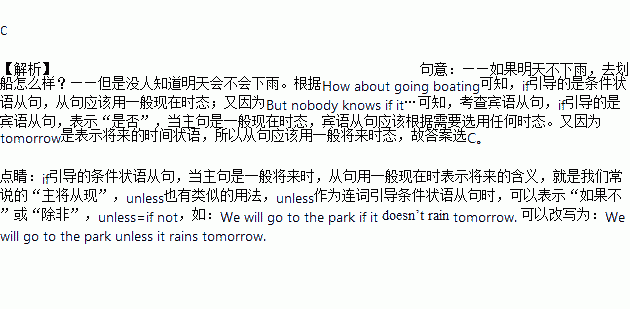
—How about going boating if it_____ tomorrow. —But nobody knows if it _______tomorrow.
A. won’t rain; rains B. doesn’t rain; rains
C. doesn’t rain; wil1 rain D. won’t rain; will rain

 名校课堂系列答案
阅读下列短文,根据短文中的信息完成文后表格。在答题卡标有题号的横线上,写出空缺处所填单词的正确形式。(每空一词)
The Daming Temple
Initially(最初) built during the Daming Period of Liu Song Dynasty in the Southern Dynasty, the Daming Temple lies on the hillside of the Shugang Ridge(山脊) in the northwest of Yangzhou. In the Sui Dynasty, the wonderful Qiling Tower was built at the site. In the Tang Dynasty, the abbot(住持) of the Daming Temple Jian Zhen sailed across to Japan to spread Buddhism. The Pingshan Hall was built here in the Song Dynasty The Daming Temple enjoyed its highest fame in the Qing dynasty
The Daming Temple Scenic Spot mainly consists of three parts, the temple complex, the Memorial Hall Of Master Jian Zhen and the Pingshan Hall.
After going through the Gate Hall. You will find two ginkgo trees growing to the north of the hall. Further north stands the main hall of the temple, called the Mahavira Hall(大雄宝殿),which is a one-story building with a triple-eave roof(三重檐屋顶). To the east of the Daming Temple stands the high Qiling Tower. In the Tang Dynasty many a poet like Li Bai, Gao Shi, Bai Juyi and Liu Yuxi visited and climbed the tower and wrote verses. The present Qiling Tower, a nine-story structure reaching 70 metres in height, was rebuilt in 1995 in the style of the Tang Dynasty.
The main building of the Memorial Hall Of Master Jian Zhen is located to the northeast of the Mahavira Hall. Jian Zhen, a famous master of Buddhism in the Tang Dynasty, was a Yangzhou native. He resided in the Daming Temple as the abbor for many years before he left for Japan. Jian Zhen’s sailing to Japan had great influences on Japan.
To the west of the Mahavira Hall is the Pingshan Hall which was built by Ou Yangxiu. After the failure of the reform(改革), he was demoted(贬职)to Yangzhou to take office as the mayor. Years later, Su Dongpo, Ou Yangxiu’s student, came to Yangzhou. In order to memorize his teacher, he built the Guilin Hall behind the Pingshan Hall. Besides, Emperors Kangxi and Qianlong admired Ou Yangxiu for his personality, statesmanship(治国之才) and essays so much that they came here each time they went on their southern inspection tours.
The Daming Temple | ||
1. | In the Sui Dynasty, the emperor had the wonderful Qiling Tower 2. In the Tang Dynasty, Jian Zhen, the abbot of the Daming Temple spread Buddhism. In the Song Dynasty, the Pingshan Hall was built. In the Qing Dynasty, the Daming Temple enjoyed its 3. fame | |
It mainly 4.three parts, | The temple complex | The Mahavira Hall is a one-story structure with a triple-eave roof. In the Tang Dynasty, many 5.visited and climbed the tower and wrote verses. The present Qiling Tower is 70 metres 6.. |
The Memorial Hall Of Master Jian Zhen | The Mahavira Hall lies to the 7.of the Memorial Hall Of Master Jian Zhen. Jian Zhen’s sailing to Japan8. Japan greatly. | |
The Pingshan Hall | After9. in the reform, Ou Yangxiu was demoted to Yangzhou to take office as the mayor. In 10.of his teacher, Su Dongpo built the Guilin Hall behind the Pingshan Hall. | |