题目内容

改写句子 按括号中的要求完成改写后的句子,每个空格填一个单词。(5分)

改写句子 按括号内的要求完成改写后的句子,每空一词。(5分)

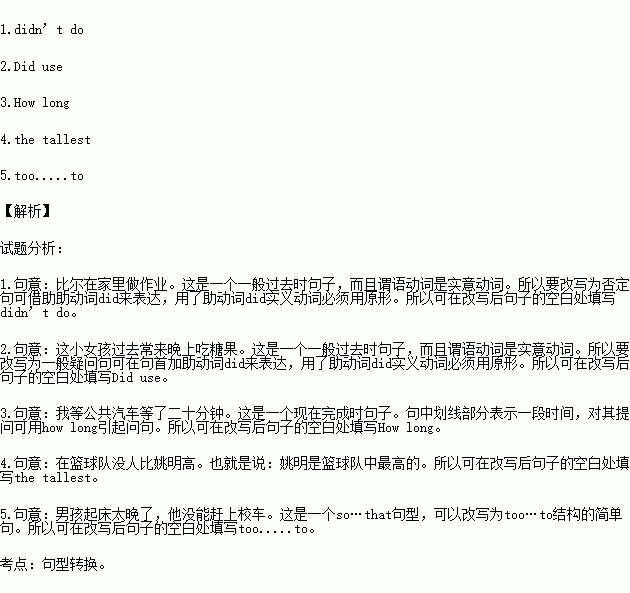
1.Bill did his homework at home. (改写为否定句)

Bill ________ ________ his homework at home

2.The little girl used to eat candy in the evening.(改为一般疑问句)

_________ the little girl __________ to eat candy in the evening?

3.I have waited for the bus for twenty minutes. (就句子划线部分提问)

______ ______ have you waited for the bus?

4.Nobody else is taller than Yao Ming on the basketball team.(改写句子,句意不变)

Yao Ming is ________ ________ on the basketball team

5.The boy got up too late, so he couldn’t catch the school bus. (改写句子,句意不变) The boy got up _________ late ________ catch the school bus.
练习册系列答案
相关题目

Do you understand “OMG” when you receive a piece of text message like this? Its meaning is “oh my god”. Have you seen Brb (be right back), gr8 (great), cya (see you)–it’s a lot easier to use abbreviations (缩写) when we text, isn’t it? But while we might think nothing of it, there’s an ongoing discussion that text messaging can have a bad influence on people’s grammar. Many believe the abbreviations are giving students bad habits when it comes to spelling and punctuation (标点).

Some teachers say that texting and social networking cause students to be lazy when writing. A study showed that young adults who often use text messaging find it rather difficult to turn back to correct grammar when needed.

But another view is that text messaging has no influence at all. Many people consider it to be a language of its own. We could compare it to a foreign language which students learn. This doesn’t have any influence on their native language.

Whether it’s bad or not, it seems that text language is becoming very popular. According to another study, 64 percent of teens said they used informal (非正式的) “text language” in their writing.

But it’s not just a matter of language. Students who text a lot during class may have difficulty paying attention. In another study, students were asked to complete a questionnaire on how many text messages they sent and received during class. On average, students sent more than two text messages during classes lasting 50 to 75 minutes. The study showed that students who often text during classes can’t easily keep their attention on the lesson, which will surely harm their learning.

Topic: Use abbreviation 1. texting

Facts

Students sent more than two text messages during classes lasting 50 to 75 minutes.

A study showed 2. percent of teenagers used text language in their writing.

3.

Text messaging can have a bad influence on people.

Abbreviations are bad for students’ 4. and punctuation use.

Students become 5. because of texting and social networking.

Young adults find it hard to return to correct grammar once they have got 6. to abbreviating.

It is 7. for those who text a lot to pay attention in class.

Text messaging can hardly influence people.

It is considered as a language.

It could be 8. to a foreign language which students learn.

Conclusion

Using abbreviations can make it 9. to send text messages.

No matter it’s good or bad, “text language” is becoming more and more 10. .

Many students in China are learning English. Some of these students are small

children. Others are teenagers(十几岁的青少年). Many are adults. Some learn at school, others study by themselves. A few learn English language (语言)over the radio, on television, or in films. One must work hard to learn another language.Why do all these people want to learn English? It is difficult to answer that question. Many boys and girls learn English at school because it is one of their subjects. They study their own language and maths and English ... Some people learn English because it is useful for their work. Many people often learn English for their higher sutdies, because at college or university(大学) some of their books are in English. Other people learn English because they want to read newspaper and magazines in English.

1. Many students in China are learning English, aren't they? ____.

A. No, they aren't B. No, they are

C. Yes, they are D. Yes, they aren't

2.If one wants to learn another language well, he must ____.

A. learn at school B. study by himself

C. work hard D. study hard

3.The sentence "It is difficult to answer that question" means ____.

A. that question is not difficult to answer

B. that question is difficult to answer it

C. it is difficultly to answer that question

D. it is hard to answer that question

4."Their own language" means ____.

A. Chinese B. English C. French D. Japanese

5.What's the Chinese of "study by themselves"?

A. 和他们一起学习 B. 自学

C. 向他们学习 D. 通过学习

The date was like any other day in his life. After school David walked past the shop on the street corner. He stopped to look at the front row of shoes, and he felt sorry for himself. He really wanted to have a new pair for his birthday.

He sadly walked away and thought of how to tell his mother. He knew she would give him anything if she could. But he also knew very well she had little money. He decided not to go home at once, as he looked worried and he didn’t want to make his mother worry about it. So he went to the park and there he sat on the grass. Then he saw a girl in a wheel chair(轮椅). He found that the girl moved the wheels with her hands. David looked at her carefully and was surprised to see that the girl had no feet. He looked down at his own feet. “It is much better to be without shoes than without feet.” It was not right for him to feel so sorry and sad. He went away and smiled, thinking he was luckier in life.

1.David was so sorry that ____

A. He really wanted to have a new pair for his birthday

B. he forgot to bring any money with him.

C. his mother couldn’t buy him a pair of shoes.

D. he walked past the shoe shop.

2. From the story we know that ________.

A. David’s mother has much money.

B. David’s mother wouldn’t buy him anything.

C. David’s mother was not a poor woman.

D. David’s mother would give him anything if she could.

3.David didn’t go home at once ________.

A. because his mother was at work.

B. because he wanted to sit on the grass in the park.

C. because his mother wouldn’t give him any money.

D. because he didn’t want to give his mother any trouble.

4. In the park, David saw a girl________.

A. without feet. B. without hands.

C. walking slowly. D. looking down at his shoes.

5. At last David ________.

A. left the park sadly.

B. decided to buy a new pair of shoes.

C. thought he’s more lucky than the girl in the wheel chair.

D. didn’t know what to do with his old shoes.

违法和不良信息举报电话:027-86699610 举报邮箱:58377363@163.com

精英家教网