题目内容
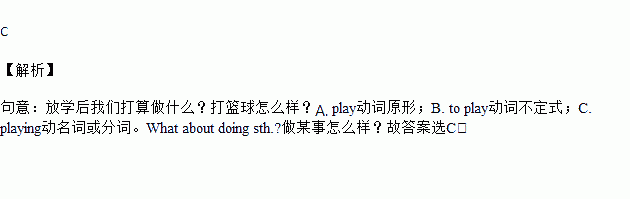
—What are we going to do after school?—What about___basketball?
A. play B. to play C. playing
判断下列每组单词划线部分发音,从A、B、C、D四个选项中选出发音不同的那个单词,并把答题卡上对应题目的答案标号涂黑。
1.A. cake B. Dale C. map D. name
2.A. nice B. six C. ring D. it
3.A. pen B. leg C. red D. he
4.A. those B. box C. go D. phone
5.A. number B. June C. bus D. cup
---_________ do you want to go to?
---Beijing, the capital of China.
A. What B. Where C. Which place D. When
When you were young, who rode you around on the back of his bike? Who played football and flew kites with you in the park? Who helped you __ your first difficult math problem? Who taught you the difference between ____? Your dad. Now it is your turn to do something for him. This Sunday, June18, is ____Day. So why not do something ____to thank your dad?
The idea of Father’s Day came from a(n)____lady called Sonora Smart Dodd in 1909. She wanted a special day to honor(纪念)her father. He raised(抚养)six children by himself____his wife died during the birth of their____child. Dodd thought there needed to be a day to honor great and loving dads. Her father was born____so she chose to hold the first Father’s Day celebration on his birthday in 1910. In 1924, US president Calvin Coolidge____the idea of a national Father’s Day Finally, in 1966, the third Sunday in June was made Father’s Day
There are many ways to____your love and thanks. Send____a greeting card. Usually fathers prefer card that are not too emotional(感性的). So perhaps choose one that will make him____. A small present, such as a photo of your family, ____ make him feel like a king. Send him____: the red rose is the official Father’s Day flower. If he has a____ ,cover his desktop with words like “I love you, Dad.”
1.A. with B. to C. for
2.A. old and young B. big and small C. right and wrong
3.A. Mother’s B. Father’s C. Children’s
4.A. easy B. special C. strange
5.A. British B. Japanese C. American
6.A. when B. until C. after
7.A. third B. fourth C. sixth
8.A. in May B. on May19 C. on June19
9.A. liked B. disliked C. needed
10.A. take B. bring C. show
11.A. her B. you C. him
12.A. cry B. jump C. laugh
13.A. should B. can C. must
14.A. flowers B. books C. clothes
15.A. watch B. computer C. car
—Do you often study with a group?
--Yes. I find ___ really helpful to study that way.
A. it B. that C. this
—Could you tell me the way ___ the railway station?
--Go along this road and soon you’ll find it.
A. at B. to C. in
An Wang was a Chinese-American computer engineer and inventor. He was born on February 7, 1920 in Shanghai, China. He was the oldest son of his family. He had an elder sister, Hsu; a younger sister, Yu; and two younger brothers, Ping and Ge.
An Wang's formal education began at the age of six. At that time, he entered the third grade. He had a great interest in science and Maths. His father taught him English. He graduated from Chiao-Tung University in his hometown with a degree in communications engineering.
He designed radio transmitters and receivers (无线电发射机和接收机) for China during World War II. After the war ended, he studied for a training program and went to study at Harvard University in Cambridge, Massachusetts. There he got a master’s degree in 1946. After about a year, he got his doctor’s degree in engineering and applied physics from Harvard University. He did great work in the field of magnetic core memory (磁芯存储器) and became an important person in the history of inventing. At the age of 70, he died.
1.How many children were there in An Wang’s family?
A. Two. B. Three. C. Four. D. Five.
2.What was An Wang interested in?
A. Science and English.
B. Science and Maths.
C. English and Maths.
D. Science and Chinese.
3.What can we know from the passage?
A. An Wang and other kids went to school at the same time.
B. An Wang lived a hard life when he was young.
C. An Wang invented things to help China in World War II.
D. An Wang didn’t get a doctor’s degree during his whole life.
4.Which is the RIGHT order?
①World War II ended.
②An Wang began his formal education.
③An Wang studied at Harvard University.
④An Wang graduated from Chiao-Tung University.
⑤An Wang designed radio transmitters and receivers.
A. ②④①③⑤ B. ②④③⑤①
C. ①③②④⑤ D. ②④⑤①③
5.What’s the passage mainly about?
A. An Wang’s family.
B. An Wang's school.
C. An Wang’s life stories.
D. An Wang’s inventions.
— My cousin Tina can find out the answers in a short time.
—Then she must be very wise.
A. friendly B. intelligent C. nice
She has never_________, but she knows a lot about the world with the help of the Internet.
A. gone to abroad B. gone abroad C. been to abroad D. been abroad