题目内容

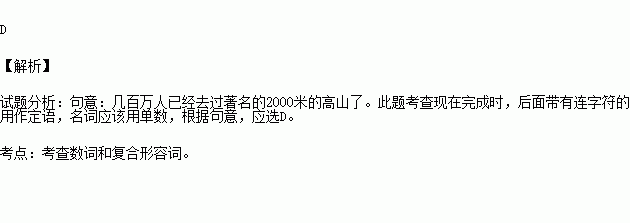
________ people have been to the famous ________ mountain.

A. Several millions; 2000-meter-high

B. Several millions; 2000-meters-high

C. Several million; 2000-meters-high

D. Several million; 2000-meter-high
练习册系列答案
相关题目

When doing his math homework, Lu Lifei, 14, from Jiangsu, came across a problem. He couldn’t work it out. So he took out his cell phone, opened a special app and searched the problem. Answers soon appeared on the screen.

Nowadays, many students do homework with the help of the Internet like Lu. They search information online, use apps or discuss through social networks like QQ and WeChat.

“It’s convenient. You don’t have to wait or get a tutor(辅导,约束)on the spot,” Lu said. “You also learn by seeing how others work them out.”

It also improves students’ abilities, said Wang Shiying, 15, from Shanghai. And it’s especially true for new types of homework.

Wang’s Chinese teacher often asks students to give lectures on great authors. When it comes to Wang’s turn, she usually searches online, picks out certain stories and makes PowerPoint presentations.

“I’ve become adept(熟练的) at finding information online and using Microsoft Office.” Wang said. However, this trend (趋势) also brings up problems. Some students just copy the answers online without thinking. They become lazy. Huang Pengxiang, a head teacher from Shanxi said that knowing how to use the Internet is important. The key is to have good self-control.

“No matter how difficult the problem is, think about it independently (独立地) first,” Huang said. “Be sure to understand the reasons behind the answers, or you won’t make progress. If you’re not confident about your self-control, ask your parents for help.”

1.What way does the article mention when students today come across the problems?

______________________________________________________________________

2. What does Lu Lifei think of studying on screen?

________________________________________________________________________

3.What lectures does Wang Shiying’s Chinese teacher often ask her students to do ?

______________________________________________________________________

4.How will the Internet affect the students if they only copy the answers online without thinking?

______________________________________________________________________

5.What is the key to use the Internet according to this article?

______________________________________________________________________

BEIJING—The sky is gray and air smells strange. It’s another day of smog.

On Saturday, heavy haze(霾)still covered north and east China. Highways were closed and couldn’t take off on time.

The smoggy weather the country’s land from north to south, including Beijing, Hebei, Shandong, and 6 other provinces. People could only see clearly than 50 meters in some areas.

Cities Shanghai and Nanjing have been covered by the gray sky for the past several days. Many walkers in the street had to wear . In the Lukou airport in Nanjing, more than 60 flights were canceled(取消) on Saturday the haze, which also made primary and middle schools and kindergartens stop on Thursday and Friday in Nanjing.

The office worker of Environmental Protection said earlier this week that there were several reasons behind the widespread haze: unpleasant weather conditions making difficult for smog to disappear, automobile exhaust(尾气), and coal use for winter heating.

To fight pollution, the Chinese government now plans to clean up the air by cutting coal use, some factories, and removing 6 million old cars from the roads.

“We must face up to the facts,” said Yan Naiqiang, a professor of environmental science at Shanghai Jiao Tong University. “The treatment of smog will be a long fight. From now on, if we use buses or cars less and do more riding, we believe a clear sky is not a faraway dream.”

1.A. coaches B. trains C. flights D. double-deckers

2.A. afforded B. affected C. admired D. announced

3.A. less B. more C. farther D. nearer

4.A. in B. like C. around D. outside

5.A. hats B. gloves C. sunglasses D. masks

6.A. besides B. except C. because of D. for

7.A. classes B. rest C. work D. shopping

8.A. mainly B. mostly C. main D. most

9.A. that B. this C. one D. it

10.A. close B. closing C. open D. opening

You may know that more people drink coffee than tea around the world. And that, after oil, it is the second biggest traded commodity(商品). You may also know that the drink comes from beans which are first roasted and then ground(研磨). But what else do you know about this popular drink?

It is said that the story of coffee started with an Ethiopian goatherd(牧羊人)named Kaldi. One day Kaldi was surprised to see that his goats were behaving very strangely. Instead of grazing(吃草)quietly, they were jumping around, almost dancing. He also noticed some red “cherries” from a plant that the goats were eating. He tried some himself and was surprised by the feeling of extreme happiness and excitement. He felt like dancing too!

But it wasn’t used as a drink at first. It was used as food. The coffee berries, mixed with animal fat, were used by monks to stay awake during long hours of prayer. From Ethiopia, coffee was later cultivated(培育)in Yemen and the first hot drink was developed there around AD 1000. Three centuries later Muslims were keen coffee drinkers and as Islam spread, so did coffee. Coffee houses appeared in Cairo and Mecca.

For hundreds of years the plants were protected safely. But some beans were smuggled(偷运)out of Arabia and taken to India. In the 17th century, coffee was soon grown in a new continent. From India to Indonesia, a century later the beans were once again smuggled to Brazil. Brazil is now the largest coffee producer in the world.

It was the caffeine(咖啡因)that made the goats dance and kept the monks awake. Although it is found in other soft drinks and tea, coffee has the most caffeine. In the short term(短期), a couple of cups of coffee can prevent fatigue and delay sleep. But several cups a day, every day, can cause anxiety and restlessness.

The1. _______of coffee

Discovery

Kaldi found that his goats had strange 2._______ after they ate some red cherries.

Kaldi himself tried some, and he became very happy and excited.

At first

Coffee was used as food instead of a drink.

In AD1000

Coffee was cultivated in Yemen and the first hot drink was 3.______.

In AD1300

Coffee 4._______ appeared in Cairo and Mecca.

In the 17th century

Coffee was soon grown in a new continent, from India to Indonesia.

Now

Coffee has become a5._____drink, but too much coffee may cause anxiety and restlessness.

完形填空 先通读下面的短文,掌握其大意,然后在每小题所给的四个选项中,选出可以填入空白处的最佳选项,并在答题卡上将该项涂黑。(本大题共10小题,每小题1分,共10分)

I sat down to read under an old tree in the park. I felt my life was , for my whole world was dark.

A young boy ran up to me, out of . He stood right before me with his head down and said , “Look what I found!” In his hand was a flower, and what a poor sight! The flower was dry and dead. I gave him a small smile and then turned my eyes away so that he could take his dry flower and go off to play.

However, he sat next to my side and placed the flower to his and said in surprise, “It smells sweet and it’s beautiful, too. That’s I picked it. Here, it’s for you.” The flower before me was dead. But I knew I must it, or he might never leave. So I accepted the flower, and replied, “This is just what I .” Just then, for the first time I noticed that the boy could not see --he was blind.

Tears(眼泪) came down my face as I him for picking the best one. “You’re welcome.” he smiled, and then ran off to play. I sat there and wondered how he was able to learn about my pain(痛苦).

Through the eyes of a blind child, I could see the problem was not with the world; the problem was me. And for all those years I myself had been . I decided to see the beauty in life, and every second of my life. And then I held that dry flower up to my nose and breathed in the smell of a beautiful rose.

1.A. hopeless B. colourful C. simple D. wonderful

2.A. mind B. trouble C. breath D. work

3.A. sadly B. excitement C. angrily D. excitedly

4.A. head B. nose C. ear D. neck

5.A. how B. when C. where D. why

6.A. buy B. sell C. Receive D. accept

7.A. admire B. dislike C. want D. have

8.A. forgave B. thanked C. paid D. hated

9.A. cheerful B. useful C. blind D. deaf

10.A. waste B. enjoy C. lose D. Forget

违法和不良信息举报电话:027-86699610 举报邮箱:58377363@163.com

精英家教网