题目内容

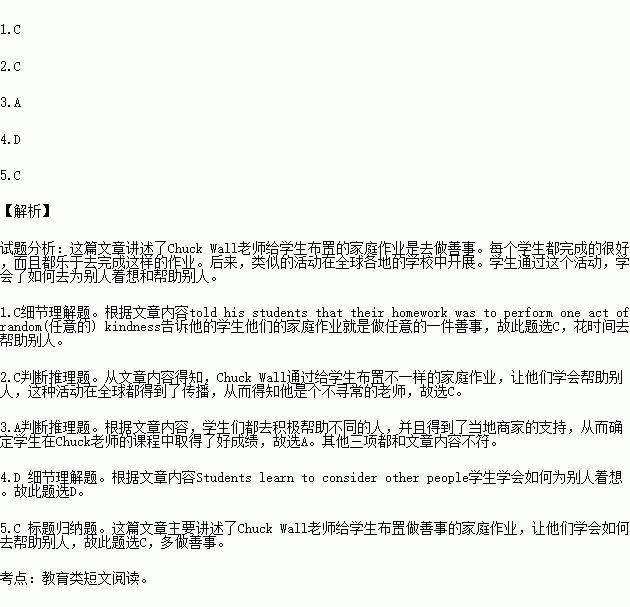
Chuck Wall teaches management and human relations at Bakersfield College. He walked into class one day and told his students that their homework was to perform one act of random(任意的) kindness. His students did not understand the homework and didn’t know what to do, but the professor would not answer their questions. He encouraged his students to work it out for themselves.

One week later, the students entered the classroom excited to share their stories. One student told of giving away blankets to the homeless. Another reported on helping a dog to find its owner, and another student had been trying to find a long, lost friend. Students were energized (给予活力) by the homework assignment and wanted other people to be kind too. With the support of local businesses, the students made stickers to put on cars that invited people to do something kind for others. They sold the stickers and decided to donate the money to a center for the blind。

Since then, similar kindness activities have been started in schools around the world. Many schools organize a Random Acts of Kindness Week, around November 13th, to celebrate World Kindness Day. Some schools use each day of Random Acts of Kindness Week to perform a different kind act, such as making a new friend, helping someone, doing community service, or raising money for a charity. Students learn to consider other people and thank about how small actions can make the world a better place.

1. The professor’s homework was to ask his students _________.

A.to write about kindness.

B. to be kind to strangers

C. to spend time helping others

D. to go out to raise money

2.We learn from the passage that ________.

A. Chuck’s students are not clever enough

B. the students didn’t do Chuck’s homework

C. Chuck Wall is an unusual teacher

D. no students enjoyed Chuck’s homework

3.It is certain that _________.

A. the students got good grades in Chuck’s class

B. kindness activities are not widely accepted

C. Chuck Wall was not good at designing homework

D. the students only helped people they knew

4. In kindness activities students learn _________.

A. to deal with difficult things

B. to do great things every day

C. to know about the world

D. to consider other people

5.Which is the best title of the passage?

A. Learning Kind Things

B. Teaching Kindness

C. Doing more kind activities

D. Bakersfield College
练习册系列答案
相关题目

Last Friday, after doing all the family shopping in the town. I wanted to have a rest before catching the rain. I ____ a newspaper and some chocolate and ____ into the station coffee shop. It was a cheap self-service place with long tables to ____ at. I put my heavy bag down on the floor, ____ the newspaper and the chocolate on the table and then went to get a cup of coffee.

When I came back with the coffee, There was someone ____ in the next seat. ____ was a boy, with dark glasses and old clothes, and ____ bright red at the front. He had started to eat my chocolate!

Naturally, I was rather uneasy about him, but I didn’t want to have any ____. I just read the newspaper, tasted my coffee and took a bit of chocolate. The boy looked at me in ____.Then he took a ___ piece of my chocolate. I could hardly believe it. Still I didn’t say anything to him. When he took a third piece, I felt more angry than uneasy. I thought, “Well, I shall have the last piece.” And I got it.

The boy gave me a strange look, then ___ up. As he left, he shouted out, “There’s something ____ with that woman!” Everyone looked at me, ____ I didn’t want to quarrel with the boy, so I kept quiet. I did not realize that I had ____ a mistake until I finished my coffee and was ready to ____. My face turned red when I saw my unopened chocolate under the newspaper. The chocolate that I had been eating was the boy’s!

1.A. stole B. bought C. sold D. wrote

2.A. went B. sat C. seated D. looked

3.A. sit B. seat C. lie D. laugh

4.A. pushed B. took C. put D. pulled

5.A. jumping B. playing C. sitting D. sleeping

6.A. He B. It C. Who D. What

7.A. cut B. washed C. covered D. colored

8.A. coffee B. trouble C. chocolate D. matter

9.A. carelessness B. anger C. surprise D. happiness

10.A. first B. second C. very D. last

11.A. stood B. took C. cried D. looked

12.A. strange B. wrong C. OK D. funny

13.A. and B. but C. so D. while

14.A. spelt B. corrected C. made D. found

15. A. finish B. leave C. jump D. shop

I am a professor of sports and exercise so I often deal with nervousness in my research with sports people.Actually, most people experience nervousness at some time or another.

If you are feeling anxious, my advice is to first find the cause or causes.Make s list of those things that are making you nervous and work out which ones you can do something about.Focus all of your efforts on managing the causes that you can control.

Most people cannot tell the difference between controllable(可控制的) and uncontrollable causes, so things they can’t control become a big reason for nervousness.Dealing with this is very important if people want to keep a healthy mind.

Simply try to accept the uncontrollable causes of nervousness.You might be worried about the weather on a big day, an accident or an attack on the train, or perhaps just things that other people are doing at work.The results may be very important but there is still no use worrying because you can’t control any of these things.Accept that you can’t control everything.Once you understand this, it becomes easier not to worry.

If a situation, such as swimming, is causing you to be anxious, try to face it as often as possible so that you can get used to it.

It can often help to think about yourself doing the thing that make s you nervous—then close your eyes and imagine it going well.Imagine how the flight or job interview is going to happen so that you can get used to it.This will help you understand that the thing you fear most is probably not going to happen.

1.The writer thinks there is no use worrying about some causes of nervousness because_____.

A.most are not very important

B.they are not the real causes of the problem

C.they cannot be controlled by people

D.it’s better to deal with one cause at a time

2.If swimming makes you nervous, what should you do according to the writer?

A.Go swimming often to get used to it.

B.Avoid going to the swimming pool.

C.Find a swimming teacher.

D.Imagine watching others swim.

3.What is true about nervousness according to the passage?

A.It usually has only one cause.

B.It is usually caused by people.

C.People can easily manage it.

D.Most people suffer from it.

4.What is the main purpose of this passage?

A.To introduce the writer’s sports experience.

B.To advise on how to deal with nervousness.

C.To help people remember their fears.

D.To explain the dangers of nervousness.

违法和不良信息举报电话:027-86699610 举报邮箱:58377363@163.com

精英家教网