题目内容
Imagine 50 years from now. Imagine the perfect school.
Getting to school is already difficult because of traffic. In 50 years' time, it will be even more difficult. A solution is needed.
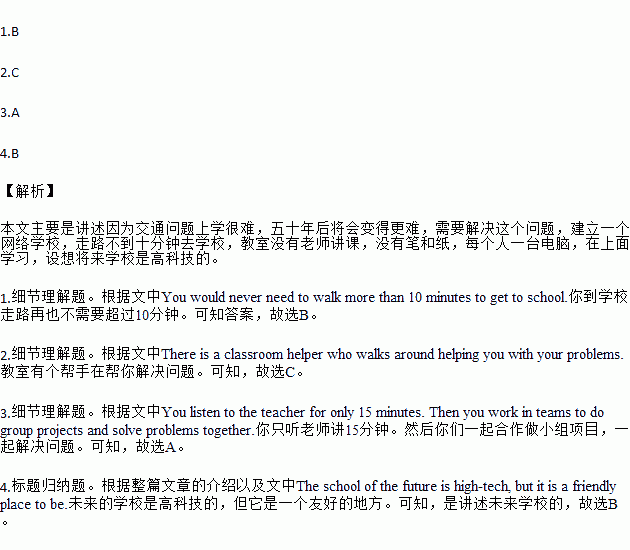
Imagine one big school in your city, a big cyber school(网络学校), but the classes are in many different places. In fact there would be classes all around, both in the suburbs and in the city. You would never need to walk more than 10 minutes to get to school.
Once you get there, there is no teacher speaking at the front of the classroom. Instead, there is a large screen playing a video of the teacher. There is a classroom helper who walks around helping you with your problems. You can get the best teaching there, and you have a helper who can help you understand your work.
You listen to the teacher for only 15 minutes. Then you work in teams to do group projects and solve problems together.
The days of pen and paper are gone. You each have your own computer and you do all your work and assignments on it. After classes finish, you can stay there and talk with your school friends.
You each have a locker to keep your personal things. There is a fridge to keep your lunch and a microwave to warm it. There are sofas to sit on when it's time to read a book.
Your classroom would always be cool in summer and warm in winter. There is solar and wind power on the roof of the building. Each room is kept at a comfortable temperature automatically.
The school of the future is high?tech, but it is a friendly place to be.
1.How long might it take you to walk to a cyber school in the future?
A.More than ten minutes. B.Less than ten minutes.
C.More than thirty minutes. D.Less than five minutes.
2.If you have a problem in class, who can you ask for help?
A.Your classmates. B.Your teacher.
C.A classroom helper. D.A large screen.
3.What can we learn from the passage?
A.Students listen to the teacher for only 15 minutes.
B.There are no sofas to sit on when it's time to read a book.
C.Students can keep their lunch in their lockers.
D.Students still use their pens and paper.
4.Which of the following can be a proper title for the passage?
A.Life in the Future B.The School of the Future
C.The Computer of the Future D.The Classroom of the Future

 轻松课堂单元期中期末专题冲刺100分系列答案
书面表达
新的一年马上就要到了, 李华计划在新的一年中有新的气象。请根据表格中的信息,以第一人称的形式说说李华的新年计划,并谈谈为什么制定这样的计划以及如何实施。
注意:1. 文章需要包括表格内所有的信息;2. 可适当发挥但不得出现真实的个人信息(人名、地名、学校名等);3. 词数:80左右(开头已给出, 不计入总词数)。
New Year's resolutions | Why | How |
Take up a new hobby | ||
Get a lot of exercise | ||
Improve English | ||
... |
New Year is coming, so I am going to make some New Year's resolutions.
_______________________________________________________________________________
_______________________________________________________________________________
_______________________________________________________________________________
_______________________________________________________________________________
_______________________________________________________________________________
_______________________________________________________________________________