题目内容

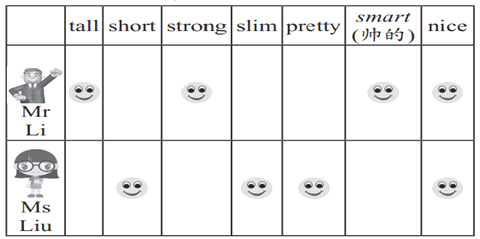
【题目】请根据下面的图表,用英语简单介绍一下你的两位新老师。

要求:

1.内容覆盖图表中的要点;

2.50词左右,不包括所给的开头。
My new teachers

I have two new teachers. They are Mr Li and Ms Liu.

_______________________________________________________________________________________________________________________________________________________________________________________________________________

【答案】My new teachers

I have two new teachers. They are Mr Li and Ms Liu.

Mr Li is a tall man. He is very strong. I think he is very smart. He is nice to the students. And Ms Liu is a short woman. She is very slim. She is pretty. She is very nice, too. We are happy to be their students.

【解析】试题分析:考生首先要认真分析图表并认真审题,确定文章的中心。注意文章文体、人称和时态。要求介绍。同时应选用合适的连接词或过渡词,使文章具有一定的连贯性。在检查环节,考生必须认真查验是否有漏写情况,有无拼写错误及标点误用等。

写作亮点:这篇文章语言规范,叙事清楚,词汇及时态运用正确,能够把提示的内容叙述清楚,语句通顺,意思连贯是一篇不错的文章。

练习册系列答案
相关题目

【题目】阅读理解
"I love you" might be one of the most important sentences in the English language. It shows the closeness among family members and friends.
In Mandarin, "I love you" translates as “我爱你”, but the way it's used in China might be a little different, and Chinese are wondering why.
The Global Times reports that two online videos showing children telling their parents "I love you" have been widely spread in China. The first, filmed by an Anhui TV station, shows a number of college students telling their parents they love them. The answers are mixed. "Are you drunk?" asked one parent. In another similar video, a father even said— "I am going to a meeting, so cut the crap."
Even the positive attitudes make it clear that the words are expressed rarely. "I am so happy you called to say that. It is the happiest thing that happened to me in 2014," one parent answered.
However, Chinese families hardly use those words. "The parents' answers show that many Chinese are not good at expressing positive feelings," Xia Xueluan, a Sociologist from Peking University, told the Global Times. "They are used to educating children with negative language."
This isn't the first time that China has done some soul-searching about familial love — last year China Daily asked a lot of people if they said 'I love you' to their parents, lovers, and children. "I have never said 'I love you' to my family, and I don't think I will in the future," one 56-year-old told the paper, "Saying it aloud is embarrassing for me."
Still, that doesn't mean that love can't be expressed. In another article, China Daily spoke to Zhao Mengmeng, a 31-year-old woman who said she had never told her father she loved him face-to-face. Sometimes actions speak louder than words, however — Zhao gave her father, a photo album featuring photographs of them together on every one of her birthdays in June 2012. The pictures were popular online, being forwarded hundreds of thousands of times on Weibo. Her father was very excited when he heard about it.

(1)What does the underlined word Mandarin probably mean?
A.French
B.Japanese
C.English
D.Chinese
(2)What can we infer(推断) from the parents' answers in Paragragh3 and 4?
A.Some parents don't love their children.
B.Parents in China are too busy.
C.Most Chinese students rarely express their positive feelings to their parents.
D.Children in China are always taught negative language.
(3)What will that 56-year-old person feel if he/she says “I love you” to the families?
A.embarrassed
B.excited
C.proud
D.unhappy
(4)Why did Zhao give her father a photo album instead of saying "I love you"?
A.The album is more expensive.
B.His father likes the album better.
C.She thinks actions speak louder than words sometimes.
D.She hates saying "I love you" to her father.
(5)What's the best title for the passage?
A.I Love You
B.A Photo Album
C.Two Online Videos
D.Family members

违法和不良信息举报电话:027-86699610 举报邮箱:58377363@163.com

精英家教网