题目内容
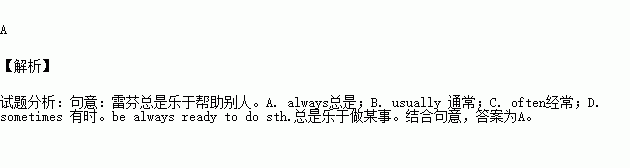
Lei Fen was _________ready to help others.
A. always B. usually C. often D. sometimes
阅读理解。
Jokes are things that we say to make other people laugh. Sometimes a joke is just a short sentence, while other times it can be a story that can take a while to tell. An example of a simple joke is:
People who tell jokes are welcomed everywhere bacause everyone likes hearing a good joke. Here
is another example of a jokes:
We say a joke is “corny” if it is stupid . An example of a corny joke is:
But some people may think a corny joke actually a good joke. Telling a good joke depends not only on the joke itself but also on the way it is told. Some people have a skill for telling jokes. And some people simply do not know how to tell jokes. Every language and culture has its own funny jokes. As a result, many jokes lose their humor if they are translated into a different language.
Some jokes depend on making fun of other people to be funny. However, these jokes may hurt people’s feelings.
Sometimes jokes are told about certain races and religions (宗教). These are called “recial” and “religious” jokes, and they can be burting people, too. Jokes about the supposed special things of the members of one sex are sometimes considered to be “sexist (性别歧视的) rubbish”. Jokes that hurt people’s feelings are not really funny.
Have you heard a good joke lately? Can you tell your classmates one that will make them laugh?
1.People who are good at telling jokes are usually _____ .
A. serious B. crazy
C. famous D. popular
2.A “corny” joke is one that is _____ .
A. very funny B. stupid or not funny
C. very short D. very harmful
3.Some jokes depend on _____ to be funny.
A. how long the sentences are
B. the age of the person who tells the joke
C. where we ate standing when telling the joke
D. the listener’s understanding of the language and culture
4.Which of the following is the writer’s opinion?
A. Jokes that hurt people’s feelings are not really funny.
B. Some people simply do not know how to tell jokes.
C. Every language and culture has its own jokes.
D. Some people may think a corny joke is good.
She didn’t go home. I didn’t go home, _____________.
A. too B. also C. either D. neither
The little boy feels______ when he sees tigers in the zoo.
A. happily B. easy C. sad D. scared
My mother often cooks__________ for us.
A. delicious something B. something delicious
C. delicious anything D. anything delicious
Jenny, let’s go for______ walk after supper.
A. a B. the C.\ D. an
书面表达
假如你是李丽,写一封信向你的英国笔友Peter介绍一下中国的餐桌礼仪。80词左右,开头结尾已给出,不计入总词数。
Dear Peter,
I’m glad to know you’re coming to China next week.___________________________
________________________________________________________________________________
Welcome to China!
完形填空
In North America people are always in a hurry. Children have ______ lessons or sports activities after school. Parents often work late and don’t get home ______ 7 or 8 o’clock at night. More than 50% of the women work at full –time jobs, and many people do part-time work.. It isn’t a ______ that the North American families don’t have time to eat many meals together.
When a family takes the time to eat a meal ______ , often there isn’t enough time to ______ the food. That is _______ “fast food” is so popular in North America. People spend about 40% of their food dollars ______ fast food.
Fast food is food such as pizza, sandwiches, or fried chicken. People usually ______ _the food from a restaurant chain (连锁店) such as Pizza Hut, McDonald’s, or Kentucky Fried Chicken. Fast food ______ work and time, ______ it is not very healthy.
Fast food is ______ in many countries . American fast-food companies now have restaurants all over the world. But not everyone is happy about the ______ of North American fast food. A group of people in Italy want to ______ against the spread of American fast food. They do not want any more fast –food chains to open restaurants in______ country. Their group is ______ the Slow Food Movement. They plan to fight against the spread of fast food everywhere in the world.
1.A. special B. double C. normal D. modern
2.A.as B. after C. until D. unless
3.A. shock B.surprise C.pity D.decision
4.A. alone B.once C.together D.again
5.A. cover B. serve C. create D.prepare
6.A.how B.what C.when D.why
7.A.about B.on C.in D.at
8.A. share B. fetch C. buy D.sell
9.A. gives B.saves C.provides D. wastes
10.A.but B.and C.or D.so
11.A.fantastic B. different C. natural D. popular
12.A.spirit B. situation C. spread D.price
13.A.turn B.fight C. press D. hold
14.A.their B. his C. her D.its
15.A. called B. spelled C. thought D. know
---Is that kate’s brother?
---Yes, he’s only five years old, ______ he knows a lot about science!
A. and B. but C. so D. or