题目内容
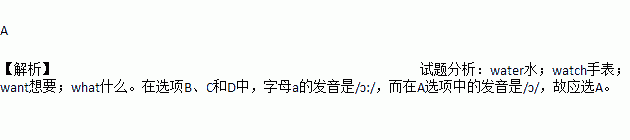
A. water B. watch C. want D. What
短文填空
请认真阅读下面短文,并根据各题所给首字母的提示,写出一个合适的英语单词完整、正确的形式,使短文通顺。
In Britain,the government,school leaders,teachers and parents all agree that students should wear uniforms.1.B British private schools have their own school uniforms.They think it’s2.i for pupils to wear school uniforms.
School leaders normally decide if pupils will have to wear a uniform,and they3.a
decide what it should look like.You know,no students want to wear4.u uniforms.
Everybody wants to wear beautiful uniforms.
Leaders have to follows the rules,and they5.c just choose anything they like.They have to6.t of the students’ feeling and taste.Here are a few7.f leaders should consider.
1.Cost.This is the first fact they should consider.Their uniforms shouldn’t be too8.e because it may cause problems for some families.Not all the families can afford it.
2.Sexism(性别歧视).The uniform policy must be equally fair(公平的)for boys and 9.g .
3.Cultrues and races.School rules must10.a pupils from all backgrounds to wear a uniform,for example,allowing Muslim(穆斯林)girls to wear an appropriate dress and Sikh(印度锡克教徒)boys to wear a traditional headdress(头饰).
书面表达
假设你的朋友叫Dick,请根据所给中文提示,用英语写一篇短文。(60个词左右)
要点:1. Dick爱好体育,喜欢网球,足球和游泳;
2. 梅西(Messi)是他的偶像,他足球踢得好,是校足球队的一员;
3. 也喜欢观看足球比赛,常在周末和队员一起踢足球;
4. 想成为NBA的成员,跟NBA的明星们一起打球,希望他美梦成真。
My friend always ______ a bus to school and walks ______ home.
A. takes; / B. takes; at C. by; / D. takes; to
--- Is your name Andy? ---Yes, ______ .
A. he is B. it is C. she is D. it’s
A. stand B. any C. apple D. Man
American and British people both speak English of course. But sometimes there are some important differences between British English and American English.
First of all, they sound very different. Often, Americans don’t say each word separately. They say words together. Americans may say “I dunno” instead of “I don’t know”. Or they may say “Whaddya say?” instead of “What did you say?” However, the British are more careful. They usually say all the words and keep them separate.
Sound is not the only difference. Words sometimes have different meanings too. For example, the vocabulary (词汇) for cars and driving is very different. Americans drive trucks, but in England people drive lorries.
Many expressions (表达) are also different in the two countries. In England, if you are going to telephone your friends, you “phone them up”. In America, you “give them a call”. When you are saying goodbye in England you might say “Cheerio!” In America you might say “See you later.”
There are also some differences in grammar (语法). For example, Americans usually use the helping verb “do” when they ask a question. They say “Do you have a storybook?” But the British often leave out the helping verb. They say “Have you a storybook?”
Most languages are like this. Languages change over time. When people live in separate places, the languages change in different ways. This is what has happened to English. It can also happen to other languages, such as French. Many people in Canada speak French but their French is very different from the French of France.
1.What does the underlined word “separately” mean in this passage?
A. 含糊地 B.快速地 C. 分开地 D. 简略地
2.The vocabulary for cars and driving is ________________.
A. an example of British English
B. an example of American English
C. the same in America and England
D. not the same in America and England
3.Which of the following is RIGHT?
A. American people usually say “I don’t know” instead of “I dunno”.
B. There are four differences between American and British English.
C. Canadians speak all the same French as Frenchmen
D. When people live in different places, the languages change in the same ways.
4.This passage is mainly about ___________________.
A. English vocabulary
B how American sounds are different from British sounds.
C the way the British say words.
D some differences between American and British English.
I have many hobbies. I never feel ________ when I am alone.
A. boring B. excited C. bored D. exciting
-What do you think of the film, Captain America: Civil War?
-______
A. It's wonderful. B. It's my pleasure. C. It's very nice of you.

 全优点练单元计划系列答案全优点练单元计划系列答案