题目内容

One day, a raven(渡鸦)happened to fly past a lake. Looking at the lake, he saw the most beautiful animal he had ever seen. It was a swan(天鹅)and its feathers(羽毛)were as white as snow. The swan was playing with other birds happily, talking and dancing. And it seemed that the other birds all liked to stay with it. When he looked at his own feathers, they were as black as coal. The raven was very angry with the swan. “How can the swan have such wonderful feathers?” said the raven. What should he do with his feathers? He thought it over and over.

Then, the raven decided that he also wanted to have white feathers like the swan’s. From that day on, the raven began to live like the swan. He moved his home from the woods to the lake. He also started to eat water plants like the swan. He tried his best to talk and dance with the other birds. The most important was that each day, the raven would wash his feathers, hoping that they would turn white. Even he went to the nearby rivers and ponds to wash his feathers because he thought the water in the lakes was not enough for him to wash them. But no matter how hard he washed his feathers, they remained black.

As he ate only water plants, he soon grew thinner and thinner. Not many days later, the raven died.

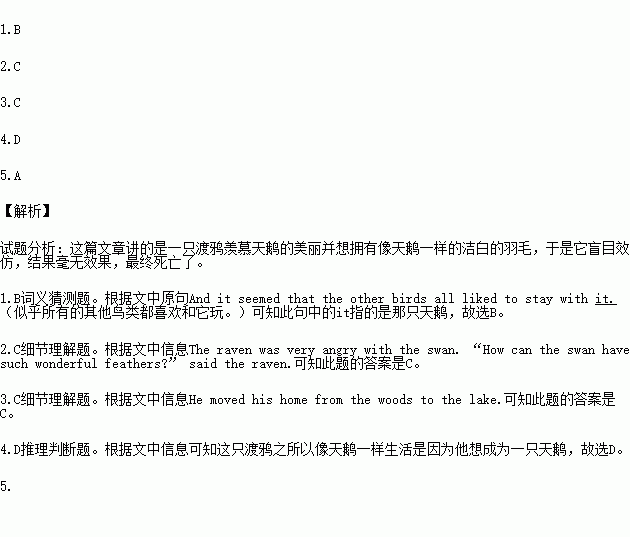
1. The underlined word “ it” in Paragraph 1 refers to ___.

A. the raven B. the swan C. the feather D. the water

2.Why was the raven angry with the swan?

A. His own feathers were as white as snow.

B. The swan did not have black feathers like him

C. The swan had beautiful white feathers

D. The swan lived in the lake with other birds

3.Where was the raven’s natural home?

A. The lakes B. The ponds C. The woods D. The rivers

4.Why did the raven want to live like the swan?

A. He wanted to make friends with the swan

B. He wanted to see the swan’s white feathers

C. He wanted to eat water plants

D. He wanted to become a swan

5. Why did the raven wash his feathers every day?

A. He thought his feathers would turn white.

B. He wanted to drive the other birds away

C. He thought his feathers were dirty.

D. He wanted to keep his feathers white
练习册系列答案
相关题目

Most young boys don’t like growing flowers and watering them. But for 16-year-old Angus, working in the garden isn’t just a hobby---it has changed his life.

Angus has a special illness and his IQ(智商) is lower than a normal boy. Six months ago, he started learning how to grow flowers. Now he spends hours in the garden growing flowers, watering and looking after them. “Before working in the garden, it was difficult for Angus to concentrate in class and sometimes he didn’t want to go to school,” says his mother Kim. “ Now he can’t wait to go to school and he is happy every day. We can see Angus is able to work in a garden center in the future.”

Research(研究) shows that working in the garden improves mental health. In the past, soldiers in Egypt treated their mental problems after war by working in the garden. Even now, some doctors advise people to work in the garden to treat their mental health problems. And doctors also advise young people like Angus to work in the garden.

The lives of hundreds of children in Britain with a special illness like Angus, have been changed by this special kind of education. When working in the garden, children have a chance to learn a lot of important skills, such as how to work with other people and how to take care of plants. Besides, the children become more confident after working in the garden.

1.Angus began to __________half a year ago.

A. need special help

B. learn how to grow flowers

C. learn a special illness

D. hate his mother

2.After working in the garden, Angus _______________.

A. likes going to school

B. is not happy any more

C. accepts doctor’s advice

D. wants to be a soldier

3.Which of the following is TRUE about working in the garden?

A. Doctors don’t advise young people to use this way.

B. Research shows that it is difficult for women to use this way.

C. The way has been used to treat health problems for a long time.

D. The way can be used to treat all the problems.

4.The underlined word in the third paragraph means_________ in Chinese.

A. 身体的 B. 心脏的 C. 表面的 D. 精神的

5.What is the last paragraph mainly about?

A. How to take care of flowers.

B. How to get a chance to learn things

C. Advantages(好处) of working in the garden for children

D. The activities children can do in a garden

语法填空

根据上下文意思用所给单词的适当形式填空或者填入所缺单词。

This story tells us about what happened on a flight between a passenger and an air hostess. When the plane had just taken 1.__________, the passenger rang and told the air hostess that he needed a cup of water to take his medicine. She told him that she 2. __________ (bring) him the water in ten minutes.

Thirty minutes later, when the man’s ring for service sounded for the 3. __________ (two) time, the air hostess was still in a hurry. She was4.__________ busy that she forgot to deliver him the water. As a result, the passenger was late taking his medicine. She hurried over to him with a cup of water, but he refused it.

In the 5.__________ (follow) hours on the flight, each time the air hostess passed by the passenger she would ask him with a smile 6. __________ he needed help, but the passenger never 7.__________ (pay) attention to her.

When the passenger was going to get off the plane, he asked the air hostess8. __________ (hand) him the passengers’ booklet (意见薄). She was very sad. She knew he would write down sharp words9.__________ might result in her losing her job. But with a smile she handed it to him.

Off the plane, she opened the booklet, and smiled10.__________ (happy), for the passenger had written, “On the flight, you asked me if I needed help twelve times in all. How can I refuse your twelve sincere smiles?”

That’s right! Who can refuse twelve sincere smiles from a person?

违法和不良信息举报电话:027-86699610 举报邮箱:58377363@163.com

精英家教网