题目内容
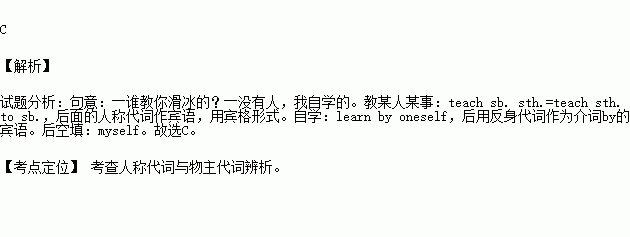
- Who taught _ skating?
- Nobody. I learnt it by_ .
A. your, myself B. you, me C. you, myself
I _____the book to the library if I have time tomorrow.
A. return B. will return C.have returned
Fire was discovered many thousands of years ago. The first time humans saw fire was probably when a tree was destroyed by lightning(闪电). Humans soon learned how to make fire. They probably made the first fire by rubbing (摩擦)two sticks together.
Fire was very important to humans. They needed to keep warm at night. They used fire to cook food. They used fire to keep enemies and wild animals away. In some parts of the world fire was used to send messages. The Indians in America, for example, used fire to make smoke as a message. In some other countries people lit fires to warn their friends of danger.
Fire was also used to give light. Before the invention of the oil lamp(灯), humans burned sticks to get light.
One man even used fire to tell the time. He invented a candle clock. He made a candle that took exactly twelve hours to burn. Then he marked this candle in twelve equal(相等的) parts. He lit the candle and could tell the time by counting the number of parts left of the burning candle. But the candle clock did not always work well. If there was a wind blowing on the candle, it burned too quickly.
请务必将1-5小题的答案写在答题卡的相应位置!
(一)根据短文内容简要回答问题。
1.How did Indians in America use fire?
2.What happened to the candle if there was a wind blowing on it?
(二)将短文中划线的句子译成汉语。
3.
4.
(三)请给短文拟一个适当的标题。
5.
—What about going to Jingpo Lake for a trip next weekend?
--OK. But I’m not sure _____ it will rain.
A.whether B.where C.why
We had_ awful weather_ we couldn't finish the work on time
A. so, that B. such, that C. such an, that
The girl in the classroom_____ be Mary. She called me from Beijing just now.
A. mustn`t B. needn`t
C. shouldn`t D. can`t
People in North China eat noodles as their main food ___ people in the south eat rice.
A. as B. while C. when
—You _______be excited that you are going to get the award.
— I can't wait for it.
A. should B. can C. need D. must
Good learners aren’t afraid _______mistakes. Instead, they learn ________mistakes.
A. of making, from B. of make, from
C. to make, in D. to making, in