Section A Short Conversations
Directions: In Section A, you will hear ten short conversations between two speakers. At the end of each conversation, a question will be asked about what was said. The conversations and the questions will be spoken only once. After you hear a conversation and the question about it, read the four possible answers on your paper, and decide which one is the best answer to the question you have heard.
1. A. At home. B. At a restaurant. C. At a meeting. D. At a grocery.
2. A. Patient and doctor. B. Customer and salesman.
C. Student and teacher. D. Hostess and servant.
3. A. By car. B. By bus. C. By train. D. On foot.
4. A. A driver. B. A car seller. C. A reporter. D. A police officer.
5. A. They’d better not go riding. B. It’s no fun riding in the rain.
C. They can go riding half an hour later. D. Riding a bike is a great idea.
6. A. It’s difficult. B. It’s easy.
C. It’s too short. D. It takes her only one hour.
7. A. Take a day off from work. B. Go and join the people in the office.
C. Find more people to help with the move. D. Move to a new place at free time.
8. A. Informative. B. Difficult. C. Too long. D. Dull.
9. A. The woman believes that the man can give up smoking.
B. The man finds it easy to give up smoking.
C. The man has not given up smoking.
D. The man has convinced the woman that he can give up smoking.
10. A. The lab is generally locked on Saturday morning.
B. The man didn’t have the key to the lab.
C. Nothing unusual happened in the lab on Saturday morning.
D. The lab should never have been locked.
Section B Passages
Directions: In section B, you will hear two short passages, and you will be asked three questions on each of the passages. The passages will be read twice, but the questions will be spoken only once. When you hear a question, read the four possible answers on your paper and decide which one would be the best answer to the question you have heard.
Questions 11 through 13 are based on the following passage.
11. A. Gas. B. Solar energy. C. Alcohol. D. Electricity.
12. A. Air traffic conditions. B. Traffic jams on highways.
C. Road conditions. D. New traffic rules.
13. A. Go through a health check. B. Carry little luggage.
C. Arrive early for boarding. D. Have security checks.
Questions 14 through 16 are based on the following passage.
14. A. Woman Missing After Tornado Hits Town.
B. Injured Woman and Missing Cat ___ Result of Tornado.
C. Frightening Storm Causes Damage.
D. Woman Offering Reward for Her Missing Cat.
15. A. Milk and tea make tasty drink. B. Milk adds much protein to tea.
C. Good news for British. D. Milk destroys health benefits of tea.
16. A. Because Jordan supports America in the war on terrorism.
B. Because Jordan is not far from America.
C. Because Jordan was against the Iraqi War.
D. Because Jordan likes to make friends with other countries.
Section C Longer Conversations
Directions: In Section C, you will hear two longer conversations. The conversations will be read twice. After you hear each conversation, you are required to fill in the numbered blanks with the information you have heard. Write your answers on your answer sheet.
Blanks 17 through 20 are based on the following conversation.
|
Book a plane ticket Name: Tom Ward Destination: Madrid Airlines: China 17 Airlines Flight: N0. 18 Class: 19 class Departure time: 9:00 a.m. Date: 20 6th Airport: Shanghai Pudong International Airport |
Complete the form. Write ONE WORD for each answer.
Blanks 21 through 24 are based on the following conversation.
|
Why doesn’t Jason go to the
party? |
Because he has to finish a 21 paper. |
|
When will Jason hand in the
paper? |
22 . |
|
Why doesn’t Jason lend his
car to Linda? |
Because Linda has no 23 . |
|
How will Linda come back from
the party? |
24 |
Complete the form. Write NO MORE THAN THREE WORDS for each answer.
54、(10分)某校生物兴趣小组的同学对某小学一年级的全体学生进行遗传调查,结果汇总如下表,请根据表中数据分析并回答下列问题
(注:甲性状显性基因为A,隐性基因为a;乙性状显性基因为B,隐性基因为b,)
|
|
表现型 |
96届 |
97届 |
98届 |
99届 |
||||
|
男 |
女 |
男 |
女 |
男 |
女 |
男 |
女 |
||
|
甲性状 |
有耳垂 |
302 |
300 |
411 |
322 |
338 |
248 |
312 |
223 |
|
无耳垂 |
110 |
98 |
126 |
111 |
108 |
80 |
102 |
75 |
|
|
乙性状 |
正常 |
404 |
398 |
524 |
432 |
436 |
328 |
402 |
298 |
|
患者 |
8 |
0 |
13 |
1 |
6 |
0 |
12 |
0 |
(1)从上述表格中可总结出的遗传现象有
①_____________________ ②_____________________
(2)在遗传调查中发现,某男生表现为无耳垂且是乙性状患者,其父母表现为有耳垂且乙性状正常,该男孩的基因型是________________________,其母亲的基因型是________________________。
(3)调查中还发现一男生患有色盲,其同胞姐姐患有白化病,其家族系谱图如下:
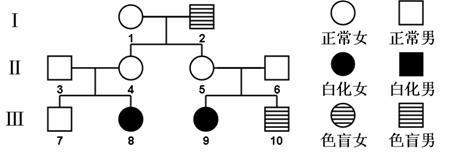
进一步的调查统计发现大约在200个表现型正常的人群中有一个白化基因杂合子。现有一个表现型正常,其双亲也正常,但其弟弟是白化病患者的女人,与一个无亲缘关系的男人婚配,他们所生孩子患白化病的概率为___________。
浙江嘉兴一中09-10学年高二下学期4月月考
51、(10分)下图为蛋白质合成的一个过程,据图分析并回答问题:
|
氨基酸 |
丙氨酸 |
苏氨酸 |
精氨酸 |
色氨酸 |
|
密码子 |
GCA |
ACU |
CGU |
UGG |
|
GCG |
ACC |
CGC |
|
|
|
GCC |
ACA |
CGA |
|
|
|
GCU |
ACG |
CGG |
|
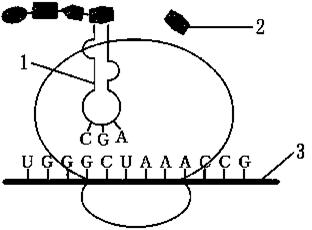
(1)图中所示属于蛋白质合成过程中的_____步骤,该过程的模板是________。
(2)由图中信息可推知DNA模板链上对应的碱基序列为_______________。
(3)根据图并参考右表分析:[1] 上携带的氨基酸是______,这个氨基酸与前面的氨基酸是通过_______________(反应)连接在一起的。