第二节  写作(满分10分)

   以Which Media Is More Popular,Newspapers Or Websites?为题写一篇120词左右的议论文。

   论点提示:报纸一直被认作了解世界、传递消息、受人欢迎的媒体。随着网络的出现,一部分同学认为:人们更喜欢从网上读新闻,因为报纸上的消息不及网上的消息新。而另一部分同学持反对意见:人人都可在网上发表消息,网上的消息不及报纸消息真实。根据这两种看法谈谈你的观点。

   Which Media Is More Popular,Newspapers Or Websites?

-------------------------------------------------------------------------------------------------------------------------------------------------------------------------------------------------------------------------------------------------------------------------------------------------------------------------------------------------------------------------------------------------------------------------------------------------------------------------------------------------------------------------------------------------------------------------------------------------------------------------------------------------------------------------------------------------------------------------------------------------------------------------------------------------------------------------------------------------------------------

KEY:1-5。BCAAB。 6-10。BACAB。 11-15。 BACAB。

    16-20 CCBAB  21-25 CBBDA  26-30 CBCDD  31-35 CDAAB

36-40 ACBAC   41-45 DBCAA   46-50 BBDCD   51-55 CABCD

56-60.DABBA  61-65 CADCD  66-70 BCDAB  71-75 DADBC

  76. job 改为jobs         77. keeping改为keep

   78. parents 前加my        79. have改为had

   80. whichever 改为whatever    81. worked改为working

   82. know 改为knew        83. 去掉class前的the

   84. way 后加of          85. √

(E)

   As the pace of life continues to increase, we are fast losing the art of relaxation. Once you are in the habit of rushing through life, being on the go from morning till night, it is hard to slow down. But relaxation is essential for a healthy mind and body.

   Stress is a natural part of everyday life and there is no way to avoid it. In fact, it is not the bad thing it is often supposed to be. A certain amount of stress is vital to provide motivation and give purpose to life. It is only when the stress gets out of control that it can lead to poor performance and ill health.

   The amount of stress a person can stand depends very much on the person himself. Some people are not afraid of stress, and such characters are obviously important for managerial responsibilities. Others lose heart at the first signs of unusual difficulties. When exposed to stress, in whatever form, we react both chemically and physically. In fact we make choice between "flight or fight" and in more early days the choices made the difference between life or death. The crises we meet today are unlikely to be so extreme, but how little the stress is, it involves the same response. It is when such a reaction lasts long, through continued exposure to stress, that health becomes endangered. Such serious conditions as high blood pressure and heart diseases have established links with stress. Since we cannot remove stress from our lives ( it would be unwise to do so even if we could), we need to find ways to deal with it.

71. People are finding less and less time for relaxing themselves because

   A. they do not know how to enjoy themselves

   B. they do not believe that relaxation is important for health

   C. they are traveling fast all the time

   D. they are becoming busier with their work

72. According to the writer, the most important character for a good manager is his

   A. not fearing stress        B. knowing the art of relaxation

   C. high sense of responsibility   D. having control over performance

73. Which of the following statements is true?

   A. We can find some ways to avoid stress.

   B. Stress is always harmful to people.

   C. It is easy to change the habit of keeping oneself busy with work.

   D. Different people can withstand different amount of stress.

74. In paragraph 3," such a reaction" refers back to

   A. asking a choice between "flight or fight".

   B. "reaction to stress both chemically and physically"

   C. " responding to crises quickly"

   D. "losing heart at the signs of difficulties"

77. In the last sentence of the passage "do so" refers to

   A. "expose ourselves to stress"

   B. "find ways to deal with stress"

   C. " remove stress from our lives"

C.   " establish links between diseases and stress"

高二英语考试题(Unit 11-13)

NAME:        CLASS:      NO:   

第二卷(共20分)

(D)

   In toy stores, what is old is new again.

   Some of the latest toys to hit store shelves include several names that were popular in the 1980's. Among them: He-man, My Little Pony, Teenage Mutant Ninja Turtles, and Transformers. Their appearance is surprising in an industry where all but classic toys like Barbie dolls tend to stay in the market for only a few years before they leave kid culture for good.

   The return of toys introduced a generation ago, say experts, is largely a generational effect. These toys were among the first to be marketed primarily through TV cartoons. The result: The toys carried with them a much stronger brand identity than toys from previous ages. When those who played with these toys during the 1980s began having children of their own, businessmen realized they could take advantage of parents' emotional ties by bringing the toys back.

   "We're starting to see a lot of properties and products coming back now for the kids of Generation X," says Greg Livingston, vice president of Wonder group, a children's product marketing firm. But other industry observers say this return-of-toy trend is more rooted in basic economics. When the economy isn't strong, they say, toy-makers become more careful.

   One of the safest marketing techniques is bringing back toys that are proven successes. "If you're in the business of making and selling toys, you're going to go the safest route, which is using proven brands," says Stephanie Oppenheimer, co-founder of the Oppenheimer Toy Co., an independent consumer group that rates toys; Other companies use product ideas that have sold well in other countries, such as Japan. Still, Ms. Oppenheimer also believes that American consumers simply are not

in the mood for new, high-tech toys anymore. "People are interested less in what we wish we had and more in what we already have," says Oppenheimer. "As a country, we're looking for things that remind us of simpler times."

67. The expression in the first paragraph "what's old is new again" means that "________.”

   A. both old and new toys are sold

   B. old and new toys are of the same price

   C. old toys are in fashion again

   D. old toys have taken on new forms

68. Which of the following is NOT listed as the cause for the return of the toys popular about two decades ago?

   A. Generational effect.    B. Economic factors.

   C. Marketing techniques.   D. Fierce competition.

69. The expression "for good" in the second paragraph can be replaced by _________.

   A. for ever         B. for the future

   C. for the best        D. for all

70. The main purpose of the passage is _________

   A. to introduce the development of kid culture in the past century

   B. to analyse the reappearance of toys popular in the 1980s

   C. to promote the marketing techniques of toy manufacturers

D. to show the impact of high-tech toys on the kids of Generation X

(C)

                People

NOBLE SMUGGLER

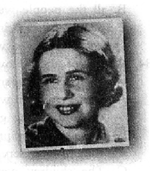
This Thursday, Irena Sendler will be honoured for her work as a smuggler(偷运者). During World War II, the Polish social worker smuggled nearly 2,500 Jewish children out of the Warsaw ghetto(聚居区). She gave them new identities, found them safe places with good-hearted Christians, and kept the children's real names buried in jars in her neighbours' gardens. (The play, Life in a Jar, based on her story, is being performed.) At 93, Sendler lives in a Warsaw nursing home and is too weak to travel to Washington D.C., to receive the 2003 Jan Karski Award for Valor and Compassion from the American Center of Polish Culture. One of the children she saved will accept the award for her.

You risked your life to save the children.

    I was taught by my father that when someone is drowning, you don't ask if they can swim, you just jump in and help. During the war, everyone was drowning, but mostly the Jewish children.

How did you persuade parents to give up their children?

   I had to answer honestly that I didn't even know if we would get past the guards.

What was the most frightening moment?

   When I saw a priest(牧师) in charge of an orphanage for Jewish children in the ghetto walk with them out to be killed. The children were in then best Sunday suits. The priest was killed with them.

How did you get the children to behave as you smuggled them out?

   I told the older children to act as if they were sick and sometimes gave the younger ones a sleeping pill. They were told to remember their new names. I also told the children to tell guards they had only been visiting a servant in the ghetto and were going back to their real homes outside.

Did you tell your own two children what you did?

   I never told them. Only when my daughter went to Israel did she learn all about me. I thought it was only normal to do so. And it was a very painful subject. It was always on my mind that I couldn't do more.

                        -- Samantha Levine

63. We can learn from the passage that Irena Sendler ______

   A. will go to Washington to accept the award with her daughter

   B. was caught a few times while she was rescuing the Jewish children

   C. told those parents that their children's lives would be guaranteed

   D. saved thousands of Jewish children at the risk of her own life

64. The expression "everyone was drowning" can best be replaced by "_______”

A. everyone was involved in the war

B. all the people were drowned

    C. people were facing danger and death

D. Jewish children were being killed

65. Which of the following could NOT be expected when Sendler was smuggling the Jewish children?

   A. Some children were told to pretend to be sick in front of the guards.

   B. Some children pretended to be returning home after visiting servants in the ghetto.

   C. The children were asked to remember and use new names instead of real ones.

   D. The children pretended to be brothers and sisters from one big family.

66. Sendler didn't tell her own children what she did in the war because _______

   A. she thought it was the most frightening experience

   B. the topic was too painful and heartbreaking to mention

   C.  it was already recorded and made known to the public

 D.  she planned to bury the secret in her heart until her death

(B)

   Transportation and communication networks bring people together. Yet sometimes people themselves create barriers to transportation and communication. In some countries, laws stop people from moving freely from place to place. Over the centuries, many groups of people have been denied the freedom to travel because of their race, religion, or nationality. In the Middle Ages, for example, Jews were often forbidden to move about freely within certain cities. South Africa's government used to require black Africans to carry passes when they travel within the country. Some governments require all citizens to carry identification papers and to report to government officials whenever they move.

  Countries set up customs posts at their borders. Foreign travellers must go through a customs inspection before they are allowed to travel in the country. Usually travellers have to carry special papers such as passports and visas(签证). Some countries even limit the number of visitors to their country each year.  Others allow tourists to visit only certain areas of the country, or they may require that travellers be with an official guide at all times during their stay.

   Many of those barriers to travel also act as barriers to communication.

When two governments disagree with each other on important matters, they usually do not want their citizens to exchange news or ideas freely. Countries often try to keep military or industrial information secret.

   Today, people have the ability to travel, to communicate, and to transport goods more quickly and easily than ever before. Natural barriers that were difficult or dangerous to cross a hundred years ago can now be crossed easily. The barriers that people themselves make are not so easy to overcome. But in spite of all the different kinds of barriers, people continue to enjoy travel and the exchange of goods and ideas.

59. The examples in paragraph 2 are used to tell the readers that _______

   A. people have been allowed to travel freely within the country

   B. people have not been permitted to travel freely for various reasons

   C. travellers have to carry special papers such as passports and visas

   D. customs posts are necessary at the borders of the countries

60. Some governments limit the freedom of communication because___

   A.  they intend to keep their national secrets unknown to others

   B.  they think such freedom will lead to wars

   C.  they often disagree with each other on important matters

   D.  they want to show their authority over communication

61. We may learn from the passage that _______

   A. people do not care about the removal of barriers between countries

   B. people can not remove the obstacles made by themselves

   C. man-made barriers are sometimes harder to overcome than natural ones

   D. barriers should be taken for granted as they always exist

62. Which of the following can serve as the best title of the passage?

    A. Barriers Made by People

   B. Functions of Communication

    C. Restrictions on Transportation

    D. Progress of Human Society

(A)

   Daniel Brown was just five years old when he climbed into the family car and let it roll away down the road. He was only three when be flooded the kitchen.

    His mother, Angela Brown, is in despair. She is very busy looking after her new baby, a little gift called Laura, as well as Daniel. She told us, "Daniel is so full of curiosity." At that moment, we hear a huge crash and then silence. We go upstairs and find Daniel crawling out of a wardrobe(衣橱) he has pulled over onto the floor, with a book in his hand. "It's for you, Mum," he says and looks up at his mum and smiles. Seven-year-old Daniel has a lovely face. He has golden hair, big brown eyes, and a friendly smile. I have to admit that Daniel doesn't look like a naughty boy.

    Angela told me all about it. "Once I found him as he was about to put Jasper in the washing machine." Jasper, she explained, is the Browns' dog. "When I asked him why, he said that he thought Jasper was dirty!  It's amazing how one little boy can cause so much trouble. Another time he cut off all the hair of the little girl next door. She was going to attend her sister's wedding and the neighbours haven't spoken to us since."

   Angela told me about Daniel's most expensive crime.  "I was about to do the washing up when the baby started crying. Daniel decided to help and filled the kitchen sink with water. When I came in the water was already flooding the kitchen and was about to flood the hall. The carpet was ruined and had to be replaced. I hope things will get better as he gets older."

   Amazingly, Daniel is quite well behaved in school. This may be because he is rarely bored. Meanwhile he continues to be the naughtiest little boy in England. Will his baby sister Laura grow up to be the naughtiest little girl?

56. What did Daniel do while his mother was talking to the author?

   A. He drove away the family car.

   B. He cut off the hair of the girl next door.

   C. He flooded the kitchen.

   D. He fell to the floor with the wardrobe.

57. Why was Daniel going to put the dog in the washing machine?

    A. He meant to clean the dog.

    B. He wanted to punish the dog.

    C. He intended to make trouble.

    D. He wished to draw his mother's attention.

58. It can be inferred from the passage that ______

   A. the mother spoiled the boy

   B. the boy found school life interesting

   C. the mother lost hope in the boy

   D. the boy had no freedom at home

1. What do the scientists think of the advertisements on TV?

A. They are boring.  B. They are good for our eyes.  C. It's a waste of time.

2. Where does the conversation probably take plate?

A. Over the phone.  B. In the lab.        C. In a store.

3. What are the two speakers talking about?

A. Something about "do-it-yourself in America.

B. The high labor costs in America.

C. The people' s living conditions in America.

4. What is the man' s problem?

A. He is tired.  B. He is sick.  C. He is thirsty.

5. At what time did Mary leave?

A.   Five o'clock. B. Ten to five. C. Ten o'clock.

Π. Listen to the following dialogues and monologue and then choose the best answer.

1).Listen to the following dialogue and answer Questions 6-7.

6. What is the woman doing now?

A. Asking questions.   B. Having a walk.   C. Going to the class.

7. What do you know about the man?

A.   He is a teacher of history.     B. He knows the woman very well.

B.   He is going to leave the school.

2)Listen to the following dialogue and answer Questions 8-10.

8. What's the matter with the woman?

A.   She has a bad cold.       B. Her car has gone wrong.

C. She can spare no time to meet her cousin.

9. How is the woman' s cousin coming?

A. By air.    B. By sea.    C. By train.

10. What does the woman' s cousin look like?

A.   A short man with dark hair.

B. A neither tall nor short man with a beard.

B.   A tall man-with glasses and fair hair.

3) Listen to the following dialogue and answer Questions 11-13.

11. What can we learn from the conversation?

A.   The bill is not clear enough.

B.   Incorrect bills are sent to the woman.

C. The bill is sent to a wrong address.

12. Why does the same kind of thing occur?

A.   The new computer is not working properly.

B. The man is not careful enough.

C. The clerks do not know how to use the new computer.

13. What does the man agree to do?

A.   Get a better computer.     B. Pay the woman extra money.

B.   Send correct bills to the woman later

4)Listen to the following dialogue and answer Questions 14-16.

14. Where can the tallest trees be found?

A. Along the northern California coast.     . B. In San Francisco.  

 C. Near Los Angeles.

15. Why do many tourists visit Muirwoods, rather than other redwood forests?

  1. It has no admission.       B. It is near San Francisco.

C. It can be seen in one hour.      - .

16. What has contributed most to the redwoods survival? .

  1. Absence of natural enemies.     B. Cool weather and daily foggy.
  2. Tough bark and damp climate.

5)Listen to the following monologue and answer Questions 17-20.

17. Where does the speaker give the talk?

 A. On TV.     B. In a class.        C. On the radio.

18. What music will be introduced?

A.   Classical Eastern music, American music and pop.

B.   Classical Western music, Indian music and pop.

C. Modem music, American Indian music and pop.

19. How many musicians are mentioned by the speaker?

 A. One.    B. Two.     C. Three.

20. What kind of feeling do the compositions to be broadcast express?

A. Pride.    B. Sorrow.    C. Joy.

 0  304442  304450  304456  304460  304466  304468  304472  304478  304480  304486  304492  304496  304498  304502  304508  304510  304516  304520  304522  304526  304528  304532  304534  304536  304537  304538  304540  304541  304542  304544  304546  304550  304552  304556  304558  304562  304568  304570  304576  304580  304582  304586  304592  304598  304600  304606  304610  304612  304618  304622  304628  304636  447348 
违法和不良信息举报电话:027-86699610 举报邮箱:58377363@163.com

精英家教网