6. He hesitated for a moment before kicking the ball, otherwise he _____ a goal.(2001上海春季)   A. had scored  B. scored    C. would score     D. would have scored      7. Mr. White _____ at 8:30 for the meeting, but he didn’t show up.(2004广西)   A. should have arrived       B. should arrive  C. should have had arrived     D. should be arriving           8. He _____ have completed his work; otherwise, he wouldn’t be enjoying himself by the seaside.(2005北京)   A. should    B. must    C. wouldn’t    D. can’t               9. –Catherine, I have cleaned the room for you.   –Thanks. You _____ it. I could manage it myself.(2005福建)   A. needn’t do  B. needn’t have done   C. mustn’t do   D. shouldn’t have done   10. –If the traffic hadn’t been so heavy, I could have been back by 6 o’clock.   –What a pity! Tina _____ here to see you.(2005湖南)   A. is   B. was    C. would be    D. has been                 11. –We missed you at this morning’s meeting, Diana.   –_____, but if I hadn’t had to meet a friend, I would have been there.(2005重庆) A. Me, too   B. I’m sorry   C. Never mind    D. Thank you   12. He paid for a seat, when he _____ have entered free.(2005山东)   A. could    B. would    C. must     D. need                13. _____ in the regulations that you should not tell other people the password of your e-mail account.(2005上海)   A. What is required   B. What requires   C. It is required   D. It requires    14. You didn’t let me drive. If we _____ in turn, you _____ so tired.   A. drove; didn’t get  B. drove; wouldn’t get   C. were driving; wouldn’t get D. had driven; wouldn’t have got  15. I didn’t see your sister at the meeting. If she _____, she would have met my brother.   A. has come B. did come C. came   D. had come  16. What would have happened, _____, as far as the riverbank?   A. Bob had walked farther B. if Bob should walk farther   C. had Bob walked farther D. if Bob walked farther  17. _____ it rain tomorrow, we would have to put off the visit to the Yangpu Bridge.   A. Were B. Should C. Would  D. Will 18. Without the air to hold some of the sun’s heat, the earth at night _____ – too cold for us to live.   A. would be freezing cold  B. will be freezing coldly   C. would be frozen cold  D. can freeze coldly 19. When a pencil is partly in a glass of water, it looks as if it _____.   A. breaks B. has broken C. were broken D. had been broken 

 1.图4-1-7表示细胞膜的亚显微结构。请根据图回答下面的问题。

                图4-1-7

(1)图中A的性质是由____________决定的。

   (2)下列有关的叙述,错误的是                     (  )

   A.适当提高温度,能使A和B的相对运动加快,通透性增加有利于生命活动的进行

   B.在动物细胞中B的不饱和程度比植物高

   C.该结构的选择透过性与B结构对极性分子的相对不透性和A的载体转运作用有关

   D.油分子能迅速通过该结构,是由于甘油能溶于B层结构中

   (3)该结构的基本功能是____________。与此相关的对生命活动至关重要的特性是____________________。

   (4)细胞识别、物质的跨膜运动等与图中____________(填字母)有关。

   (5)叶绿体和线粒体等细胞结构中均有此结构,但执行的具体功能有很大的区别,其原因是由于图中____________(填字母)不同所致。
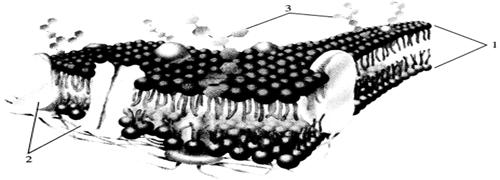
  2.下图是细胞膜结构图,下表是海水和某海洋植物细胞液的离子浓度对照表(mol/L)。根据图和表的

被测物质
钾离子
氯离子
海水
0.01
0.50
细胞液
0.59
0.04

   内容回答下面的问题。

(1)图中1是____________,2是____________,3是____________。

   (2)图中1在细胞膜中作为____________,在钾离子、氯离子通过该植物细胞膜时起__________作用。

  (3)从表中数据可知,植物细胞从海水中吸收__________离子并向海水排出__________离子。由此可见,植物细胞膜对离子的通过具有__________性。

   (4)钾离子和氯离子通过细胞膜的方式是_________,作出此判断的依据是__________。

3.图4-1-9是物质出入细胞的三种方式的模式图(黑点代表物质分子),据图回答下面的问题。
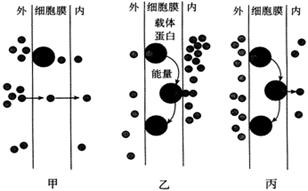
 图4-1-9

(1)与甲相比,丙方式的不同之处是__________________________。

   (2)与丙相比,乙方式的不同之处是__________________________。

   (3)对于活细胞完成各项生命活动都非常重要的物质运输方式是______________。
 0  383793  383801  383807  383811  383817  383819  383823  383829  383831  383837  383843  383847  383849  383853  383859  383861  383867  383871  383873  383877  383879  383883  383885  383887  383888  383889  383891  383892  383893  383895  383897  383901  383903  383907  383909  383913  383919  383921  383927  383931  383933  383937  383943  383949  383951  383957  383961  383963  383969  383973  383979  383987  447090 

违法和不良信息举报电话:027-86699610 举报邮箱:58377363@163.com

精英家教网