24. _______, the gathering crowd burst into applause.
A. On entering the hall
B. When he took the floor
C. The speaker took his place
D. No sooner had the speaker entered
23. Under good treatment, Linda is beginning to_________ and will soon recover.
A. turn up B. pick out C. pick up D. show up
22. --- I'm sorry. I'm afraid I was mistaken. --- ________.
A. All right B. Excuse me
C. That's all D. Don't worry about it
第一节:单项填空 (共15小题; 每小题1分, 满分15分)
21.When I saw his smiling face ,I knew ____ news was good----our football team had won _____most important match.
A./ , the B. the / C. the, a D. a , the
第二节(共15小题;每小题1.5分,满分22.5分)
6. What is the probable relationship between the two speakers?
A. Classmates. B. Teacher and student. C. Husband and wife.
7. When will they practise French?
A. In the morning every day.
B. In the afternoon every day.
C. On Sunday and Saturday.
听第7段材料,回答第8至9题。
8. Where does the conversation take place?
A. In the school. B. In the street
C. At the woman's home.
9. What are the two speakers going to do?
A. Go shopping in the malls.
B. Have a picnic in the woods.
C. Hike in the countryside.
听第8段材料,回答第10至12题。
10. What is the probable relationship between the two speakers?
A. Mother and son. B. Teacher and student. C. Friends.
11. How often do the students watch TV at school?
A. Twice a week. B. Three times a week. C. Twice a month.
12. What are the three L's?
A. Listen, look and lively.
B. Lesson, looke and learn.
C. Listen, look and lazy.
听第9段材料,回答第13至16题。
13. What did the two speakers attend?
A. A concert. B. A meeting. C. A party.
14. What was the professor like?
A. Young and ugly. B. Old and intelligent.
C. Young and handsome.
15. When did the woman leave?
A. At 9 o'clock. B. At 10 o'clock. C. At 11 o'clock.
16. Why did the woman leave?
A. Because she was very tired.
B. Because the professor left.
C. Because she didn't like the man.
听第10段材料,回答第17至20题。
17. In what college did the speaker study?
A. The medical college. B. The art college.
C. The English college.
18. How old was the cleaning woman?
A. About 40. B. In her 40s. C. In her 30s.
19. What did the speaker think of the last question on the quiz paper?
A. Difficult. B. It was a joke. C. Easy
20. What lesson did the speaker learn from the quiz?
A. Those who study hard will succeed.
B. One should respect whomever he or she knows.
C. One should make more friends.
第一节(共5小题;每小题1.5分,满分7.5分)
1. What is the probable relationship between the two speakers?
A. Husband and wife. B. Boss and secretary.
D. Teacher and student.
2. When did Bob leave his home?
A. Five years ago. B. Three years ago.
C. Eight years ago.
3. Why CAN'T the woman keep the appointment?
A. Because she must meet his uncle at the airport.
B. Because she can't come back in time.
C. Because she has to do some housework.
4. What does the woman think of the man?
A. He is so useless and can't pass the exam.
B. He never studies hard to pass the exam.
C. He likes to play ball games very much.
5. What can we learn from this conversation?
A. The English test has been put off till next Wednesday.
B. The speakers will have an English test this afternoon.
C. The speakers will attend a big meeting next Wednesday.
47.“生物科学与社会”模块(10分)(每个空格1分)
我国是全球首个批准甲型H1N1流感疫苗上市的国家。10月29日,浙江开始对部分人群接种甲型H1N1流感疫苗,甲型H1N1流感疫苗的生产工艺与往年的季节性流感疫苗基本相同,均需经过鸡胚培养、灭活病毒、纯化、裂解等工艺后制成。
(1)目前的甲型H1N1流感疫苗属于灭活疫苗,它与减毒疫苗相比有______________等特点。
(2)若将来发展为转基因蕃茄甲型H1N1流感疫苗,它的生产过程可能如下:首先获取_________有关的基因,再利用基因工程技术和植物组织培养技术获得转基因蕃茄植株。
(3)该植物在种植时若发生棉铃虫的虫害,农民引入了拟澳洲赤眼蜂,虫害得到及时的遏止,请问这种防治方法属于 ;它的优点是 防治之后需要对病虫害的防治效果进行调查,通过计算 就能知道防治效果。除了该防治方法外,农作物病虫害综合防治的方法还有 、 和化学防治技术,各种防治技术各有优缺点。总之,植物病虫害的防治,要贯彻 的方针。
(4)注射相应的甲型H1N1流感的单克隆抗体治疗该病又是一种研究方向,若研究成功,则以____________________________细胞来生产,这样生产出的抗体有_______________等优点。
46.“生物技术实践”模块(10分)(每个空格1分)
(1).大肠杆菌是生存在人体肠道中的正常菌群,每克粪便中含有109个,且能够与致病菌混杂生长。如果食品和饮用水中出现大肠杆菌,就意味着食物可能被粪便污染而带上致病菌,因而常将大肠菌的数量作为食品卫生的检测指标之一。请据此回答下列问题:
①常用稀释涂布平板法来测定大肠杆菌的数目,该方法先将LB固体培养基冷却到60℃,在___________旁倒在培养皿里,凝固后形成平板;该方法中实际统计的是培养基上的______________数目。此数据比实际值要____________(高、低),其原因是___________。实验完成后需要对培养基进行______________处理,然后才能倒掉。
②若要分离出纯净的大肠杆菌,还须将用________挑取上述菌落,用___________方法进行分离。
(2).固定化酶就是将水溶性的酶用物理或化学方法固定在某种介质上,使之成为______________________________________________的制剂。制作固定化a-淀粉酶反应柱时,需用蒸馏水反复洗涤掉未吸附的游离酶,直至出来的液体中加淀粉和____不变成___色为止。
45.芦笋是常见的雌雄异株植物之一,为XY型性别决定,雌株的性染色体为XX,雄株的性染色体为XY,其染色体数目为2N=20。野生型芦笋叶窄,在野生种群中,一株雌芦笋的一条染色体上某基因发生了突变,由窄叶突变成为阔叶,用该植株与野生型雄株杂交,F1雌雄植株中均有窄叶,也有阔叶。(基因用字母B、b表示)
⑴ 在窄叶和阔叶这对相对性状中,显性性状是 。
⑵ 上述杂交实验的结果能否确定阔叶基因在X染色体上还是在常染色上? 。
用文字简要说明推断过程。
⑶ 假如控制窄叶和阔叶的基因位于X染色体上。由于雄株的产量高于雌株,某园艺场需要通过一次杂交育种培育出一批在幼苗时期就能识别出雄性的植株,请你设计一个简单实用的杂交方案。(提供的植株有阔叶雌雄株、窄叶雌雄株,要求用遗传图解表示杂交方案)
⑷ 现只给你提供芦笋雄株,请设计一套育种方法,从理论上保证得到的子代全是雄株,写出简要过程。(不直接采用组织培养法)
① ;
② ;
③ 。
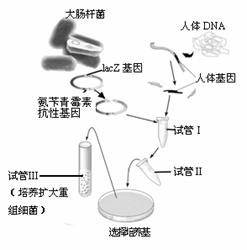
44.大肠杆菌pUC118质粒的某限制酶唯一酶切
序列,位于该质粒的lacZ基因中,lacZ基
因中如果没有插入外源基因,lacZ基因便可
表达出b-半乳糖苷酶,当培养基中含有IPTG
和X-gal时,X-gal便会被b-半乳糖苷酶水
解成蓝色,大肠杆菌将形成蓝色菌落;如果
lacZ基因中插入了外源基因,带有pUC118
质粒的大肠杆菌便不能表达b-半乳糖苷酶,
培养基中的X-gal不会被水解成蓝色,大肠
杆菌将形成白色菌落。pUC118还携带了氨苄
青霉素抗性基因。下图是利用lacZ基因的插入失活筛选重组质粒示意图。据图回答下
列问题:
(1)作为受体大肠杆菌应__________________________,以方便筛选已导入重组质粒的受体大肠杆菌。取用氯化钙溶液处理(增加其细胞壁的通透性)过的受体大肠杆菌,置于试管Ⅱ中,并加入 。
(2)图中的选择培养基中除含有大肠杆菌必需的葡萄糖、氮源、无机盐、水、生长因子等营养物质外,还应加入____________________等物质,用以筛选导入了重组质粒的受体大肠杆菌。
(3)将上述处理后的大肠杆菌置于图中选择培养基上培养,以检测受体大肠杆菌是否导入
重组质粒,请
预测菌落的颜色,并分析结果:
① 。
② 。
 大肠杆菌pUC118质粒的某限制酶唯一酶切