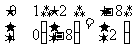
 mapped under the
translation mapping
 ?
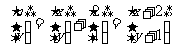
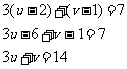
 . Draw a diagram and check!
 undergoes, separately each of the following transformations,
a translation
 followed by a reflection in the line with the equation y =
x. Find the equation of the image.
 is transformed
according to
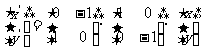 (b)
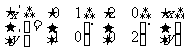
 is transformed according to
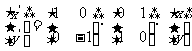 (b)
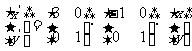 .
 (b)


 ; reflection in the x axis followed by a rotation of
90 degrees about the origin.
 ; dilation of factor 2 parallel to the x and y
axis, followed by reflection in the line with the equation y=x.
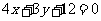 ; reflection in y = x followed by reflection in the x
axis.
 ; reflection in y axis followed by dilation of factor
3 parallel to x axis.
 then
3. Verify each of the solutions in 2 above by using matrix multiplication, and check this by drawing the graph of the two linear relations on the same set of axes and identifying the point of intersection (using CAS).
MATRICES AND TRANSFORMATIONS OF A POINT IN A PLANE
Matrices can be used to determine the result of transformations of a point on the cartesian plane. The three types of transformations to be considered are:
· Translations
· Reflections
· Dilations
We will consider each of these in turn and also consider how the CAS can be used to determine the result of these transformations.
TRANSLATIONS
Translations have two components, movement parallel to the x-axis and movement parallel to the y-axis. The matrix for translation can be defined as:

where a = movement parallel to the x-axis and b = movement parallel to the y-axis.
Consider the point (2, 4) that is transformed by the transformation  . This moves the point 1 unit parallel to the x-axis
and -3 units parallel to the y-axis.
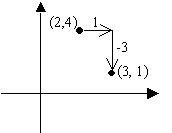
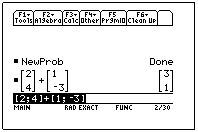
We can see that the resultant point is (3,1)
We can use this to determine the new equation of a line after it has been translated.
EXAMPLE ONE
Consider the line with the equation  . Onto what line does it map, under the following translation
of
 ?
If a point P(x, y) has an image point Q( ) then under the translation ,
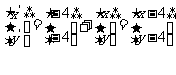
Therefore  and
 .
Rearranging these equations gives  and
 .
Substituting these values into the original
equation , gives
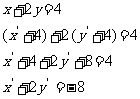
So the new equation of the translated line
is 
EXAMPLE TWO
Find the equation of the image curve, where  is the translation that has occurred to the parabola with the
equation
 . Describe the effect of the given translation on the given
curve.
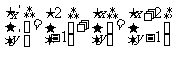
Therefore  and
 .
Rearranging these equations gives  and
 .
Substituting these
values in , gives:
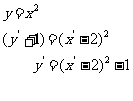
Hence the new equation is  , as expected!
EXERCISE ONE:
Q1. Onto what point does the translation map each of the following points?
(a) (1, 4) (b) (2, 4) (c) (5, -3) (d) (a, b)
Q2. What translation will map the point A onto the point A in the following cases?
(a) A
(4, 2) A(6, 4) (b) A(2,
-3) A(4, -4) (c)
A(4, 3) A(0, 0)
(d) A(-3,
-1) A(-5, 3)
Q3. Consider the line
with the equation . Onto what line does it map, under the following translations?
(a)  (b)
 (c)

Q4. Describe the effect of the given translation on the given curve and find the equation of the image curve in each case.
(a)  on the circle with the equation
 .
(b)  on the parabola with the equation
 .
(c)  on the hyperbola with the equation
 .
SOLUTIONS
EXERCISE ONE
Q1. (a) (3, 3) (b) (4, 3) (c) (7, -4) (d) (a+2, b-1)
Q2. (a)  (b) (c)
 (d)

Q3. (a)  (b)
 (c)

Q4. (a) circle, radius  units, centre (3,
1);

(b)
parabola, vertex at (2, 0); 
(c)
hyperbola; asymptotes y = 2 and x = 0; 
REFLECTIONS
In this section we will consider three types of reflections:
- Reflections in the x-axis
- Reflections in the y-axis
- Reflections in the line y = x
Reflections in the x-axis
If we reflect a point in the x-axis the x value of the coordinate remains unchanged but the y value is multiplied by negative 1. So (x, y) becomes (x, -y).
This can be defined as the matrix 
Similar logic can be applied to the other two reflections and this results in two further reflection matrices.
Reflection in the y-axis 
Reflection in the line y = x  Note:
this is the same effect as finding an inverse of a function where x and y
are interchanged.
Consider our original point (2, 4).
Reflected in the x-axis: Reflected in the y-axis:

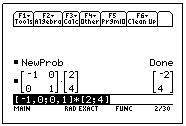
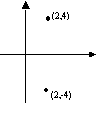
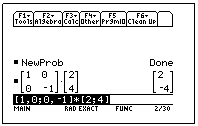
|

If more than one reflection occurs ensure the order is observed.
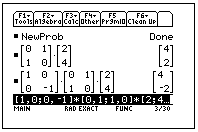
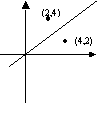
This is the point (2,4) reflected in the line y = x then reflected in the x-axis.
EXAMPLE
What does the line with
equation  become after reflection in the
(i) x axis?
(ii) y axis?
(iii) the line with equation y = x?
(i)
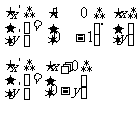
Hence,  and

Substituting into , gives 
So the equation of the reflected line is 
(ii)
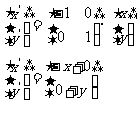
Hence,  and

Substituting into , gives 
So the equation of the reflected line is 
(iii)
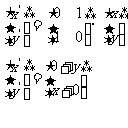
Hence,  and

Substituting into , gives 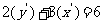
So the equation of the reflected line is 
EXERCISE TWO
Q1. Write down the coordinates of the image of each of the following points after reflection in:
(i) the x axis
(ii) the y axis
(iii) the line with the equation y = x.
(a) (4, 1) (b) (3, -1)
Q2. Using matrices determine what the curve with the equation  becomes after
reflection in the
(i) x axis?
(ii) y axis?
Q3. Curves with equation
(a)  (b)

are transformed according to 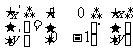 .
Find the equation of the image in each case.
SOLUTIONS TO EXERCISES TWO
Q1. (a) (4, -1); (-4, 1); (1, 4)
(b) (3, 1); (-3, -1); (-1, 3)
Q2. (i)  (ii)
Q3. (a) 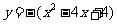 (b)

DILATIONS
We will also consider three types of dilations:
- Dilation, factor k parallel to the x-axis
-
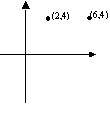 Dilation, factor k parallel to
the y-axis
- Dilation, factor k about the origin.
 Dilation, factor k parallel to
the y-axis
|
Dilation, factor k parallel to the x-axis 
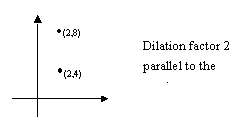
Dilation, factor k parallel to the y-axis 

|

EXAMPLE
What is the effect of a dilation by a
factor of 2 parallel to the x axis on  ?
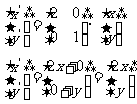
This results in the following equations :  and
 . Rearranging these equations results in
 and .
Substituting this into , gives:

Hence the equation
of the dilated line is 
EXERCISES THREE:
Q1. What is the effect of the following dilations on the given equations?
(a)
By a factor of 3 parallel to
the y axis on  .
(b)
By a factor of 2 parallel to
the x axis on  .
SOLUTIONS
Q1. (a) 
(b) ellipse 
FURTHER EXAMPLES
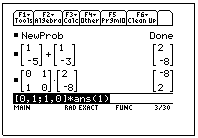
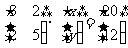
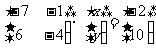
(a) Find
the image of the point (1, -5) which has been translated by and then
reflected in the line y = x.
 (ii)
 A、若图1表示正常细胞,则A、B化合物共有的元素