3. 关于一般现在时。(语法重点)
(1)一般现在时态的意义是:①表示现在的特征或状态。如:He is at home today. 他今天在家。②表示经常性、习惯性的动作。常和频率副词always, often, usually及every day等表示时间的短语连用。如:I go to school at 7:00 every day. 我每天7点钟去上学。③表示主语具备的性格或能力。如:She likes pears very much. 她非常喜欢梨子。They speak English. 他们讲英语。
(2)肯定陈述句:当主语是第一、二和第三人称复数时,谓语动词用原形。当主语是第三人称单数时,谓语动词用第三人称单数形式。例如:
①They stay at home on Sundays.
他们星期天呆在家。
②He does his homework in the evening.
他在晚上做作业。
(3)否定句:当主语是第一、二及第三人称复数时,否定句借助助动词do+not,当主语是第三人称单数时,否定句借用does+not,并将动词第三人称单数还原。例如:
①They don’t stay at home on Sundays.
他们星期天不呆在家里。
②He doesn’t do his homework in the evening.
他晚上不做作业。
(4)疑问句:当主语是第一、第二及第三人称复数时,疑问句在句首加Do。当主语是第三人称单数时,疑问句在句首加Does,并把谓语第三人称单数还原。例如:
①Do they stay at home on Sundays?
他们星期天呆在家吗?
②Does he do his homework in the evening?
他晚上做作业吗?
△以speak为例归纳动词do的各种句式:
|
肯定式 |
否定式 |
|
I speak English. You speak English. He/She/It speaks English. We/You/They speak English. |
I do not (don’t) speak English. You do not (don’t) speak English. He/She/It does not (doesn’t) speak English. We/You/They do not (don’t) speak English. |
|
疑问式和简略答语 |
||
|
Do I speak English? Yes, you do. No, you do not (don’t). Do we speak English? Yes, we/you do. No, we/you do not (don’t). |
Do you speak English? Yes, I do. No, I do not (don’t). Do you speak English? Yes, we do. No, we do not(don’t). |
Does he/she/it speak English. Yes, he/she/it does. No, he/she/it does not (doesn’t). Do they speak English? Yes, they do. No, they do not (don’t). |
(1)We __________ (get up/gets up) at seven every morning.
(2)Jane __________ (don’t wake up/doesn’t wake up) at six every morning.
(3)My father often __________ (drink/drinks) lemonade for breakfast.
(4)____________(Does, Do)the girl often __________ (draw/draws)pictures in the park?
(5)My friend often __________ (come/comes) to school by bus.
(6)____________ (Does, Do) Sally and Ann often __________ (read/reads) English in class?
(7)Jim __________ (doesn’t do/doesn’t) his homework after supper every day.
(8)Jone __________ (go/goes) home at 4:00 in the afternoon.
答案:(1)get up (2)doesn’t wake up (3)drinks
(4)Does, draw (5)comes (6)Do, read
(7)doesn’t do (8)goes
解析:本题考查一般现在时的各种句型。
(1)主语是we,与谓语动词原形搭配。
(2)考查否定句,由于主语是第三人称单数,助动词应相应变化。
(3)主语是第三人称单数。
(4)行为动词是一般现在时的疑问句,主语the girl是第三人称单数,助动词应选相应的Does,后面的动词则用原形,选draw。
(5)此题与(3)题考点相同,选comes。
(6)此题与(4)小题考点一样,但主语Sally and Ann相当于they,不是单数,答案为Do, read。
(7)此题较难,不能丢了第二个do,它是主语的动词译为“做”,答案为doesn’t do。
(8)考点与(3)、(5)相同。
1. What time is it? It’s …
这是询问时间的惯用法,如:
A: Excuse me. What time is it, please?
请问几点了?
B: It’s nine o’clock. 九点了。
英语时间的表达
(1)整点时间可表示为“钟点数+o’clock”或直接读钟点数,省去o’clock。如:
It’s ten o’clock a. m. 现在是上午十点整。
(2)非整点时间可直接采取读数法。如:
It’s eight-thirty. 是八点三十分。
注意时间的表达方式:用数词。点与分钟之间用连字如:
eleven-thirty 十一点三十分
nine-twenty-five 九点二十五分
6:10 →six-ten 8:50→eight-fifty
9:30→nine-thirty 10:15→ten-fifteen
7:45→seven forty-five 11:05→eleven-five
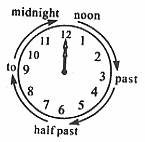
(3)非整点时间的分钟数不超过30分钟,也可用介词“past”。如:
6:10→ten past six
11:05→five past eleven
10:15→ a quarter past ten或fifteen past ten
8:15→a quarter past eight或fifteen past eight
9:30→half past nine或thirty past nine
(4)非整点时间的分钟数超过30分钟,用介词to。如:
11:50→ten to twelve
7:31→twenty-nine to eight
9:45→a quarter to ten或fifteen to ten
12:59→one to thirteen
此句话还有几种表达方式。如:
What is the time? 几点了?
What time is it by your watch? 你的手表几点了?
用英语大声说出下列表格中的时间
A: What’s the time, please?
B: It’s twelve o’clock.
|
8:05
o five. 8:10 ten. 8:15 It’s eight fifteen. 8:25 twenty-five. 8:30 thirty. |
OR |
five ten It’s a quarter past eight. twenty-five half |
|
8:35
thirth-five. 8:40 forty. 8:45 It’s eight forty-five. 8:50 fifty. 8:55 fifty-five. |
OR |
twenty-five twenty It’s a quarter to nine ten five |