1. (1)(总结动词过去式的变化规律。)
T: Stop! I’ll ask two of you to come to the blackboard. S1 and S2, please come here.
(两名学生站在讲台前面,教师让一名学生做动作, 另一个学生猜, 并将陈述句板书在黑板上, 句子呈现动词过去式的一般规律, 动词+ed。)
T: Now one of you do the action, another guesses what he did.
(S1做打排球的动作。)
S2: Did you play volleyball?
S1: Yes, you are right.
T: We can say “He played volleyball.”
…
|
He played
volleyball. He performed magic tricks. He enjoyed the party. |
T: Who can tell me the rules of these verbs?
S1: 词尾+ed。
T: Very good. Let’s go on.
(导入下一步。)
(2)(教师呈现两个图片, 体现动词过去式的第二种变化形式, 以e结尾+d。)
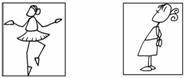
T: Look at the two pictures and find out what they did.
S1: She danced.
S2: She recited a poem.
(教师板书danced和recited并问学生变化规律。)
|
danced,
recited |
T: Yes. And can you tell me the rules?
Ss: 词尾+d。
(3)(呈现以辅音字母+y结尾的动词, 让学生了解其过去式的变化, 把y变i+ed。)
T: Please look at the sentences on the blackboard and see how to change it.
(学生不熟悉, 可进行激烈讨论, 教师板书答案。)
|
He tries
his best to do his homework. →He tried his best to do his homework. |
T: Do you know the rules?
Ss: Yes. 变y为i+ed。
(教师纠正, 必须是辅音字母+y结尾, 才能变y为i+ed。)
(4)(教师做动作, 让学生猜出动作的动词短语, 体现动词过去式表现特殊变化。)
T: This time I do action, you guess.
S1: Sang a song.
T: Yes, good. Let’s sum up the rules.
(总结动词一般过去式变化规律, 板书呈现。)
|
①词尾+ed ②以e结尾, 直接+d ③辅音+y, 把y变为i, 再+ed ④不规则变化 |