16. it 考代词。
2、语法填空
第二节 书面表达(满分25分)
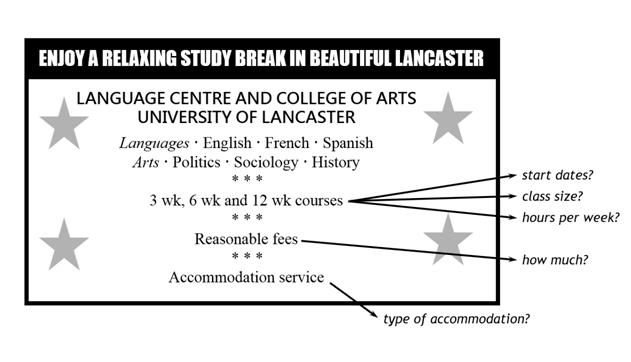
假定你是李华,计划暑假期间去英国学习英语,为期六周。下面的广告引起了你的注意,请给该校写封信,询问有关情况(箭头所指内容)
注意:1.词数100左右;
2.可以适当增加细节,以使行文连贯。
3.参考词汇:住宿-accommodation
2014年普通高等学校招生全国统一考试
第四部分 写作
第一节 短文改错(共10小题;每小题1分,满分10分)
假定英语课上老师要求同桌之间交换修改作文,请你修改你同桌写的以下作文。文中共有10处语言错误,每句中最多有两处。错误仅涉及一个单词的增加、删除或修改。
增加:在缺词处加一个漏字符号(),并在其下面写出该加的词。
删除:把多余的词用(\)划掉。
修改:在错的词下画一横线,并在该词下面写出修改后的词。
注意:1. 每处错误及其修改均仅限一词;
2. 只允许修改10处,多者(从第11处起)不计分。
Nearly five years before, and with the help by our father, my sister and I planted some cherry tomatoes(圣女果)in our back garden. Since then --- for all these year --- we had been allowing tomatoes to self-seed where they please. As result, the plants are growing somewhere. The fruits are small in size, but juicy and taste. There are so much that we often share them with our neighbors. Although we allow tomato plants to grow in the same place year after year, but we have never had any disease or insect attack problems. We are growing wonderfully tomatoes at no cost!
第二节 (共5小题;每小题3分,满分15分)
根据短文内容,从短文后的选项中选出能填入空白处的最佳选项。选项中有两项为多余选项。
The jobs of the future have not yet been invented. 36 By helping them develop classic skills that will serve them well no matter what the future holds.
1. Curiosity
Your children need to be deeply curious. 37 Ask kids, “What ingredients (配料)can we add to make these pancakes even better next time?” and then try them out. Did those ingredients make the pancakes better? What could we try next time?
2. Creativity
True creativity is the ability to take something existing and create something new from it. 38 There are a dozen different things you can do with them. Experimenting with materials to create something new can go a long way in helping them develop their creativity.
3. Personal skills
Understanding how others feel can be a challenge for kids. We know what’s going on inside our own head, but what about others? Being able to read people helps kid from misreading a situation and jumping to false conclusions. 39 “Why do you think she’s crying?” “Can you tell how that man is feeling by looking at his face?” “If someone were to do that to you, how would you feel?”
4. Self Expression
40 There are many ways to express thoughts and ideas ---- music, acting, drawing, building, photography. You may find that your child is attracted by one more than another.
A. Encourage kids to cook with you.
B. And we can’t forget science education.
C. We can give kids chances to think about materials in new ways.
D. We can do this in real life or ask questions about characters in stories.
E. Gardening is another great activity for helping kids develop this skill.
F. So how can we help our kids prepare for jobs that don’t yet exist?
G. Being able to communicate ideas in a meaningful way is a valuable skill.
D
As more and more people speak the global languages of English, Chinese, Spanish, and Arabic, other languages are rapidly disappearing. In fact, half of the 6,000—7,000 languages spoken around the world today will likely die out by the next century, according to the United Nations Educational, Scientific, and Cultural Organization (UNESCO).
In an effort to prevent language loss, scholars from a number of organizations ---- UNESCO and National Geographic among them ---- have for many years been documenting dying languages and the cultures they reflect.
Mark Turin, a scientist at the Macmillan Center, Yale University, who specializes in the languages and oral traditions of the Himalayas, is following in that tradition. His recently published book, A grammar of Thangmi with an Ethnolinguistic Introduction to the Speakers and Their Culture, grows out of his experience living, working, and raising a family in a village in Nepal.
Documenting the Thangmi language and culture is just a starting point for Turin, who seeks to include other languages and oral traditions across the Himalayan reaches of India, Nepal, Bhutan, and China. But he is not content to simply record these voices before they disappear without record.
At the University of Cambridge Turin discovered a wealth of important materials ---- including photographs, films, tape recordings, and field notes ---- which had remained unstudied and were badly in need of care and protection.
Now, through the two organizations that he has founded ---- the Digital Himalaya Project and the World Oral Literature Project ---- Turin has started a campaign to make such documents, found in libraries and stores around the world, available not just to scholars but to the younger generations of communities from whom the materials were originally collected. Thanks to digital technology and the widely available Internet, Turin notes, the endangered languages can be saved and reconnected with speech communities.
32. Many scholars are making efforts to _____.
A. promote global language B. rescue disappearing languages
C. search for language communities D. set up language research organizations
33. What does “that tradition” in Paragraph 3 refer to?
A. Having full records of the languages.
B. Writing books on language teaching.
C. Telling stories about language users.
D. Living with the native speakers.
34. What is Turin’s book based on?
A. The cultural studies in India. B. The documents available at Yale.
C. His language research in Bhutan. D. His personal experience in Nepal.
35. Which of the following best describes Turin’s work?
A. Write, sell and donate. B. Record, repair and reward.
C. Design, experiment and report. D. Collect, protect and reconnect.
C
A typical lion tamer (驯兽师) in people’s mind is an entertainer holding a whip (鞭) and a chair. The whip gets all of the attention, but it’s mostly for show. In reality, it’s the chair that does the important work. When a lion tamer holds a chair in front of the lion’s face, the lion tries to focus on all four legs of the chair at the same time. With its focus divided, the lion becomes confused and is unsure about what to do next. When faced with so many options, the lion chooses to freeze and wait instead of attacking the man holding the chair.
How often do you find yourself in the same position as the lion? How often do you have something you want to achieve (e.g. lose weight, start a business, travel more) ---- only to end up confused by all of the options in front of you and never make progress?
This upsets me to no end because while all the experts are busy debating about which option is best, the people who want to improve their lives are left confused by all of the conflicting information. The end result is that we feel like we can’t focus or that we’re focused on the wrong things, and so we take less action, make less progress, and stay the same when we could be improving.
It doesn’t have to be that way. Anytime you find the world waving a chair in your face, remember this: All you need to do is focus on one thing. You just need to get started. Starting before you feel ready is one of the habits of successful people. If you have somewhere you want to go, something you want to accomplish, someone you want to become … take immediate action. If you’re clear about where you want to go, the rest of the world will either help you get there or get out of the way.
28. Why does the lion tamer use a chair?
A. To show off his skills. B. To trick the lion.
C. To get ready for a fight. D. To entertain the audience.
29. In what sense are people similar to a lion facing a chair?
A. They feel puzzled over choices. B. They hold on to the wrong things.
C. They find it hard to make changed. D. They have to do something for show.
30. What is the author’s attitude towards the experts mentioned in Paragraph 3?
A. Tolerant. B. Doubtful. C. Respectful. D. Supportive.
31. When the world is “waving a chair in your face”, you’re advised to _______.
A. wait for a better chance B. break your old habits
C. make a quick decision D. ask for clear guidance