网址:http://m.1010jiajiao.com/timu_id_799037[举报]
听力测试(Listening Test Part)
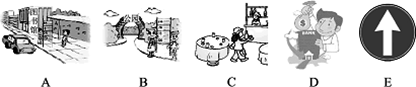
Ⅰ.Listen and choose.请听问句,根据图画选出最佳答案。(5分)

( )1.A.It’s across from the hotel.
B.It’s in front of the post office.
( )2.A.It’s on Center Street.c
B.It’s on Fifth Avenue.
( )3.A.Yes, it is in front of the post office.
B.Yes, it is behind the mail box.
( )4.A.It’s between the restaurant and the supermarket.
B.It’s in front of the bank.
( )5.A.Go down Bridge Street and turn left to Fifth Avenue.
B.Go straight and turn left to Center Street.
Ⅱ.Listen and juidge.请听小对话,判断所给句子的正(T)误(F)。(5分)
( )6.Lily is Peter’s cousin.
( )7.They can’t go to the park because it is snowing.
( )8.They have to wear uniforms at school.
( )9.The girl doesn’t like the food in Japan.
( )10.The girl would like mutton noodles.
Ⅲ.Listen and choose.请听对话及问题,选择最佳答语。(5分)
( )11.A.Yes, we can.
B.No, it isn’t.
C.No, we can’t.
( )12.A.Yes, he does.
B.No, he doesn’t.
C.We don’t know.
( )13.A.Beautiful.
B.Black.
C.Long.
( )14.A.He didn’t know the school rule.
B.He ate in the classroom.
C.He ate in the dining hall.
( )15.A.They are making a phone call.
B.They’re writing a song.
C.They’re calling Tony.
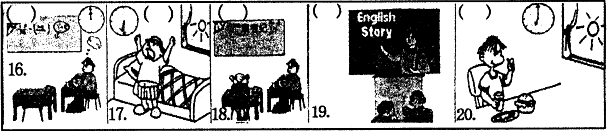
Ⅳ.Listen and number.请听短文,并将序号(A→E)按事情发生的前后顺序填入相应图片中的括号内。(5分)
在下列横线上填入适当的话语,使对话完整、正确。
A:Excuse me,sir? Could you tell me the way to the nearest bookstore?
B: 1 You can ask the lady over there.
A:Thank you all the same.(A moment later)
A:Excuse me. 2
C:No,there isn't a bookstore near here,but there is one near No.1 Middle School.
A: 3
C:It's about ten minutes by bus.
A: 4
C:The No.6 bus.
A:By the way,where's the bus stop?
C:It's over there,across from the hotel.
A:Thanks a lot.
C:You're welcome.
| . |
| A.Two. | B.Three. | C.Four. | D.Five |
| A.It’s on Sixth Avenue |
| B.It’s between the Cinema and the supermarket |
| C.It’s in front of the school. |
| D.It’s next to the supermarket. |
| A.Tom and Gina. | B.Mary and Ann. | C.Only Mary | D.Jenny. |
| A.It’s on Center Street. | B.It’s next to the bank. |
| C.It’s across from the bank. | D.I don’t know. |
| A.Jenny usually goes to work by bike. |
| B.Jenny rides past a bank and a street. |
| C.Tom drives past a post office. |
| D.A bank and a library are on Sixth Avenue. |
阅读理解.
I have a rule for travel: Never carry a map. I prefer to ask for directions.
Foreign visitors are often puzzled in Japan because most streets there don't have names. In Japan, people use landmarks in their directions instead of street names. For example, the Japanese will say to travelers, “Go straight dawn to the corner. Turn left at the big hotel and go past a fruit market. The post office is across from the bus stop.”
In the countryside of the American Midwest, usually there are not many landmarks. There are no mountains, so the land is very flat. In many places there are no towns or buildings within miles. Instead of landmarks, people will tell you directions and distances. In Kansas or Iowa, for example, people will say, “Go north two miles. Turn east, and then go another mile.”
People in Los Angeles, California, have no idea of distance on the map. They measure distance by means of time, not miles. “How far away is the post office?” you ask. “Oh,” they answer, “It's about five minutes from here.” You say, “Yes, but how many miles away is it?” They don't know.
People in Greece sometimes do not even try to give directions because visitors seldom understand the Greek language. Instead of giving you the direction, a Greek will often say, “Follow me.” Then he'll lead you through the streets of the city to the post office.
Sometimes a person doesn't know the answer to our question. What happens in this situation? A New Yorker might say, “Sorry, I have no idea.” But in Yucatan, Mexico, no one answers, “I don't know.” People in Yucatan think “I don't know” is impolite. They usually give an answer, often a wrong one. A visitor can get lost in Yucatan!
One thing will help you everywhere-in Japan, in the United States, in Greece, in Mexico, or in any other place. You might not understand a person's words, but maybe you can understand his body language. He or she will usually turn and then point in the correct direction. Go in that direction, and you may find the post office.
1.The passage mainly tells us that ________.
[ ]
A.there are not many landmarks in the American Midwest
B.never carry a map for travel
C.there are different ways to give directions in different parts of the world
D.New Yorkers often say, “I have no idea,” but people in Yucatan, Mexico never say this
2.The passage says, “In Japan, people use landmarks in their directions.” The word “landmark” mean ________.
[ ]
A.streets names
B.building names
C.hotels, markets and bus stops
D.buildings or places are easily recognized
3.In which place do people tell distance by means of time?
[ ]
A.Japan.
B.American Midwest.
C.Los Angeles, California.
D.Greece.
4.In the passage, ________ countries are mentioned by the writer.
[ ]
5.Which of the following is wrong?
[ ]
A.Travelers can learn about people's customs by asking questions about directions.
B.People in some places give directions in miles, but people in other places give directions by means of time.
C.A person's body language can help you understand directions.
D.People in different places always give directions in the same way:They use street names.
查看习题详情和答案>>
| |||||