网址:http://m.1010jiajiao.com/timu_id_4010594[举报]
按每个小题后的要求做题,将答案写在题上。
1. A: He said, “She left 10 minutes ago.” (改为间接引语)
B: He said that she ________ _________ 10 minutes _________..
2. Tom is such an honest boy that he never tells a lie. (改为同义句)
Tom is so _____ ______ _______ that he never tells a lie.
3. I felt that it was time for me to _________ __________. (采取行动)
4. Why not bring your little brother with you? (改为同义句)
Why _______ ________ bring your brother with you?
5. We must think of ways to ______ wild animals _______ being killed. (阻止)
6. A railway is being built by the workers. (变为主动语态).
The workers ______ _______ a railway.
7. I met Kate in the street yesterday. (强调划线部分)
It was _______ _______ I met Kate in the street.
8. He is seldom late for school. (改为同义句)
Seldom_______ ________ late for school.
9. _____ ______ these interruptions, the meeting would have finished half an hour ago. (要不是)
10. When did the Roman Empire ______ _______ ________? (形成)
查看习题详情和答案>>
按每个小题后的要求做题,将答案写在题上。
1. A: He said, “She left 10 minutes ago.” (改为间接引语)
B: He said that she ________ _________ 10 minutes _________..
2. Tom is such an honest boy that he never tells a lie. (改为同义句)
Tom is so _____ ______ _______ that he never tells a lie.
3. I felt that it was time for me to _________ __________. (采取行动)
4. Why not bring your little brother with you? (改为同义句)
Why _______ ________ bring your brother with you?
5. We must think of ways to ______ wild animals _______ being killed. (阻止)
6. A railway is being built by the workers. (变为主动语态).
The workers ______ _______ a railway.
7. I met Kate in the street yesterday. (强调划线部分)
It was _______ _______ I met Kate in the street.
8. He is seldom late for school. (改为同义句)
Seldom_______ ________ late for school.
9. _____ ______ these interruptions, the meeting would have finished half an hour ago. (要不是)
10. When did the Roman Empire ______ _______ ________? (形成)
查看习题详情和答案>>
做题时,先将答案标在试卷上。录音内容结束后,你将有两分钟的时间将试卷上的答案转涂到答题卡上。
第一节 (共5小题;每小题1分,满分5分)
听下面5段对话。每段对话后有一个小题,从题中所给的A、B、C三个选项中选出最佳选项,并标在试卷的相应位置。听完每段对话后,你都有10秒钟的时间来回答有关小题和阅读下一小题。每段对话仅读一遍。
1.Who does the woman suggest the man speak to?
A. Mr. Brown. B. Mr. Smith. C. Mrs. Brown.
2.What is the woman probably going to do next?
A. Go over the list. B. Go shopping. C. Go for an outing.
3.What’s the possible relationship between the two speakers?
A. Classmates. B. Teacher and student. C. Principal and student.
4.Where does this conversation probably take place?
A. In an office. B. In a garage. C. In a taxi.
5.When will the man begin to stay in the hotel?
A. On Tuesday. B. On Wednesday. C. On Friday.
第二节 (共15小题;每小题1分,满分15分)
听下面5段对话或独白。每段对话或独白后有几个小题,从每题所给的A、B、C三个选项中选出最佳选项,并标在试卷的相应位置。听每段对话或独白前,你将有时间阅读各个小题,每小题5秒钟;听完后,各小题将给出5秒钟的作答时间。每段对话或独白读两遍。
听第6段材料,回答第6至8题。
6.What does the boy want to do?
A. Go abroad. B. Live by himself. C. Find a job.
7.What does the mother expect the boy to do?
A. Rely on himself. B. Stay with them. C. Sell newspapers.
8.How does the mother feel about the boy’s job?
A. Proud. B. Hopeful. C. Doubtful.
听第7段材料,回答第9至11题。
9.What season is it now?
A. Spring. B. Autumn. C. Winter.
10.What do we know about the man?
A. He likes sports. B. He hates the cold weather. C. He never does housework.
11.What is the weather like now?
A. Cloudy. B. Sunny. C. Snowy.
12.What’s wrong with the man?
A. He broke his left arm. B. He broke his right leg. C. His left foot hurts.
13.What did the doctor tell the man to do?
A. Touch the ground. B. Lie in bed all the time. C. Have an X-ray.
14.How soon will the man recover at least?
A. In about 2 weeks. B. In about a week. C. In about 3 days.
听第9段材料,回答第15至17题。
15.Why has the man never chatted online before?
A. He has got too old a computer.
B. He hasn’t bought a computer.
C. He has no interest in chatting online.
16.What does the man ask the woman to download for him?
A. MP3 files. B. New software. C. A TV show.
17.What does the woman tell about Friends’ forums?
A. Some of the Friends’ stars are sure to show up there.
B. One can chat to people who have common interests.
C. One may clearly know who you’re talking to there.
听第10段材料,回答第18至20题。
18.How many times does one’s heart beat per minute during aerobic exercise?
A. 140. B. 100. C. 114.
19.What is the man’s advice?
A. Eating big meals every day.
B. Five small meals every day.
C. Eating no food at night.
20.Which of the following is mentioned in the talk?
A. Boxing. B. Walking. C. Cycling.
查看习题详情和答案>>
Listening Comprehension:
Part A Short Conversations
Directions:In Part A, you will hear ten short conversations between two speakers.At the end of each conversation, a question will be asked about what was said.The conversations and the questions will be spoken only once.After you hear a conversation and the question about it, read the four possible answers on your paper and decide which one is the best answer to the question you have heard.
1.A.He doesn’t like the song.
B.He doesn’t speak French.
C.He is in no mood for singing.
D.He can’t sing today.
2.A.Peter has been fired.
B.Peter has changed his job.
C.Peter is still working in the company.
D.Peter wants to leave the company.
3.A.Stay in the office.
B.Have her hair arranged.
C.Buy some birthday presents.
D.Go to Miss White’s home.
4.A.The man doesn’t like her any more.
B.The man never noticed her hairstyle before.
C.The man is telling a lie.
D.The man never praises her.
5.A.12.
B.6.
C.24
D.18
6.A.Someone may enter the house through the open windows.
B.There may be a strong wind and heavy rain tonight.
C.The man may catch cold if he leaves the windows open.
D.The windows may be broken during the night.
7.A.She found it interesting.
B.She found it enjoyable.
C.She found it boring.
D.She found it informative.
8.A.To buy a piano.
B.To play the music.
C.To listen to her sing.
D.To sing together with her.
9.A.On a fishing boat.
B.In an ocean park.
C.In a gift shop.
D.In a restaurant.
10.A.In a hotel.
B.In a school.
C.In a hospital.
D.In a police station.
Part B Passages
Directions:In Part B, you will hear two short passages, and you will be asked three questions on each of the passages.The passages will be read twice, but the questions will be spoken once.When you hear a question, read the four possible answers on your paper and decide which one would be the best answer to the question you have heard.
Questions 11 through 13 are based on the following passage.
11.A.Boston.
B.Vancouver.
C.Canada.
D.Teheran.
12.A.Because he couldn’t refuse his friend.
B.Because he was busy all evening.
C.Because Mike’s line was busy.
D.Because he preferred writing a letter.
13.A.Some tapes.
B.Some presents.
C.His overseas friend.
D.Nothing.
Questions 14 through 16 are based on the following passage.
14.A.Fashion model.
B.Film actress.
C.Social activist.
D.Cinema manager.
15.A.In 1958.
B.In 1960
C.In 1971.
D.1978.
16.A.Don’t They?
B.Klute.
C.Julia.
D.Coming Home.
Part C Longer Conversations
Directions:In Part C, you will hear two longer conversations.The conversations will be read twice.After you hear each conversation, you are required to fill in the numbered blanks with the information you have heard.Write your answers on your answer sheet.17-24做在答题纸上。
Blanks 17 though 20 are based on the following conversation.
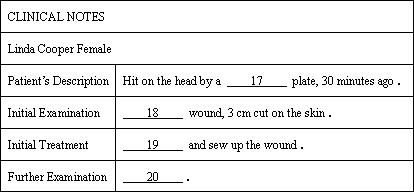
Complete the form.Write ONE WORD for each answer.
Blanks 21 though 24 are based on the following conversation.
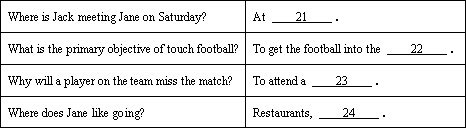
Complete the form.Write NO MORE THAN THREE WORDS for each answer.
阅读下列短文,并做每篇后面的题目,从四个选项中,选出能回答所提问题或完成所给句子的最佳答案。
There were two interesting pieces of news items in the paper a few years ago. One was about a man who received a bill from the telephone company for £2,000 a month for doing nothing.
The connection between the two news items is simple : computers -the best invention of the 20th century. The telephone bill came from a computer which made a terrible mistake ; that man's bill was only £23.26. The other item was not as amusing. A man walked into the unguarded computer room of a large packaged food company and expertly programmed the computer to pay him £2,000 a month for raw meat which he supplied to the company. Of course he never sent the meat, but he certainly received the money. The computer wrote out a bill, and even “signed” it. It was only a random (随便的) check that uncovered the trick. It could be happening in thousands of other companies all over the world.
Computers are not the magical workers that some people say they are. They make mistakes they're sometimes slower than human beings and they're easily fooled.
The US used to conscript(征兵) people with the help of a computer. The army sent out a card, which had to be filled in and sent back. It was easy to avoid being called up simply by spreading candle-wax (腊) on the card. The computer couldn't read the card, and did nothing with it.
It's in our everyday life that computers cause many problems. Let's get back to using people instead of computers, before a mistake that we can't put right.
1.In the first paragraph we can conclude ________.
[ ]
A.the paper is telling a lie
B.the first sentence is the topic sentence
C.the two news items made people surprised
D.if a man did nothing at all for the telephone company, he would still get £2,000 a month
2.The main ides of the second paragraph is ________.
[ ]
A.the computers are magical workers
B.the computers can do anything as well as man
C.the computers can write out the bill and even sign it
D.the computers sometimes also make mistakes
3.Computers ________.
[ ]
A.were used to conscript people
B.are usually faster than human beings
C.are not so magical as people expect
D.were not easily controlled and always fooled human beings
4.The writer thinks ________.
[ ]
A.we'd better use people instead of computers in our everyday life
B.we should not use computers because they always make mistakes
C.computers are widely used in our everyday life
D.if we want to work well, don't use the computers
查看习题详情和答案>>