网址:http://m.1010jiajiao.com/timu_id_2360626[举报]
The pay phone is the library.
2. 你想干什么?我想当警察.
— do you want to ?
—I want to be a .
3. 他喜欢海豚,因为它们很聪明.
He the dolphins they are .
4. 星期天,他喜欢读点书.
He likes to____some____on Sunday.
5. 你还喜欢别的什么动物?
What______ do you like?
6. 我要牛肉和土豆的面条.
I____ beef____potato noodles.
7. 谢谢你参加我们的节目.
Thanks_______ our show.
8. 现在孩子们在公园里玩得很开心.
The children in the park now.
9. 情况怎么样?
is it____?
10. 我受不了他们.
I____ them
11. 昨天我给我的父母写了封信.
I____ my parents yesterday.
12. 我不喜欢照相.
I don't like____ .
13. 他会说一点儿日语.
He can_____ Japanese.
14. 孩子们喜欢在冬天玩雪.
The children like to____ snow in winter.
15. 浩着公路一直往前走,然后左拐.
Walk____the road then____left.
I learned how to accept life as it is from my father. 31 . he did not teach me acceptance when he was strong and healthy, but rather when he was 32 and ill .
My father was 33 a strong man who loved being active. But a terrible illness 34 all that away. Now he can no longer walk. And he must sit quietly in a chair all day. Even talking is 35 . One night, I went to visit him with my sisters. I told them about one of my beliefs. I said that we must very often give things up 36 we grow our youth, our beauty, our friends, but it always 37 that after we give something up. We gain something new in its place. Then suddenly my father spoke up, “But, Peter, I gave up 38 !What did I gain?” I thought and thought, but I could not think of anything to say. 39 he answered his own question: “I 40 the love of my family.” I looked at my sisters and saw tears in their eyes along with hope and thankfulness.
I was also 41 by his words. After that, when I began to feel irritated (恼怒的) at someone, I would remember his words and become 42 . If he could replace his great pain with a feeling of love for others, then I should be 43 to give up my small irritations. In this 44 . I learned the power of acceptance from my father.
Sometimes I 45 what other things I could have learned from him if I had listened more carefully when I was a boy. For now, though I am grateful for this one gift.
31. A. Certainly B. Therefore C. However D. Meanwhile
32. A. tired B. weak C. poor D. slow
33. A. already B. still C. only D. once
34. A. took B. threw C. sent D. put
35. A. stressful B. difficult C. impossible D. hopeless
36. A. as B. since C. before D. till
37. A. suggests B. promises C. seems D. requires
38. A. something B. anything C. nothing D. everything
39. A. surprisingly B. immediately C. naturally D. certainly
40. A. had B. accepted C. gained D. enjoyed
41. A. touched B. astonished C. attracted D. warned
42. A. quiet B. calm C. relaxed D. happy
43. A. ready B. likely C. free D. able
44. A. case B. form C. method D. way
45. A. doubt B. wonder C. know D. guess
完形填空
What do you 1 about the sea? We have 2 it. Some of us have swum or washed in it. We know that it 3 very nice when the sun is 4 on it. We also know 5 it can be very terrible 6 it's windy. What other things do we know about it?
The first thing to 7 is that the sea is very big when you look at the map 8 the world. You will 9 there is more sea 10 land. The sea covers three-quarters 11 the world.
If you have swum 12 the sea, you know that it is salty. You can taste the salt. 13 go 14 the sea and carry salt from the land into the sea. Some parts of the sea are more salty than 15 part. Do you know the Dead Sea?
16 is very salty. It is 17 salty that people cannot 18 ! Fish cannot 19 in the Dead Sea! 20 strange sea!
根据短文内容,选择佳答案(30分)
(1) A. know |
B. knew |
C. known |
D. knowing |
[ ] |
(2) A. look |
B. see |
C. looked |
D. seen |
[ ] |
(3) A. looks |
B. looked |
C. look |
D. looking |
[ ] |
(4) A. light |
B. lighting |
C. shine |
D. shining |
[ ] |
(5) A. this |
B. that |
C. where |
D. which |
[ ] |
(6) A. what |
B. that |
C. where |
D. when |
[ ] |
(7) A. forget |
B.hear |
C. see |
D. remember |
[ ] |
(8) A. out |
B. to |
C. in |
D. of |
[ ] |
(9) A. look |
B. think |
C. known |
D. find |
[ ] |
(10) A. then |
B. than |
C. that |
D. over |
[ ] |
(11) A. in |
B. on |
C. of |
D. at |
[ ] |
(12) A. in |
B. at |
C. over |
D. down |
[ ] |
(13) A. river |
B.Rivers |
C. Water |
D. Lake |
[ ] |
(14) A. off |
B. of |
C. in |
D. into |
[ ] |
(15) A. another |
B. other |
C.others |
D.one |
[ ] |
(16) A. That |
B. It |
C. What |
D. Which |
[ ] |
(17) A. very |
B. much |
C. so |
D. such |
[ ] |
(18) A. to sink |
B. sink |
C. sank |
D. sunk |
[ ] |
(19) A. life |
B. live |
C. to live |
D. living |
[ ] |
(20) A. So a |
B. How a |
C. What a |
D. When a |
[ ] |
I learned how to accept life as it is from my father. 31 . he did not teach me acceptance when he was strong and healthy, but rather when he was 32 and ill .
My father was 33 a strong man who loved being active. But a terrible illness 34 all that away. Now he can no longer walk. And he must sit quietly in a chair all day. Even talking is 35 . One night, I went to visit him with my sisters. I told them about one of my beliefs. I said that we must very often give things up 36 we grow our youth, our beauty, our friends, but it always 37 that after we give something up. We gain something new in its place. Then suddenly my father spoke up, “But, Peter, I gave up 38 !What did I gain?” I thought and thought, but I could not think of anything to say. 39 he answered his own question: “I 40 the love of my family.” I looked at my sisters and saw tears in their eyes along with hope and thankfulness.
I was also 41 by his words. After that, when I began to feel irritated (恼怒的) at someone, I would remember his words and become 42 . If he could replace his great pain with a feeling of love for others, then I should be 43 to give up my small irritations. In this 44 . I learned the power of acceptance from my father.
Sometimes I 45 what other things I could have learned from him if I had listened more carefully when I was a boy. For now, though I am grateful for this one gift.
31. A. Certainly B. Therefore C. However D. Meanwhile
32. A. tired B. weak C. poor D. slow
33. A. already B. still C. only D. once
34. A. took B. threw C. sent D. put
35. A. stressful B. difficult C. impossible D. hopeless
36. A. as B. since C. before D. till
37. A. suggests B. promises C. seems D. requires
38. A. something B. anything C. nothing D. everything
39. A. surprisingly B. immediately C. naturally D. certainly
40. A. had B. accepted C. gained D. enjoyed
41. A. touched B. astonished C. attracted D. warned
42. A. quiet B. calm C. relaxed D. happy
43. A. ready B. likely C. free D. able
44. A. case B. form C. method D. way
45. A. doubt B. wonder C. know D. guess
查看习题详情和答案>>
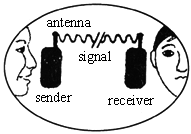
A mobile phone
(手机)is in fact a small radio. A radio sends a person's voice over a long way to another radio. A voice that is sent by radio is called a signal(信号). A radio signal travels very quickly.Only a few years ago, mobile phones were very largE
.They needed large batteries(电池). They had to be powerful(功率高的)to send their signal to faraway places. This was because most cities had only one antenna tower(中继站)for mobile phones.Today's mobile phones are small and easy to usE
.Now most cities have a lot of antenna towers, not just onE.This means that each mobile phone doesn't have to send its signal far away, so they don't need to be so powerful. Mobile phones today use small batteries. A large city, where lots of mobile phones are used, can have hundreds of towers.Do you know what use a mobile phone has? Yes, you can use it to do a lot of things.
Call your friends and family from almost anywhere.
Call the police immediately if there is an accident in the street.
Send or receive e-mail.
Get information from the Internet.
Send and receive messages.
Sending short written messages is a popular way to use your mobile phonE
.Many people use short forms of words, so the messages are quick to write and reaD.Can you guess what these messages mean? Try reading them out. What do you hear?RUOK?
CUL8R!
That's EZ!
Will I C U B4 2moro?
That's Gr8 !
(1) The writer talks about _________ uses of a mobile phone.
[
]A
.threeB
.fiveC
.sevenD
.nine(2) What does the writer think of today's mobile phones?
[
]A
.They are small but very powerful.B
.They are very popular and cheap.C
.They are very easy for us to use.D
.They arc big enough to send a signal.(3) What does the writer write the article
(文章)for?[
]A
.To give us some common knowledge of the mobile phone.B
.To introduce how the mobile phone works and what use it has.C
.To tell us what short forms of words mean in written messages.D
.To show us in what way the mobile phone is expected to develop. 查看习题详情和答案>>