网址:http://m.1010jiajiao.com/timu_id_2319187[举报]
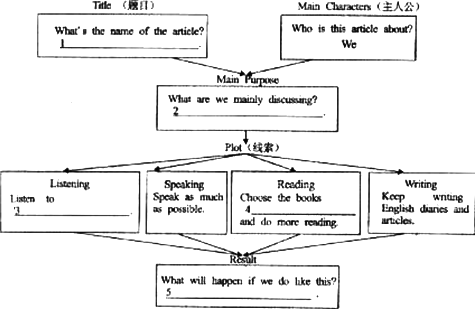
Can you swim?Do you like swimming?Yes?Well, how can you learn to swim?I think the best way is to go into the water and learn.I' m afraid you'll never learn to swim just by reading books about swimming or look-ing at others swimming.It's the same with the English study for us kids today.We must practice, practice and practice.
Listening and speaking are very important for beginners.The children in English-speaking countries first listen to others.Then they try to imitate(模仿)and speak.We can listen to English programs on radio.You may just understand a few words.It doesn' t matter.Just be relaxed, try to get the main topics(论题,话题), then the main ideas, then the main sentences(句子), then the key words, then the full meaning.As for speaking, speak as much as you can.
Reading and writing are more important for school students.First we must choose the books we're interested in.A lot of reading will improve your language sense(语感).This is the most important.
Keep writing English diaries(日记).We can also write English articles.You may even post them to English magazines.Don't be afraid of failure(失败).Failure is the mother of success.
Easier said than done.Well, let's do more practice from now on.I' m sure you' ll learn English well in this way.
As we all know, the environment around us is getting worse and worse. In some places we can’t see fish 26 in the river or trees on the hills. Some people even have no clean water to drink.
Recently, a new lifestyle called low carbon life is 27 every comer of our country. The meanings of low carbon are 28 energy and no waste. It is such an important project that I can’t wait 29 my ideas on how to promote it.
First,we should 30 a no-car day every week in our school. Because cars not only cause serious air pollution but also waste energy. 31 the no-car day, neither students 32 teachers are allowed to drive to school. At the same time,just walk or run. Use our 33 and enjoy the fun.
Second, we had better not use plastic bags 34 . No one can stand the “white pollution”, 35 it is wise to use cloth bags which can 36 again and again.
37 ,one thing 38 we should keep in mind is that every big thing comes from the small details. So, as students, we ought to turn 39 the lights the moment we leave, use 40 sides of the paper, and reuse our textbooks and so on.

All in all, it weighs greatly for all of us to put the low carbon lifestyle into practice. Just set our mind to these:no-car days, no plastic bags, and no waste. Let’s do it now.
26. A. swims B. swimming C. to swim D. swam
27. A. spreading B. moving C. living D. becoming
28. A. below B. high C. above D. low
29. A. to express B. express C. expressing D. expressed
30. A. set off B. set up C. put on D. put down
31. A. in B. at C. on D. with
32. A. nor B. or C. both D. and
33. A. foot B. cars C. buses D. legs
34. A. any more B. no more C. no longer D. never
35. A. because B. so C. but D. although
36. A. reused B. be used C. is used D. use
37. A. Finally B. Final C. Last D. Lately
38. A. who B. what C. that D. whose
39. A. up B. down C. on D. off
40. A. both B. each C. every D. all
查看习题详情和答案>>
is to speak to a foreigner. This week's question comes from a student who is eager to start a conversation
with the foreigners he sees every day. One student asks, "Is it Okay to try to talk to foreigners I see in the
street?"
The answer is yes or no, but probably no! If you see a foreigner who looks lost, it is polite to ask him,
"May I help you?" But, otherwise, you should probably let them get on with their business. Situations,
however, do exist (存在) where it is quite all right to talk to foreigners. If a foreigner enters your school,
office, shop or restaurant, for instance (例如), feel free to ask him (for example):
— What is your name?
— Where do you come from?
— What do you think of Beijing?
— How long will you stay in Beijing?
There are also situations where it's Okay to talk to foreigners in public places. If you see a foreigner
alone in a restaurant, bar or coffee shop, it may be appropriate (合适的) to ask him or her:
— Is this seat free?
— Do you mind if I talk to you in English?
You can probably help them if they are new to China and if they are alone. You may be able to make them
feel more welcome.
After a few such questions, you should know whether this person wants to talk to you or not. If they ask
you similar questions, or if they give long, informative answers, you're in luck. If not, then give them their
privacy (独处). Talking to strangers is fun if you choose the right time and place.
B. Americans
C. your classmates
D. French people
B. it is polite to interrupt foreigners in a conversation
C. it is impolite to interrupt a foreigner when he or she is on business
D. it is impolite to help a foreigner find his way
B. Have you eaten your dinner?
C. Can you help me with my English?
D. Nice to meet you.
B. talk with foreigners in an accepted way
C. have a meal with foreigners in a restaurant
D. move to a place where a foreigner lives
B. Health
C. Language
D. Business

Are you the only child in the family? If so. you are the most important in your family. Parents are the
closest people to you in the world. But a lot of middle school students have a problem. They feel they're
not as close to their parents as before. They even don't think their parents are fair to them.
Some students tell me that their parents often say a lot to them, but never listen to them. Some say
their parents don't let them play computer games. Others say when they're making phone calls to friends,
their parents like to ask if they're speaking to a boy or a girl. These make them very unhappy. Some
students even decide to leave home because they' re afraid to tell their parents when they do something
wrong, or when they don't do well in exams. Then they usually think running away is a good way. But
running away may bring them some more problems.
Problems are part of life. Here are some suggestions for your problems.
(1) Find a good chance to talk with your parents. Don' t be afraid to tell them your feelings.
(2)Get help from others, like good friends or teachers.
(3)Keep a diary to help you know more about yourself and your feelings.
(4)Show your parents you're growing up. Then they' ll feel you' re no longer a small child.
If you follow the advice, you'll have a happy life and never think of running away.
B. classmates
C. parents
D. friends
B. Middle school students don' t have any problems.
C. Many students want to run away.
D. Some students don't think their parents are fair to them
B. quarrel with our parents
C. leave our parents
D. not tell anyone
B. Because it can help us practice writing.
C. Because it can help us understand ourselves better.
B. hobbies
C. families
D. problems
Children are amazing! They pick up languages so naturally and easily. Have you ever wondered why? It's not because they have great natural language abilities. 61.In fact, studies show that an adult's potential(潜能) to learn language is as good as a child's .
So why do children still seem to acquire(学到) languages more quickly than the rest of us? It's because of the way they learn. Children learn by simply doing what comes naturally—they listen, copy and communicate. Let's take a closer look at how children acquire languages. Perhaps we can discover a better, more "natural" way to learn English.
Children don't practice grammar drills, but use languages to talk about things that interest them. This helps them learn to express themselves. They don't worry about inadequate(不足的) vocabulary or poor grammar. 62.They find ways to express themselves, and they do it successfully.
63.Students should pay more attention to genuine(真实的) communication. Look for chances to talk with people in English. If you can't find a foreigner to talk to, talk with other English students instead. Start an English discussion group and chat about music, movies or whatever interests you.
Don't worry about making mistakes. The aim is to learn how to communicate easily and comfortably. 64.记住你甚至用一个很少的词汇也能够成功的交流。
Trust your own natural ability to learn English. You've got more potential than you probably realize!
阅读短文,按要求完成下面的任务。
任务一 将61处所给的英文翻译成中文。61____________________________
任务二 将62处改成复合句62 ___________________________________
任务三 将63处改为被动语态。63______________________________
任务四 将64处所给的中文翻译成英文。64 _____________________
任务五65. As a student, how should you learn language by reading the passage?
查看习题详情和答案>>